Some deliveries may take a little longer than usual due to regional shipping conditions.

DOWNLOAD THE APP


Customer Services
Copyright © 2025 Desertcart Holdings Limited
DOWNLOAD THE APP
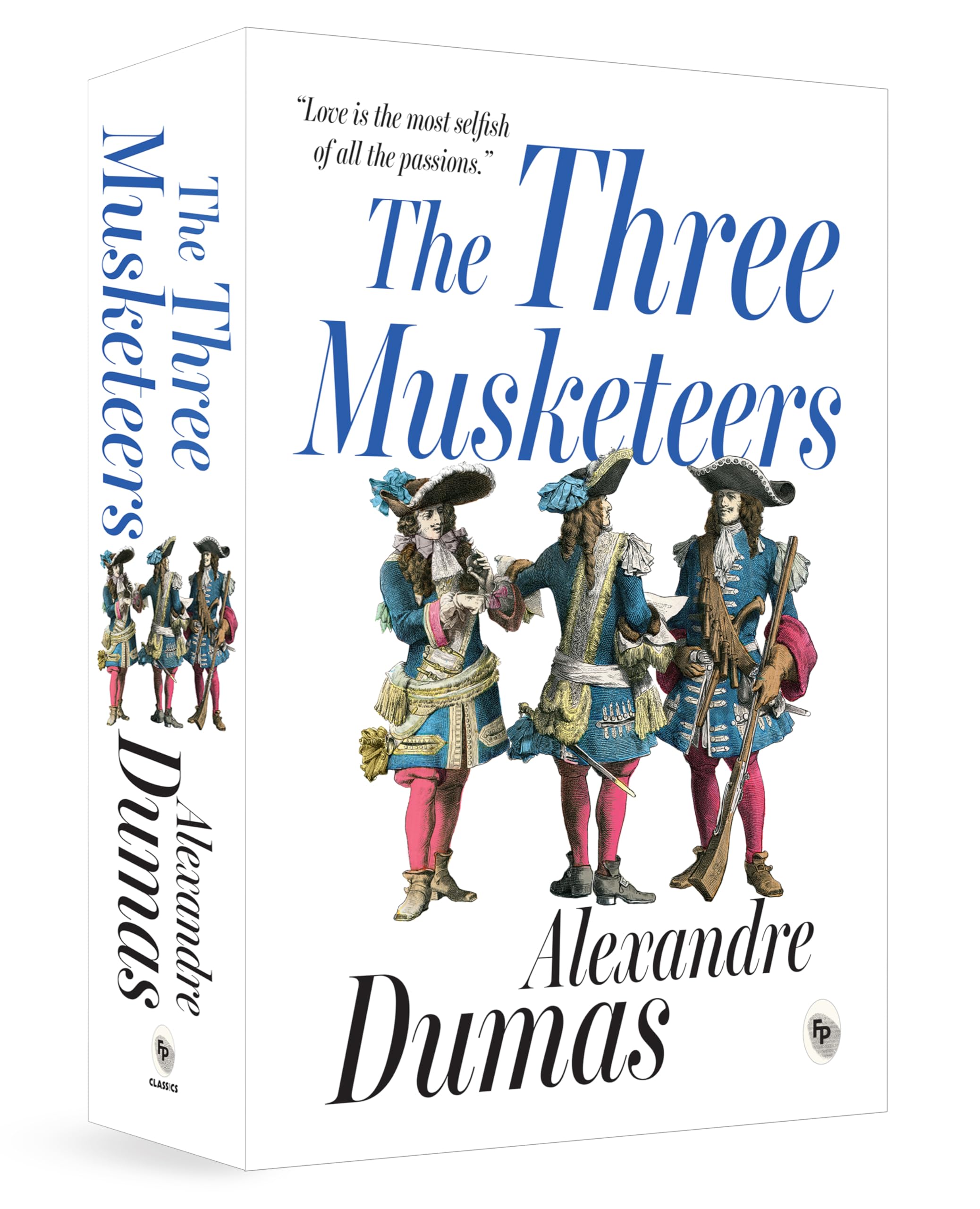
📖 Unlock the adventure of The Three Musketeers — where classic meets contemporary!
The Three Musketeers, a first edition published by Fingerprint! Publishing, offers a 696-page abridged version of the classic novel tailored for young readers aged 7-10. With a compact size of 21.59 x 14 x 5 cm and a strong 4.5-star rating from over 4,300 readers, this pristine copy is perfect for both new readers and collectors seeking a high-quality edition.


| Best Sellers Rank | #13,291 in Books ( See Top 100 in Books ) #138 in Literary Theory, History & Criticism #332 in Classic Fiction (Books) |
| Book 1 of 3 | D’Artagnan |
| Country of Origin | India |
| Customer Reviews | 4.5 4.5 out of 5 stars (4,397) |
| Dimensions | 21.6 x 14 x 3.7 cm |
| Edition | First Edition |
| Grade level | Preschool - 2 |
| ISBN-10 | 8172344694 |
| ISBN-13 | 978-8172344696 |
| Importer | Prakash Books India Pvt Ltd |
| Item Weight | 573 g |
| Language | English |
| Net Quantity | 1 Count |
| Packer | Prakash Books India Pvt Ltd |
| Print length | 696 pages |
| Publication date | 1 January 2013 |
| Publisher | Fingerprint! Publishing |
| Reading age | 7 - 10 years |
M**A
Loved it
it's so good but an abridged version for modern readers
S**I
Best Edition for a book
I generally prefer the penguin black classics over others because of the extra content that is given and the reasonable price. The book arrived in pretty neat condition and opens like butter. The only downside to these editions is that the cover chips away and the spine cracks after just one read no matter how matter how carefully you handle them. Not good for display. If you are someone who want to buy as a collectable then go for other éditons or publications
M**H
Whats with the Fonts man!!
I am so used to everymans library books, but this edition of book came up with whole different font which is unbearable to read! I wish they had chose any other font! Ruined it for me!!
G**L
D'Artanan Romances
Master of Swashbuckling Heroic Novels; Very Popular Character D'Artanan and his three Musketeers - Athos, Aramis, Porthos....and Milady... One of my most favourite novels. Translated by Richard Pevear (with her wife Larissa Volokhonsky) - A very known names in translators community.....It surely captures the essence of Dumas...
K**.
Superb Language Writing
This is am amazing storytelling from the author. I wish that we too produce such authors here locally. Gripping Content 🤗
S**R
The unabridged classic. The dream of high school days
This certainly the unabridged and real translation of the original classic novel. If anybody wishes to enjoy the original novel its a must read.
M**M
Quality doesn't match the novel i.e., the paper quality
Printing is good but the paper quality is very meagre so the book may not be preserved for a long period.
P**4
A mad classic
This is a superb or stupid book, depending on your point of view. Dumas père was writing 200 years ago about "events" 150 years before that. As if that wasn't enough it was translated into English, and bowdlerised, smack bang in the Victorian era. So expect anachronisms and political correctness on every page. In addition expect longeurs, when the writer goes into seemingly irrelevant reveries. But... If you can get past that you will find a rip-roaring, whip-cracking, highly misogynistic (alas), page-turning classic. Possibly the most fun classic novel, bar Pride and Prejudice, it has ever been my pleasure to read.
M**S
It's great to finally read the book. Rather than just see the film version of the story which often differs in nuance and details of plot.
M**L
Considering how many books I read per month, I am staggered that it took me 32 years to finally get around to reading the Three Musketeers. This is an excellent book and one of the best pieces of literature that I have ever got my hands on. I was totally gripped from start to finish. D'Artagnan goes to Paris to seek his fortune and hopefully to join the coveted King's Musketeers. No sooner is he in the capital than he is fighting a duel with the Musketeers and this brings him to their notice. Since there are no vacancies in the elite group, D'Artagnan is put in the Kings Guards and promised a place in the Musketeers when a vacancy arises. Despite this though, D'Artagnan and the three Musketeers, Porthos, Aramis and Athos, are soon inseparable and are soon getting into fights and adventures, especially with the dangerous Cardinal Richeleau and the deadly but mysterious Milady. But with people like the Duke of Buckingham, Lord De Winter and Monsieur De Trevielle, the group soon triumph and get the girl... A wonderfully written, absorbing story and I can't wait for part 2 in the Musketeers trilogy.
R**4
Edizione economica con copertina flessibile Vintage Classics French Series. È molto leggero e i caratteri non sono troppo piccoli. In fondo al libro ci sono molte note che aiutano a comprendere aspetti storici. Rapporto qualità prezzo ottimale.
N**A
Todo bien me encanto el diseño de la pasta blanda además de que llego rápido y sin daños. Estoy feliz con el servicio y el producto.
M**S
All translators must struggle with two competing goals: 1) being faithful to the original author and 2) making the translated text accessible to the reader. In this translation of _The Three Musketeers_, the translator, Richard Pevear, generally gravitates towards the first goal. His vocabulary choices almost always favor the original French usage rather than modern English usage. For example, early in the book, Pevear refers to Milady as Rochefort's "interlocutrix". Now I don't know about you, but I grew up going to California public schools, and if I ever used a word like "interlocutrix", I'd get my face bashed into a locker. My background notwithstanding, I think it's clear what's going on here. The word "interlocutrix" is an uncommon yet legitimate English word with French roots. Pevear has chosen to use the uncommon word in order to remain faithful to Dumas' original French text which presumably used the French cognate for "interlocutrix" whatever that is. I could come up with literally dozens of such examples, and eventually I just started keeping a separate list of obscure words and definitions so I only needed to refer to a short list rather than slog through the dictionary every time I came upon one of those recurring obscure words. By the time I finished the book, I had a five page (12 pt. Times New Roman type, single-spaced) list of obscure words. They range from 17th century French clothing ("tabard", "doublet", "jerkin") to horse-related terminology ("caparison", "sorrel", "croup") to 17th century military terminology ("counterscarp", "revetments", "circumvallation") and many others. In all these cases, I'm convinced that Pevear chose to use the English cognates of original French words rather than more modern English equivalents. In fairness to Pevear, he does provide extensive notes explaining the historical references made by Dumas, which is extremely reader-friendly, and I profited from them greatly. Even in these notes, however, he leaves out some obvious choices such as "Rosinante" and "Circe". In short, if you're an English speaker with no knowledge of French but would like to get a feel for Dumas' prose style and usage, this is the book for you. It is a remarkably faithful translation that really gives you a feel for the nuances of the original text. If you're unfamiliar with the obscure words chosen for the translation but are willing to make repeated trips to the dictionary (or keep a side list as I did), you'll be richly rewarded with keener understanding of life in 17th century France as well as a greater appreciation of Dumas' prose style. For what it's worth, a doublet is close fitting jacket worn by European men in the 16th and 17th centuries; a jerken is a hip-length collarless and sleeveless jacket worn over a doublet, and a tabard is a tunic or cape-like garment emblazoned with a coat of arms. A caparison is an ornamental covering for a horse or for its saddle or harness; a sorrel is a brownish-orange colored horse, and a croup is the rump of a beast of burden, especially a horse. A counterscarp is the outer side of a ditch used in fortifications; revetments is a barricade against explosives, and circumvallation is the act of surrounding with a rampart. Rosinante is the name of Don Quixote's horse, and Circe is the goddess of Greek mythology who turned Odysseus's men temporarily into pigs but later gave him directions for their journey home. And an interlocutrix is simply a woman who is participating in a conversation. I'll close with my favorite quote from the book, spoken by Cardinal Richelieu. He was musing about finding someone to assassinate the Duke of Buckingham, but Milady argued that potential assassins would be afraid to proceed for fear of "torture and death". Le Cardinal replied, "In all times and in all countries, especially if those countries are divided by religion, there will always be fanatics who ask for nothing better than to be made martyrs." It's as true today as it was when Dumas' wrote it more than 160 years ago.
Trustpilot
2 weeks ago
3 weeks ago