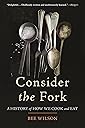
Consider the Fork: A History of How We Cook and Eat
Product ID: 8262087
🍴Explores cooking evolution
📚In-depth culinary history
🧑🍳Insights from top chefs
Desertcart purchases this item on your behalf and handles shipping, customs, and support to SINGAPORE.
🍽️ Forking Amazing: A Journey Through Culinary History!
Consider the Fork is a compelling exploration of the history and evolution of cooking tools and techniques, offering readers a unique perspective on how these innovations have shaped our culinary experiences across cultures.
| Best Sellers Rank | #78,249 in Books ( See Top 100 in Books ) #40 in Food Science (Books) #48 in Gastronomy Essays (Books) #74 in Gastronomy History (Books) |
| Customer Reviews | 4.4 out of 5 stars 911 Reviews |
A**R
A delectible history of cooking and eating that will appeal to readers of many tastes!
This is a fascinating book for anyone who cooks... or eats. It delves into the history of things we use to cook and eat, like pots and knives and grinding utensils of various types and forks and spoons . It considers the ways we cook like frying and boiling and making frozen food. We don't usually use terms like science and technology in connection with cooking and eating, but the author does fairly frequently, impressing me in way I had never considered with how these terms are and have been very applicable to this topic throughout history. The lore was varied and delightful. Did you know that Einstein invented a refrigerator? Or what is the origin of the old phrase "A pint's a pound"? Or that yummy yucca is toxic if eaten raw? Or why Europeans introduced such blunt table knives? This is a book I will be recommending to a lot of friends. Although there is a Reading Group Guide included, I do not really see this as a reading group book. However, my own book group will be reading it this month, and I may have to eat my words!
K**R
Good read, but missed opportunities.
Consider the Fork: A History of How We Cook and Eat by Bee Wilson is an interesting book on the history of the technology of cooking and eating. She is attempting to fill a perceived void in food history books: while there are plenty of books on the ingredients and recipes of history, there are very few books on the equipment used to prepare and eat those ingredients and recipes. While this book does fill this void in an informative and entertaining way, she has not closed off this void. Large portions of the book concern themselves with the technological changed wrought in the last 2 centuries, and the focus is very European (Asia seems to be reduced to the wok, the tou, chopsticks, and the electric rice cooker, and it's as if no technology is used in Africa at all). The book is fascinating to read -- it's only when looking back do the holes appear. The book's primary division is based on technology, not time or place. The first chapter discusses the history of pots and pans, the third "fire" (or heating technology), leaving the necessary interplay between what gets heated and how it gets heated to be somewhat split between the two chapters. The second chapter discusses knives and their evolution and use, including both table and kitchen usages, while the discussions of spoons and forks at the dinner table waits until chapter 6. Food preservation is mainly discussed in the chapter "Ice", which is mainly concerned about the changes brought about by the advent of refrigeration over the last 200 years -- which means canning, brining, smoking pickling, fermenting, drying, etc gets restricted to just a small handful of pages. It seems odd that a book on the history of cooking technology misses such a historically important aspect of the history of how we cooked and ate. While she mentions many times that the available technology shapes the foods eaten, and vice-versa, the discussion of individual technologies divorced from their overall context robs the ability to explore this interplay in detail. One rarely gets a sense of how meals were prepared and eaten at any particular place and time, nor how advances in one kitchen technology caused changes in others. This, I feel, was somewhat of a lost opportunity. All in all, it was a good read, but it left plenty of room for other books on the same topic.
P**3
A fun read about cooking tools and history of cooking in general but far more than that!
If you enjoy cooking ....or just enjoy eating....this book is a fun and entertaining read. But it is also far more than that. Combining anthropology and archaeology this well researched and documented book reveals far more than the history of apparatus and how cooking has changed. I discovered this book while reading a novel in which one of the characters was reading the book. I am glad that I ordered it for myself. Despite its contents heavy on history and science it is eminently readable. I bought it for my daughter for Christmas thinking she would enjoy it. Decided to read it myself and am so glad that I did. Written by a British writer it has a European and British tilt but for me that makes it all the more interesting. I think you will be surprised at the breadth of knowledge imparted you would never have thought about and certainly never associated with cooking much less the apparatus used for cooking. Covering the history of various cooking tools, both those that work and those discarded anyone interested at all in the subject of food will find this a tasty read. If there were six stars I would give it to this book and can highly recommend it both to the culinary inclined, those interested in history as well as the general reader.
A**1
Fascinating food factoids
I loved this book so much I gave it as a Christmas present to my 4 best friends. The history of cooking from pre-history to mandolins and sous vide. Fascinating factoids I'm still using to amaze my friends. Do you know when Europeans started using forks? Or when Chinese started using chopsticks? And what effect those developments had on human teeth? Do you know when what we think of as stoves made their first appearance? Before that, everyone had to make sure the fire never went out. Refrigerators and ice? So much information and written in such an interesting way. Mostly European perspective, but the whole world does get covered.
C**S
Tasty, but with a few bitter bits
If you're interesting in cooking, this is the book for you. Didn't know that mortar and pestles have been around for 20,000 years? True, apparently. The overbite that humans have? Only 200-250 years since that developed; before that, top teeth met bottom teeth in the front of the mouth to make tearing meat from the bone directly more efficient. Changes in eating habits made for changes to the jaw. Amazing. Anyway, great info about food preparation through the ages, development of kitchen gizmos and labor-saving devices (especially once slaves and indentured labor disappeared from homes of the wealthy). Neat info like Americans are the only cooks in the world to use measuring cups and measuring spoons; everyone else measures in their hand or with their fingers (just a pinch) ... who knew? And some measure by weighing each ingredient, apparently much more exact. Charmingly written, like having a conversation, though a bit more editorial attention would have been helpful. A few words are glitched almost as though the ebook was scanned from a print copy, but howlers like the following show up every once in a while: "This whirling mechanism was a big improvement on quern still took two the basic quern, but a large rotary women to operate, one to feed in the grain and one to keep turning it." Huh? I swear I read that six times and still can't figure out what it might have been originally, how many sentences are jumbled together, or what. ('Quern' I got because it's explained elsewhere - it's the bottom part of a circular grain mill against which the upper stone is rotated to grind the grain.) So, I recommend the book despite the few puzzles that appear here and there. Graphically excellent, illustrations are crisp and clear (though I don't understand why fractions are sometimes displayed as graphics; one doesn't need a picture of 7/16" when the numerals as text are fine; typographically okay, formatted fine on my Kindle Keyboard.
F**H
You Need This If You Have an Interest in the History of Food
This has become one of my favorite books in my small food library. I guess I have a few hundred books about food and history and culture and geography, etc. I thought that I had read a lot about food, though I don't pretend expertise, but just about every page of this book told me something I didn't know. What I especially like is the way that the book links changes in technology throughout history to food preparation and recipes. It shows in a kind of seemless way how food topics, such as "manners," that we take for granted often grew out of something completely unexpected or that we would not think to connect. As I read, I just keep stopping and saying, "Wow." For example, like another food book High on the Hog, this book makes it clear how incredibly dangerous food prep has been for women until fairly recently. And, how much people resisted devices that made the kitchen safer and more efficient.
M**O
Interesting book with a few issues
I got this book because I am sort of a food nerd and there are few things out there that focus on the technology rather than the food. However this book is not a primer in the sense of teaching one what to do in the kitchen but is more a history of various kinds of kitchen tech. It is divided into chapters by type - one for heat sources, forks, spoons, pots, etc. Each one goes as far back in history as the implement can be traced and looks at how it was used, spread culturally and changed over time. If you have interest in this type of material a lot of it is quite fascinating and will provide lots of random facts for dinner parties, at least if you go to dinner parties with other nerds (which I do!). My biggest complaint is there are so many typos in the kindle edition! It is the worst kindle book I've read! They charge $13 for it yet seemed to assign the intern as copy editor, if anyone at all. It really surprised me that the quality would be so poor on a book like this. So I regret the price for sure, and hope they release a proof-read version. Otherwise I have a few things I don't like about the content. First there is a very strong francophilia as far as cuisines go. She also discusses things in Britain a fair amount and the as a distant third, China. Occasionally other cultures pop in but you get the idea that she used maybe limited source material? Which brings me to my other concern - what source material did she use anyway? There is a lot of "experts say" sort of thing, with little attribution or notes or anything, and so given the style, in which she intersperses personal experiences and observations in with the history, I often found myself wondering where her information was coming from, and how completely researched it was. The overall impression is one of anecdotes rather than a comprehensive history. Still they are usually enjoyable anecdotes! I'd say overall an interesting book but one I don't have complete faith in.
J**O
Enjoyment is the word that comes to mind
The reviews and commentary have used a plethora of adjectives to describe this book — delightful, a joy to read, sparkling, fascinating, lively, entertaining, a dash of fun. They are all true. Even if you are a serious reader, this book will please you. Well written, and you will learn something too. And yes, delightful, fun, and enjoyable.
Trustpilot
1 month ago
2 weeks ago