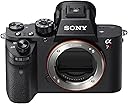
🚀 Elevate your vision with Sony’s powerhouse: where pro-grade detail meets unstoppable creativity.
The Sony ILCE-7RM2 is a professional-grade full-frame mirrorless camera featuring a groundbreaking 42.4MP back-illuminated CMOS sensor, 5-axis in-body image stabilization, and advanced 4K video recording with full pixel readout. Designed for demanding photographers and videographers, it offers fast hybrid autofocus with 399 phase-detection points, robust connectivity via Wi-Fi and NFC, and a durable ergonomic build, making it a top-tier choice for capturing ultra-high-resolution images and cinema-quality videos.


| ASIN | B00ZDWGFR2 |
| Guaranteed software updates until | unknown |
| Item model number | ILCE7RM2/B |
| Manufacturer | Sony |
| Product Dimensions | 24.41 x 15.49 x 14.4 cm; 625 g |
S**E
This is the best camera I've ever owned. I've gone through tons of cameras looking for professional quality videos (I rarely use my a7R for pictures) and this camera has bested them all in terms of quality and performance! With my particular situation, I record videos in low lighting.. very low lighting. I was using a Canon Rebel T5i before swapping to the Sony and while that camera can manage great video quality, it doesn't handle low-light very well. The Sony a7R not only handles my particular situation well, the way it deals with color is superb! I have a blue screen behind me that's almost pitch black, yet the picture quality is so clear that I can chroma key it out without problems. If you're buying the a7R for pictures, it's VERY easy to get a stunning photo in crystal clear quality. I should also point out I'm using the T * FE 55mm F1.8 ZA lens which has no zoom function. One issue I have is that the touch screen on the back of the camera doesn't pull out, making it difficult for me to adjust settings while having the camera on myself, but anybody buying a camera like this isn't buying it for selfies, so it's just a personal issue.
T**T
I decided to move to Sony's platform from shooting Nikon's D810 and I'm really glad I did. While the controls might not be quite as intuitive as my Nikon D810 and this camera definitely wouldn't work well as a weapon in a pinch, the image quality is so perfect and amazing that it's forgivable. Here are the pros and cons as I see them to owning the SonyA7rII: Pros: Amazing image quality - the best I've ever seen - and I did a lot of side by side with the D850. When dealing with high end camera's that occupy very top of the DxoMark scale, it really comes down to specific needs and personal preference. The EVF is absolutely fantastic to use. It's clear, the colors are wonderfully vibrant and true to life, and the ability to zoom in on far away objects from the viewfinder for perfect focus is a great benefit worth the extra demand on the battery. Silent mode which uses an electric front shutter is great and now (after upgrading to the latest firmware version) appears to work when uncompressed RAW is selected Though small, this camera feels solid and, with the grip, fits my large hands comfortably Though Sony doesn't have a large lens selection, the lenses they do have are insanely sharp and bar none among the best I've ever owned, particularly their Zeiss lenses and new Sony "G" lenses. To give some perspective - the best lens for Nikon ends at a 36 sharpness rating, Sony's lens lineup almost starts where Nikon leaves off and goes up to an insane 46 rating (per DxoMark). I can use this camera with ALL of my vintage glass including Nikkor AI and NAI MF lenses, Helios, Pentacon, Zeiss, and INDUSTAR, etc. All that's needed is a simple adapter and each of every one of theses lenses benefits from Sony's 5-axis in-body image stabilization. the shallow depth of the camera body ensures it's compatible with virtually every 35mm camera lens ever made - something that I ran into trouble with on my D810 because Nikon actually has the widest body of all camera makes. My M42 mount lenses (for example) would have to be mounted slightly inside of the D810 body to get the right magnification and infinite focus. And that's not even an option because doing this risks destroying the mirror. Even vintage Nikkor AI and NAI lenses can't be used without fairly major modification which also ruins the lens value. A lot of people seem to really dislike the A7 line UI. I personally kind of like the interface. Maybe it’s because I work with a lot of technology, but I find it pretty simple to use and after owning my camera for a few weeks have the placement of everything committed to my long-term memory. It also looks more modern than Nikon or Cannon’s UI. It might seem a little segmented at first, but in the end, everything kind of makes sense as a whole so I’m counting it as a pro. Love that Sony included two batteries and a charger. This really makes me feel like I bought a high-end camera. If they’d throw in a screen protector (see my grumble below), I’d be completely happy with the included accessories. Cons: The battery life could be better I'd love to see the build quality be just a bit more robust. I.e. I wouldn't take this on out in sub zero weather, do a photo-shoot in a sand storm, or bring it with me white water rafting. Even decent weather sealing would be a nice gesture. This one is probably on the top of my list - I'd love to see dedicated controls for all major settings that I use every day. I can set the aperture from the back dial and the exposure from the front dial, but it would be great to have a control for the ISO. I virtually always shoot in full manual mode and having to right click on the wheel to bring up an ISO dialogue before selecting the ISO is just the tiniest bit annoying. The camera should come with a snap on screen protector like Nikon provides. When you spend this much on a camera and don't get basic protective equipment, you feel like Sony is being a tad on the penny pinching/apathetic side. Some tips: Knowing how short the battery life would be I loaded on six batteries and bought a grip for the camera so I can use two at a time. With the grip I can shoot about half of what I used to get away with using my D810, which is workable Get a good protective carrying case/backpack for this camera to keep it safe. My final verdict: It's overall the best camera I've ever owned. While it is quirky in some way, some of the quirks are starting to grow on me. Now we'll see about longevity. The shutter is rated at 500,000 actuations, so I'm hopeful.
R**E
Walking around with this camera is very comfortable - yet not as stealthy as my RX1R II. The body is solid though a little small and I find my pinky dangles in the air - so I use it to support the bottom of the body. Middle and ring fingers hold on to the small front grip (which is comfortable) and my index finger lives between the shutter release and shutter speed dial (explained a little more below). There is a slight bump-out on the rear where my thumb comfortably sits and provides quick access to the f-stop dial. It's a slightly different grip on the RX1R II which, though smaller, doesn't make it seem as small - maybe the lack of the bump-out grip in the front of the RX1R II. I enjoy the placement of the buttons and dials on this camera. They are solid and smooth to operate - and the ones that need to click into position do so. At this time, with the camera always in manual (M) mode I have the front dial set to adjust shutter speed, the rear to adjust f-stop and a button on the rear to adjust ISO on the fly. A single click on the button brings up the ISO menu, then the thumb wheel allows me to quickly scroll to the rating I want. The only other button programmed so far is C1 for eye detection. Obviously, only used in portraits but seems to nail it every time. I use this same setup on the RX1R II. I have been using the Exposure Comp wheel more and more to give me the exposure exactly how I want it rather than relying on post to correct that. Also been getting into relying almost solely on the histogram in the viewfinder to expose my work now. The shutter release is smooth and pleasing (and I like the sound of it) and has the option of silent shutter, though I haven't tried that to date. SONY A7R II - SENSOR The A7R II has a 42.4-megapixel back-illuminated 35mm full-frame Exmor R CMOS sensor powered by the BIONZ X image processing engine to support 14-bit uncompressed RAW images. Technically, getting an ISO range of 50-102,400 but realistically using ISO 100-25,600. Even more realistically for my style is ISO 100-6400. Unlike my RX1R II, there is no optical low-pass filter on this camera. 5-AXIS IMAGE STABILIZATION The Sony A7R II has 5-Axis Image Stabilization which has been maximized for the 42 MP sensor. This system corrects camera shake while shooting along the 5 axes of angular shake (pitch & yaw), shift shake (along the x/y axis), and rotational shake (roll). Pair this with a IS lens (like the Zeiss Batis 85 I have been using) and you can freehand some ultra-lowlight photography. BATTERY Battery is notoriously bad on these cameras, but there are a ton of tips and tricks out there to increase life. Best thing I suggest is tossing the camera into Airplane mode - this turns off all the Wi-Fi and searching for networks. With this off, I can shoot all day with 3 batteries at the ready. To be honest, I shoot so little on a typical day (200-300 max photos) that I seldom need to jump to a backup. Some other things you can try are reducing the brightness in the monitor and viewfinder, having a short power-save time, turn off the "Sunny Weather" option, turn off audio signals and turn off Pre-AF. If I am walking around between shots, I tend to switch the camera off too. Not sure how much that helps, but a habit I picked up with the RX1R II. I also suggest having a couple battery backups and a couple chargers in the house. Right now, I have 2 Sony stock batteries and 2 off-brand ones. I haven't noticed much of a difference between the two. For the house, I have a pair of chargers, as these batteries seem to take forever to get to a full charge. At least with a pair, I am able to cut the charge time in half. FINDER / SCREEN There are a couple ways to compose images with the A7R II. Either the screen on the back of the camera with LiveView or via the Electronic View Finder (EVF) that's really a godsend. The camera has the intelligence to automatically only power the view you are using. If LiveView, the EVF is powered off. If you put your eye to the EVF, it fires up in an instant and the back screen powers down. Very good for a camera that's a battery whore, as mentioned above. With either of these views, you can increase or decrease the resolution, though they both look really good at standard. Very bright and quite responsive. Nearly identical to what I said about the RX1R II and not like the LiveView of the past (where my last experience was with a laggy Sony NEX-3). I keep the rear screen fairly dim, so I like to use the finder as my review of images when needed. The eye cup for the A7R II finder is much better than the RX1R II, by the way. The former is a proper viewfinder with a rubberized eye cup (see rear image of A7R II below in the My Defaults section) while the later is a pop-up EVF and does not offer eye relief at all. Both screens offer a slew of data from shutter speed, ISO, f-stop to digital levels, histograms and so on. I won't bore you with all the goodies, but there is a plethora of stuff that can be added to or removed from either screen. The rear screen tilts up and down which is nice to hold over your head or at your feet to frame a decent shot. I don't use the screen often, but really enjoy the ability when I need it to compost a shot this way. I find this can be a stealthy way of composing a shot without those around aware of what you're doing - if stealth is your motive. AUTOFOCUS The Sony A7II offers up 25 contrast detection points and 399 phase detection points covering about half the sensor. The modes available here are Single, Continuous and Manual focus as well as AF-A and DMF modes that can be used with the native FE glass. As I don't tend to shoot moving targets, I stick to Single mode for almost all my shooting and have found it to be quite fast and really accurate. As always, you can also switch the focus areas between Wide Area, Zone Area, Center Area (my preference), Flexible Spot, Expand Flexible Spot, Lock-on AF Expand Flexible Spot, Lock-on AF, Eye AF (which I mapped to C1), and Face Detection. Like with the Sony RX1R II, the files spoil me. There is a great deal of latitude in them and so much shadow detail. The IQ is really nice to work with and I am getting the hang of how they behave with my one-click edits. Conclusions It is very early on with this camera to have any firm conclusions, but I have to tell you, I was secretly hoping to not love this one. I have my film cameras that I am more than happy with, and my Sony RX1R II that I figured was all I wanted. I wanted to shoot this, get it out of my system, then return it. Well, it's not going back. As soon as I strapped on the Zeiss Batis 85 and walked around with the Sony A7R II I was smitten. This camera is really offering everything I currently want in a digital setup. Gorgeous files with the colors I enjoy, great speed and a joy to walk around with. I read complaints about the menu system, but really, once you set it up once, you don't need to dig in there much and it truly isn't that bad. This is a fine compliment to my film work and will also be a great compliment to the Sony RX1R II - so yes, they are both staying. I plan to get a ton of use out of this throughout the year and re-touch this review with future thoughts, uses, issues or what have you.
D**R
totally excellent very fast shipping prompt courteous service. the images from this camera are incredible. I use it for coin photography. It is way beyond any DSLR. I have ever owned this camera has taken my photography to a new level. I have been invited to do some family portraits. see how that goes thank you so much. great deal and a great camera.
J**L
I was looking for the quality of medium format film images and reviews suggested that this camera produce images equal to some medium format digital cameras. So far this camera has met my high expectations. The main advantage of this mirrorless camera over a dslr is evident with a quality prime lens where the compact size and weight is most beneficial. To really appreciate the image quality requires great glass like the 1.8/55, a tripod and a hands free trigger. That does not mean that this camera cannot be used for compact carry with the pancake 2.8/35 (with an ingenious tiny lens hood) and a shotgun sling. It can also be used for available light shooting with the 1.8/55, perhaps using eye focus. Features like weather resistance, in camera stabilization, eye focus, silent shooting mode, ISO minimum shutter speed, dynamic range optimization, manual focus zoom, programmable buttons, in camera apps and wireless communication are nice. Sony seems committed to software improvement as this camera is now up to firmware 3.0 which SUPPORTS UNCOMPRESSED RAW (82 meg files). As for lenses, this camera takes FE (Full Frame E Lenses) and E (APS-c) lenses. E (APS-C) lenses should work on this camera in sensor crop mode (using only part of the FF sensor). And the FE lenses for this camera should work on Sony E (APS-C) cameras with the expected crop. Many shorter Canon L lenses will autofocus with an adapter. Due to a number of adapters, this camera can be used with lots of legacy glass in manual focus mode. I strongly recommend that you carry a number of batteries when on a shoot with this camera and turn on airport mode. If you need a bigger body, you can add a Gariz case or two battery grip. My wish list. Currently, as far as my test show, most in camera lens corrections ARE reflected in the RAW files. So if you plan to do post processing lens corrections you may want to turn off all in camera lens corrections (Gear --> 7 --> Lens Corrections Option in the Menu). My wish for Firmware 4.0 is an option to turn off in camera lens corrections only for RAW, leaving lens corrections on for JPEGs, as I am currently shooting in RAW+JPEG. Another wish is the ability to program a button to switch from FF (full frame) to APS-c and back. This would allow for easy in camera cropping (55 -> 88 ) on the fly. I was able to import the uncompressed raw + jpegs to the no longer supported Aperture 3.0 on OS X 10.11.1 as the A7Rii RAW conversion is part of the operating system. Have fun!
Trustpilot
2 days ago
1 week ago