Some deliveries may take a little longer than usual due to regional shipping conditions.

DOWNLOAD THE APP


Customer Services
Copyright © 2025 Desertcart Holdings Limited
DOWNLOAD THE APP
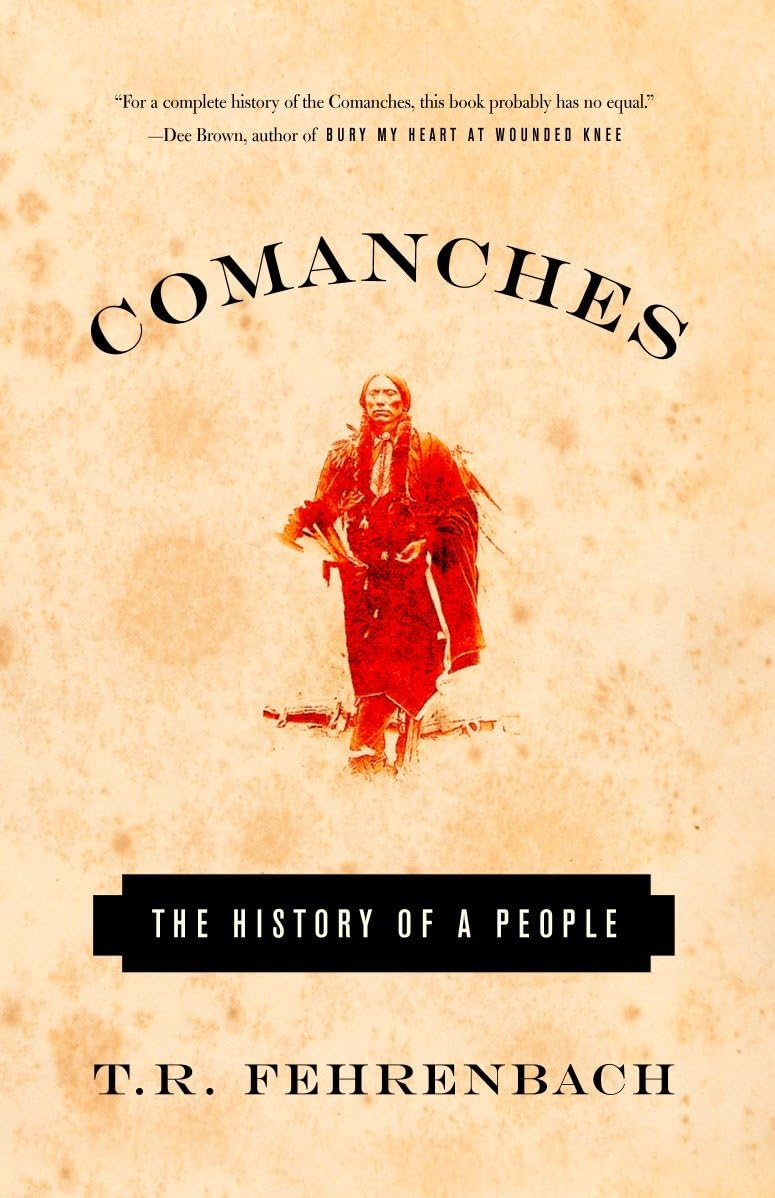
📖 Own the story history forgot — be part of the conversation.
Comanches: The History of a People is a well-written, deeply researched book offering a balanced and poignant account of the Comanche tribe and the broader American West settlement. With a 4.7-star rating and top rankings in Indigenous and Native American history categories, this used book in good condition is a must-read for professionals seeking a nuanced, emotionally rich perspective on a pivotal cultural clash.
| Best Sellers Rank | #60,974 in Books ( See Top 100 in Books ) #5 in Indigenous History #73 in Native American History (Books) #89 in Cultural Anthropology (Books) |
| Customer Reviews | 4.7 out of 5 stars 673 Reviews |
R**N
An enjoyable read for history buffs with an open mind
If you have a PhD in history and are looking for an exhaustive, cross-referenced academic work, look elsewhere. If you're politically correct and offended by warfare, greed, western civilization or any other defining aspect of humanity, look elsewhere. However, if you're one of those who enjoy studying history with an open mind and with no axe to grind, this is a well-written account of an aspect of the American experience that is rarely heard today, other than in echoes from the names on Southwest maps. The book starts with a description of the Amerindians in general, not just the Comanche but all the various people that emigrated at one time or another from the Asian continent across the land bridge of the Bering Straight. These people weren't any different from any other humans alive at the time, and lived in much the same way. Although I'm no academic historian, in my opinion the author makes a better argument than Jared Diamond in "Guns, Germs and Steel" that what really defeated the Amerindians wasn't guns, germs, or steel, but simply time. By the time the Mayans built their pyramids, the ones in Egypt had been abandoned for thousands of years. The Amerindians had yet to create their Bablyon, Greece, or Rome, and their cultures still clung to the magical, superstitious world view that the white tribes of Europe had when they too were overwhelmed by the advance of civilization and the scientific concept of cause and effect. The difference was that no newspapers existed thousands of years ago to chronicle those events. The author argues that Amerindian culture was doomed whether it was the Europeans or the Chinese that landed first, and regardless of whether they brought guns or gifts. It was both an inevitable and poignant loss of an earlier human cultural existence, one buried deep in the human race but left behind in the same way a growing child wistfully leaves behind their younger years. And, in essence, the above is the major thread of this book. For good or ill, civilization had destroyed the tribes of Europe and Asia and created a new cultural force, one that was now pushing across the world. The history of the Southwest Indian conflicts was the history of the clash of these two cultures, the old and the new, with the Amerindian culture never truly able to comprehend the forces pushing against it and the settlers never truly understanding the depth of the resistance. The result was decades of misunderstanding on both sides, integrated with the racism and greed on both sides that remain with the human race today. This book provides gripping accounts of those conflicts in this context, with the Comanches fighting the white settlers with the same motivations for which they fought the Apaches or the Dakota, not just to protect territory, but even more so to provide for their people and prove their personal magic. The settlers, meanwhile, through racism and greed failed to provide any mechanism by which the Comanches could adapt to the weight of the civilization bearing down upon them. Even during the final years of conflict, more Indians were killed by the rifle fire of other Indians than by that from the white settlers. Although they were on their way, time had not yet given the Indians their Rome, and they were culturally unprepared to fight it when it arrived. This book is an excellent, detailed chronicle of that tragic battle as it played out for the Comanches.
R**R
A profound history
This history is actually twofold: a history of the Comanche and a history of the settling of the west. These two stories are told with an even hand, giving a fair hearing to both Amerindians and White expansion. It is very well researched, using contemporary and current information to inform the narrative. Perhaps most importantly, it is well-written, more a story than an account, offered by an author who has written not only from the head but also from the heart. It is a touching book that will inform you while also moving you. You will be glad you read it.
B**K
Entering a life altering universe
Opened a whole new world into Ameridian culture. Fehrenbach not only covers The Comanche, but ANYTHING to do with the Comanche. The book is so easy to read and a treasure trove full of information. Its the first book ive read to where I was required to take notes just so I would not forget pertinent information. I can not recommend this book high enough. I have order 10 more books on Amerindian culture and ALL of Fehrenbachs books because of this single book. You're wasting your time by not reading this!
M**G
Excellent History of the Comanche Indians
This is an excellent book about the Comanche Indians, but it also covers other Indian tribes, such as the Apaches, Caddos, Wichitas, etc. I live (and have lived most of my life) in the part of Texas known as Comancheria, and I never knew a lot of the events in this book. It covers a lot of history of this part of Texas, explains how a lot of towns and geographic features in this part of Texas got their names, etc. This book does a good job of describing what life was like for plains Indians, how they differed from Indian tribes in other parts of the country, how and why they became such great horsemen, hunters, and warriors. It also explains well the demise of the Indians, not just the Comanches, but all Indian tribes in North America. It's easy to get sad about that, but take a step back and look at it objectively like the author does, and you can see that, for better or worse, once the Europeans arrived in the Americas, the Indians days were numbered. I also recommend "Empire of the Summer Moon" by S.C. Gwynne. It concentrates more on the latter years of the Comanches and their last chief, Quanah Parker. He was half white, his mother was Cynthia Parker, who was kidnapped by the Comanches at the age of 9, was adopted into their tribe, spent over 20 years with them, and when finally found, did not want to come back to the white man's world. It's an amazing story itself.
B**X
A good read the second time around
I am reading this for a second time and enjoying it even more.
D**N
Amazing history of a people facing a tsunami of change
If you think this book is about the Comanche’s, you’re missing the point. This book is a case study of people being forced to adapt too quick against their will. In the age of AI, and other technological developments, we are all Comanches now. Read this book, learn why they failed, and cultivate a spirit of adaptability.
C**N
An Excellent Piece by T.R. Fehrenbach
This is a well written, balanced look at the history of the Comanches by T.J. Fehrenbach. He focuses upon the interactions of the Comanches with European-Americans. It starts out slow; in particular, the prehistory of the Comanche before their interactions with the Spaniards feels a bit nebulous (the first 150 pages). However, once Fehrenbach begins to discuss concrete historical events, the book becomes a rapid read. When I say the book is balanced, I refer to viewing the events of European colonization from an objective perspective. He neither delights in the European actions nor attempts to apologize in hindsight. He simply explains what took place without editorializing. Fehrenbach soberly recounts the destruction of the native peoples by European settlement and conquest, disease, and the decimation of the buffalo through hunting in the 1870s. Yet he is also clear about the warlike attitudes of the Comanche, the savagery of their conduct (to fellow Native Americans as well as Europeans), and the inability of both peoples to reconcile very different cultural perspectives. He does not absolve nor excuse the Europeans, but also explores the reasons the conquest was inevitable, and helps one to understand both the perspective of settlers who were taken as captives, killed or mutilated, and how they responded with their own violence, as well as the perspective of the Native Americans who saw their way of life being ripped away. The book has violent moments. It discusses the history as it actually happened. Fehrenbach also uses racial terms which wouldn’t be used today. They reflect a different era, and the racial attitudes of the 19th century. Fehrenbach doesn’t endorse them but doesn’t sanitize history either. This is an excellent work, and I highly recommend it to anyone who enjoys history, in particular, North American history.
S**Y
Not exactly the "noble" savages
I'm drawn to Feherenbach's books because of their readability. Years ago I picked up his long one volume history of teh Korean war and were fascinated with it. He was very prescient about Viet-nam in just a few paragraphs at the end. Comanche, was a different story. I'd always loved the John Ford movie, "The Searchers". Recently, Ford and John Wayne, the lead, have been accused of racism for the movie. Never taking anything for granted, I felt it my time to learn about the Comanche. What the author gave me was a full bodied no holds barred all the warts showing view of a people who terrorized not only the Spanish, Mexicans, Texicans but every other American Indian tribe that encountered them. A wild violent people with a world view quite at odds with the rest of the world. Admirable for their "virtues" nonetheless, a people you would not want to meet on the road. Their clannishness kept them safe from the diseases that decimated other tribes. What can one say about a people who even drove the mighty Apache off teh plains and into the mountains. A real eye opener which explains why the average cavalry trooper was advised to keep that one last bullet for himself. Well researched, well written and a joy to read.
Trustpilot
5 days ago
2 months ago