🎧 Hear life on your terms—discreet, smart, and unstoppable.
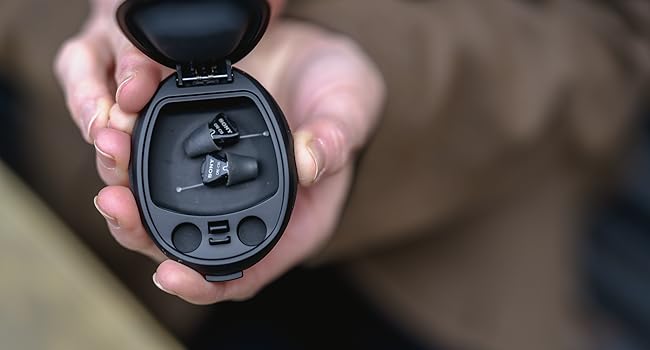
The Sony CRE-C10 OTC hearing aids deliver prescription-grade sound quality in a compact, virtually invisible design. Featuring an easy-to-use app for personalized sound customization, automatic environmental adjustments, and up to 70 hours of battery life, these FDA-cleared devices offer a comfortable, discreet solution for mild to moderate hearing loss. Perfect for professionals seeking seamless integration of advanced hearing technology with everyday style and convenience.








| ASIN | B0BXYZVT1T |
| Additional Features | Customize your hearing with the Sony | Hearing control app, Fits discreetly inside the ear canal for a virtually invisible look, Prescription-grade sound quality |
| Age Range Description | Adult |
| Audio Driver Type | Balanced Armature Driver |
| Battery Average Life | 70 Hours |
| Best Sellers Rank | #363,453 in Health & Household ( See Top 100 in Health & Household ) #249 in Hearing Aids |
| Brand | Sony |
| Built-In Media | 6 size 10 batteries, Care tools, Click sleeves in 4 sizes, Jewel case with hearing aids |
| Cable Features | Without Cable |
| Color | Black |
| Compatible Devices | Cellphones |
| Connectivity Technology | Wireless |
| Control Method | App |
| Control Type | control |
| Customer Reviews | 3.3 out of 5 stars 217 Reviews |
| Ear Placement | In Ear |
| Earpiece Shape | Rounded Tips |
| Enclosure Material | Plastic |
| Form Factor | In Ear |
| Frequency Range | 8600 Hz |
| Headphone Folding Features | In Ear |
| Headphone Jack | No Jack |
| Headphones Ear Placement | In Ear |
| Headphones Jack | No Jack |
| Item Height | 2.25 inches |
| Item Weight | 0.18 Kilograms |
| Manufacturer | Sony |
| Model Name | CRE-C10 |
| Model Number | CREC10 |
| Noise Control | Active Noise Cancellation |
| Number of Items | 1 |
| Specific Uses For Product | Hearing Impairment, Everyday Use |
| UPC | 027242928800 |
| Unit Count | 1 Count |
| Warranty Description | 1 Year |
| Water Resistance Level | Not Water Resistant |
| Wireless Technology | Wi-Fi |
D**H
These are great!
These hearing aids have been shockingly good. My pricey regular hearing aids are going back for repair--again. Even when they are working I have never been happy with their performance. I ordered these to use as a backup and expected them to be a poor substitute. What a surprise! They are better than my regular aids. I hear sounds and people with both my expensive HAs, but with these I actually understand consistently. The downloaded app (android) worked well and I quickly worked my way through the initial hearing test. Given the state of my hearing I was not sure these would work for me. However, the test went quickly and my hearing aids were set up. Then I moved through my day. I was pretty sure my experience would be frustrating, that they would not be very good, and that I'd be posting another kind of review. On the contrary! I was struck by the clarity of all types of conversational speech--something that is very important to me, and a continuing problem with my other hearing aids. I have now worn these for four days in a variety of situations, including small group gatherings and meetings, outdoors, one-on-one conversations, listening to audio, TV, and I am very satisfied. I haven't tried them in a very crowded noisy restaurant or very large crowd yet, and I wouldn't be surprised if they fell short there. But so do my expensive ones. Right now, speech in conversations, as well as from TV, is crystal clear. I am wearing them about 14 hours per day. They have been comfortable and there has been no squealing or feedback. I'm just hoping they don't break. The battery door seems a little vulnerable to me. I want these to last. I will update as I experience these in more difficult situations, but so far, it's all good. Update 8/10/2024 - These continue to work well. Can't believe it, but they are better in restaurants and group situations than my regular HAs. The battery door, contrary to my original evaluation, seems to be pretty robust. I put in the battery the wrong way once and tried to force the door to close. Couldn't, and nothing broke. But, do be careful. The batteries go in differently on each aid so it can be easy to make a mistake. Update 8/28/2024: I have now worn these in just about every imaginable situation. In a very noisy restaurant I found it easy to understand everyone, although the music playing in the background sounded atrocious. Walking down a high traffic street I encountered a little annoying background noise, but it was quite tolerable. I could understand what people around me were saying which was most important. My expensive hearing aids cancel background noise better, but I am constantly asking people to repeat themselves or spell out words. I am very pleased!
T**R
3 failed in 11 months. Apple Earpods pro is superior.
This is an updated review since I have had mine a couple months. This is for the invisible model - I didn't want any colossal thing hanging off my ears and the batteries are so each and cheap to replace that I'll take that any day. As others have mentioned - there is one major flaw in the software. One of my ears is pretty poor and the setup told me I can't use this. I literally had to repeat the setup 5 or 6 times to get past that step. At one point some wishful thinking and lying and saying I could hear a tone finally got past that. The should fix the software not to utterly reject the user in this case. What if over time that ear gets worse and I have to reset them? I'm supposed to throw in the trash? Which leads me to my next complaint - limited and simplistic software. After setting them up they didn't work all that well so I used the "customization" feature a couple times and finally got them to work GREAT. But now I have a real fear of ever successfully repeating the step should I need to. A simple way to save the settings would suffice. I should be able to save my settings. Otherwise, Sony, when these need eventual replacement the new one may have to be returned. Try to name a product where you can't save the settings somehow? Once I finally got them customized they work really well if not perfect. I do have some residual feedback at times. My ear that hears poorly is dramatically improved, proving they should have better software and let you use it even if it won't be optimal. I have no intention of ever paying an audiologist for what is essentially the same thing, so OTC is my only option. The battery as I suspected is a non issue. The Amazon Basics brand is practically free and it only takes a couple seconds to swap. They last a long time and you get two different audible warnings before a battery dies so really not a big deal. If Sony could make a couple small improvements - allow you to save settings and let setup continue even if results won't be optimal - this thing would be just about perfect. Nowadays, I am wearing them more and more. I can watch TV with my wife again and let her handle the volume control. I hear background noises in the house I have not heard in years. Overall they are well worth the money! Edit: After a few months one failed. Sony sent me a replacement fast so I’m raising to 5 stars for decent service which is rare these days. Second edit: A couple months later one failed again. Once again Sony came through. But given the fact that these are expensive and the warranty is so short (1 year) its looking like these are not going to be worth the money over time as they just don't hold up well. Final edit: One star. They only last 3 months or so on average, the third pair just had another failure. I use them lightly an am extremely careful, so I view this as unexceptable. I have a few weeks left on warranty but will not bother to get another replacement - the lifespan is too small to be useful for this product. And lastly when I bought the Apple EarPods pro 2 I realized they are so much better I would never go back to Sony. Threw them in the trash.
C**U
Good value
Only one complaint, really. Every so often, they “disconnect” and I have to go through setup again. If this happens to you, though, just select to keep previous settings when you come to that screen. I’d like them to be able to tune out extraneous noise and focus on the voices around me, but the very expensive ones my friends and family have don’t even do that well (from what they tell me). I’d also like to switch between quiet environment and noisy quickly and not have to go into the settings to go through the “troubleshooting” steps. Otherwise, these are user-friendly, very unobtrusive and “invisible” and I can hear! Without them, everything is very muffled and voices sound like they are mumbling. Battery life is fair - they last between 4-5 days. I buy the ones from Costco, so not too expensive.
A**D
The change in your life could be profound
Executive summary: the CRE-C10 is life-changing, and excellent! But there is much more to consider. Let me tell you what I've discovered: Straight off, the Sony CRE-C10 is a world apart from the inexpensive (mostly under $100) models, and unlike those, is considered a medical device, and as such is sales tax free in the USA. Because it's OTC (Over-the-Counter) you can buy it direct, without an Rx or a visit to a hearing professional. And although its price, at nearly $1,000, is high, it's much less expensive than one you'd buy from a hearing center/audiologist. I chose to purchase the replaceable-battery model (called the Sony CRE-C10), yet I'll also provide in this review a comparison with the rechargeable battery model that's called the Sony CRE-E10. The two are significantly different in size, appearance, and features, each with its own pros and cons. Which model you choose will depend upon what you value most. The rechargeable one has more features, some of which may be important to you. The replaceable battery model is virtually invisible. Thus, appearance might be a decisive factor. Indeed, at least for me, the most important difference is the appearance. While the C10s are true stealth tech and can't easily be seen, everyone will know you're wearing the E10s, which sit outside the ear and are black and seemingly as large as quarters. Will they get clocked as a hearing aid or a bluetooth speaker? Do you care? Here are some reasons to care: 1. Vanity. 2. Privacy. 3. To combat ageism. 4. To combat (illegal) discrimination due to being perceived as a person with hearing loss (e.g., job discrimination). 5. Because you don't wan't to be seen as an older adult (or anyone) who is hearing impaired and thus a target for crime. While the stigma of hearing aids isn't anything near what it was 30 years ago, how you feel about yourself always matters. So, let's first talk about whether you need this, and also whether it will help you. Sony is clear that they classify this for use by people 18 and over who believe/perceive they have mild to moderate hearing impairment. That's basically part of the FTC's OTC ruling. The Sonys are meant to be adjusted (tailored to your specific hearing loss) solely using the app, without the intervention of an audiologist or hearing professional. There are the usual caveats and warnings about seeking medical help, etc., under certain specified circumstances. If these apply to you, follow the advice please. If you'd like a view from the medical establishment, Johns Hopkins Medicine has an online article covering Over-the-Counter hearing aids, and their FAQ includes their answer to the question, "why should I see an audiologist before getting an OTC hearing aid?" The tenor of the article is from the medical-professional side and is worth reading. Yet the FTC now allows you to purchase an OTC hearing aid, and thus you do not require a visit to a physician or audiologist before you buy one. Johns Hopkins also has a telling article entitled, "The Hidden Risks of Hearing Loss," which is a must read; so please read it even though its conclusions might be surprising and are somewhat controversial. This is vital information that you and your loved ones should know, because it addresses hearing loss and a putative connection to dementia, its possible interference with "some of the mental processing needed to walk safely." Wow! To be clear, my input in this review is just from the point of view of a consumer who has purchased this because of a perceived mild-to-moderate hearing loss, and my advice is my personal experience, not medical advice. Let me describe my before-and-after experience: The 1st question you'll need to answer: Do you have 'mild to moderate' hearing loss? I'm pretty sure I'm over the mild, and a bit into the moderate. See if this rings a bell, as most likely you can hear bells, like the loud ding on the desk of the concierge. But can you hear: Birdsong? Wind? The water faucet? Steam? The clinking of a set of door keys? The touch-tone pitches as you enter a phone number on the iPhone keypad? Or the various clicks on entering a text? People talking on their phones as they walk by, and what they're saying? Conversations? And critically: An approaching car! (And as a quick aside: If you are watching TV and someone tries to talk to you, especially from behind, and you feel annoyed, that's another clue to look for. It's your brain on overload trying to concentrate on two things at once. That's what it felt like to me.) Here's a kind of hearing test you might want to try before you buy: If someone says these two names to you softly, can you tell them apart? Janet Janice They differ only in the final sound, and the "s" which ends Janice is a hissing (voiceless) sound that will be difficult or impossible to hear if you have a lot of high frequency hearing loss. Yes, that's right. Even though most speech is mid-frequency, it's vital to hear those higher frequencies, as they affect your ability to discern consonants, especially initial and final ones, and thereby play a big role in intelligibility. There are two ways of saying that final "t" in Janet: with a puff of air (British) or without ('merican). I knew a lot of Janets and Janices, and it was a problem. Also, English requires hearing vowels clearly, lest pit/pete/pet/pate/part/put/putt are insufficiently differentiated. And if everything is muffled, it's hard to tell them apart. That's the before. Here's the after, which is the good news: All of the above normal sounds were pretty much inaudible (or very nearly inaudible) to me before firing up the Sony, and all are perfectly clear now. The water faucet near made me jump! And now I can hear the "ding!" of the toaster over from outside the kitchen, and can converse with people who speak softly even while they are wearing a medical mask. With the TV on. The difference is night and day. It's really worth something to not drive your friends crazy. Now, to be sure, even with a $100 low-price hearing aid, all of those normal sounds (birdsong, etc.) become audible, but not necessarily in a good way. Most of those less-expensive aids are not adjusted to your particular hearing loss, with the result that your likely perception may be that everything is loud, and annoying, so as a result you may not really want to wear them. Some of these low-price models have "modes", being different frequency curves, but they never helped me at all. My hearing loss, and quite possibly yours, too, is with the higher frequencies. After going through the steps to customize the aids in the app, Sony picks a frequency curve it thinks is right (and I wonder of there's some built-in AI intervention). But you can override, adjust, and question later on. Note that Sony believes, as do many in the field, that it may take weeks for you to adjust (it's your brain that's adjusting for you), but for me, not really. I've worn them for only a few days and I forget they're in. Until something beeps at me. From behind. Before I get to discussing the differences between the two models, I want to talk about what you get in the box, and what you have to do to make these work. There is manual that comes in the box. It is a model of excellence. It's superb. Every single step is made as simple as possible, clearly shown in drawings, and backed up by videos (QR codes are in the manual). You will need time, and you will need patience. Specific to the CRE-C10: Here are some things to consider: The #10 batteries are very small, and it takes dexterity to put them in -- and while not on the level of threading a needle, it's getting there. Putting the hearing aids themselves in is easier, and you will get better at it. You also get better at the batteries and removing the attached tab without pulling out the battery (practice, practice). You do not want to be starting off with these outdoors and have one land in the yard. The manual urges you to go slowly and in a quiet place. It's supposed to take I think 10 minutes, but it took me much longer. Putting the hearing aids in and taking the app's hearing test: Since I dove into this on a wing and a prayer, I freely admit that I was scared of little hearing aids that fit in the ear. (Sony refers to them as "self-fitting Completely-In-Canal (CIC) hearing aids.") And although it might be scary at first to put something into ones ear, you'll be a pro in no time. Although the back end of the hearing aid sticks out by merely a few millimeters, a short built-in metal cord makes it easy to extract. Depending upon factors such as the anatomy of your ear canal and the size of the sleeve, the hearing aid might be flush, or a bit in, or a bit out, and this could be different for each ear. (There is actually a totally invisible hearing aid style (Invisible In-The-Canal, or IIC) but for my money, the CIC is invisible enough.) Before putting the CRE-C10 it into your ear, the aid must always be attached to its click-sleeve, a rubbery cone that comes pre-attached when you first open the box. You must never put the sleeve in alone, and you must never put the aid in by itself, they must always be attached. The first time you try to extract the hearing aid you may have trouble finding that short metal cord (it looks like it's an antenna. It isn't. Or it is, no one knows, at least not me. It's maybe a quarter of an inch long.) Do not panic. Feel around carefully and you will find the metal cord and be able to remove the hearing aid, which, by the way, comes with the Small "click sleeve" already attached, and Extra-Small, Medium, and Large sizes all on-the-ready should you need them. The manual contradicts itself, in one place saying that once you remove a sleeve you should discard it, and in other, instructing you to remove the sleeve to clean it. The click-sleeves snap into place. If you are attaching, say, a new sleeve to the hearing aid, in order to hear the confirming "snap" sound you may need to put it near "the other" ear, the one that still has its hearing aid in place. Definitely go for that snap, because it means the sleeve and the aid are firmly attached to one another. (You'll see how firmly the first time you try to remove a click-sleeve.) OK, it's in, here comes the hearing test: From my reading of both the C10 and E10 manuals, it appears the hearing test should be the same for both. You get to take the hearing test only after downloading the app and allowing it to synch with the hearing aids. The "hearing test" in the app moves slowly. It first plays (initially in one ear only) three tones. The tones are short, but they are longer than beeps. They are all at the same pitch, but they vary in loudness. Maybe on this first iteration they will go: loud, soft, medium. Or in a different order. And the app asks you "how many tones did you hear? 0, 1, 2, or 3?" This series of tones is repeated, and to the best of my memory, the tones are repeated softer, and the order of loud and soft is varied (but for you, maybe that will be different, as I said, I think there's an AI built into the app looking in and deciding what to do next). So, there were times I heard all three, or just two, or just one, and even, nothing. This is the app making a judgement of your hearing. Are you done? No you're not done. You're just getting started. Next the whole process will be repeated for a higher pitch (maybe two octaves up). Clearly this is to allow the app to judge your hearing loss by playing tones at different volumes, and and different pitches. Next, there is another series of tones, if I recall correctly at lower pitch, more in line with the pitch of male and female voices. The app will ask you to move on, and if you agree, and then, are you done? No you're not. You have two ears. So the whole thing now proceeds, all of it, for the other ear (left is first, right is next). Then you're done. Back to the setup: There are very specific instructions as to putting the batteries in and closing or not closing the battery door when you begin the setup. These will not seem to make any sense. Follow them. The hearing aids can detect ultrasonic sounds produced by your phone (you can't hear them, your cat can). Your phone app communicates with the hearing aids, not with WiFi (they don't have WiFi), not with Bluetooth (they don't have Bluetooth), but with some secret proprietary high-frequency communication system. Cool! (The rechargeable ones have Bluetooth. More on that later.) OK. Now you are done, you can put them it, try not to drop them (remember, choose your location carefully) and proceed to hear stuff you haven't heard in years. Everyone I tried them out on was astounded. They were finally able to speak at a normal volume. For the most part, this should help many marriages. Except the ones where someone is having a call they hope you can't hear. Kidding. (Not kidding.) So now you are wearing both aids, and you move on to possible further adjustments in app: The app (which is wonderful for the setup, but quite wonky for the menus, I mean, really not that clear at all) will allow you to set the overall volume. I think you will end up after the setup with the slider in the middle, giving you a lot of room to go louder or softer as needed. Always adjustable from your phone. The app also has a frequency slider, marked "bass" on the bottom and "treble" on the top. If you want to hear the effects of this as a self-test, just say "shh" to yourself and watch the difference as you amp up the treble. (The slider is really adjusting ONLY the treble, from minimal to maximum treble; it does nothing to the bass). There is another part of the app where you can adjust the volume (now called "loudness") separately for each ear, if you feel one is too soft or too loud. And while you already did this in the setup, it's nice to have this backup. There is an additional whole slew of adjustments that you can make, found in the app under "fine tuning," which are presented to you as a series of "problems" and suggested solutions (numbered 1 to 4). One more note of interest: Before I used the Sonys I would see videos of classical music where the cymbals or the triangle or the snare drum played on the video, but were not audible to me. Bad engineering? Nope. It was me. Can hear them now. Now I'm going to get into the two different models, since this is important. PROS of the C10s (the model with replaceable batteries, which I reviewed here, which I use): Small, light, almost invisible in the ear. Much longer battery life ("up to 70 hours") than the rechargeable E10s. Not a fashion statement. Stealth. These pros are strong reasons to opt for the small C10s! Guaranteed for a year, and with a stated likely life of 5 years. If you remember to bring along batteries you should not be left in the cold. Of course if you drop the batteries you will be. When I opened the pack they went flying (you get 6 to start and at around 25 cents each they could add up to $150 a year--or maybe just half that--depends how much you use them). CONS of the C10s: Difficult to insert batteries, at least the first time you try. I required a bright light and reading glasses. And even then, these suckers are small, under the size of an aspirin, and slippery. No Bluetooth. So you can't hear music through them. But you can still answer the phone. Hey you have hearing aids, so you can hear the phone now. Not waterproof. Do not take a shower in them! Think of them as delicate jewels: no hairspray, etc. PROS of the E10s (the model I didn't use, that has rechargeable lithium-ion built in): Rechargeable, so you can't run out of batteries. And, like the AirPods, the case itself recharges the hearing aids, I think up to three times. A full charge (like 4 hours) gives you "up to" 26 hours of use, or 23 hours if using streaming. Pretty bullet-proof. Water resistant. App will let you adjust directionality, so you can turn on or off (to whatever extent, no spec given) the front, rear, left, or right, and, for example, thereby accentuate only the forward (and further narrow its field like a zoom microphone). This should be helpful in noisy environments like restaurants, where you want to hear the person you're looking at. I don't own these aids, and I have no experience yet in restaurants with the C10s but I imagine, if it works well, it's potentially worth a lot. Preset curves start lower in the frequency range, and there are 6 the app choses from rather than 4. Does this matter? It might. The overall amplification appears that it might possibly be higher. Bluetooth! But not for Android, only for iPhone. So you can play music! I don't imagine the music will be on the level of Apple, but this might matter to you. CONS of the E10s: A fashion statement. People will see these. Will you be advertising your hearing loss, or will people clock these as cool bluetooth? I think they will become an unwelcome conversation starter unless you're OK with your hearing issues. And maybe you'll like the look. Lots of pix online to judge for yourself. Built-in lithium ion battery is not user replaceable. I don't know if one day it stops charging whether it can be replaced by Sony. No stated likely life. Do you want a lithium ion battery next to your ear? There is a potential for charging problems, as with any rechargeable item. You are advised to charge this every night, and warned if you don't charge for six months it might no longer accept a full charge. A bit more expensive, if you think of $300 as "a bit." Overall, I'm glad I chose the smaller C10s, because (and this is ironic, I know) I'd almost rather be seen as "hard of hearing" than caught wearing hearing aids and be seen as "hard of hearing." And there is a difference: in one case, you don't necessarily have to admit to the disability; in the other, you could be advertising it. Just being honest. So now you have it. They work, they're a bit of a chore to get started, but the app is extremely helpful. My experience was the best, and I'd recommend them to anyone willing to give them a try. *** Update May 6th, 2023: The other day, while reading in bed with my head propped up by my left hand, the left hearing aid fell out. Quietly. But I felt it slipping, so put it back in. I should have done more. Because later the next day I accidentally fell asleep (were both aids in?) and upon awakening the left one was again missing. I did not yet know it had fallen under the bed in an elaborate hearing aid escape maneuver, so frantically retraced my steps until I thought to move the bed, and whew! (BTW, the manual says you should not wear the aids while sleeping...) The lesson, which I did not learn until mishap #2, is this: If one ever slips out, then that needs to be addressed right away. This could have been a $998 loss, so I'd just recommend if you have doubts, do not go horseback riding just yet, and see how they fare for a while in safer locations. If one falls out, best to try other click-sleeve sizes. *** Update May 12th, 2023: Many sites stress that it's vital to keep the hearing aids dry; at minimum they should be stored with the battery door open (opening the battery door turns the hearing aid off). But I've decided to add a desiccant packet (in the 2-gram size silica gel packet -- they're very cheap by the hundred, and available on Amazon) which actually fits the small case included with the hearing aids. One more thing: If you misplace that small case, it could be hard to find. So I've put an Apple AirTag in the case. The AirTag, the 2 open hearing aids, and the silica gel pack just fit, if you put them in the order of AirTag, aids, gel pack on top. At least you'll know where exactly where they are hiding -- but you could need another pair of hearing aids to hear the AirTag's beep ;-)
C**K
Decent but the app is terrible
The product is decent. They work to improve mild to moderate hearing issues. One caveat, They make everything louder, so if you are in a loud environment already, all the background will be louder too. There is no way to dampen background sound/versus speech all that well. It is what it is, and if you buy them on sale, they are very good for the price point. The major issue with this product is the app. It is absolute garbage. It works like an app from 2009. It continually forgets your settings and doesn't allow you to log back in easily. The app makes you want to just say to heck with it and live with the hearing loss. Maddening.
S**Y
hurt my ears
Helped my hearing without distortion; but terribly ill fitting in my ear. Small dome wiggled out and medium dome hurt my ears terribly. Had to return.
R**R
Excitement to disappointment. Open, used items, missing parts. Sony Customer Service sucks.
Review of Sony CRE-C10 Self-Fitting OTC Hearing Aids for Mild to Moderate Hearing Loss, Prescription-Grade Sound Quality, Compact Virtually Invisible Design, Customizable App, and Replaceable Batteries, Black I wanted to love these, and I did really like the size and fit and concealment. I received a used, open box, with the extra package of 6 batteries missing. There were already batteries in the hearing aids. There were what appeared to be earwax flakes in the hearing aids compartment. I contacted Sony customer service, if that’s what you want to call it. Once you manage to contact them (my only way was finally via text-chat), I was given a case number and the representative had no clue how to help me and told me that he “escalated” it, and that he would contact me or call me or email me by the end of day with a response. That was 2 days ago, and I still have no responses in any form! I went ahead and cleaned things up and found earpieces that fit best. I went ahead and tried the setup. I was so excited to get them and try them that I ignored the open box issue. The app sucks. It just sucks. Upon trying to set up my account with my preferred email address, it just kept telling me that I was using the wrong password. I tried resetting the password but never got any emails to do the reset. I ended up having to use a different email address and setting up another new account. It worked. The hearing test was very poor. Any tones played are barely audible, even at the highest level. Yes, I have had professional audiologist testing and have tried another brand of hearing aids. Those tones were all easily noticeable at various levels. I finally got the aids “paired” to the app and the app did its thing of doing the settings. I barely noticed any differences in the hearing than without the aids. Maybe it was because of the open box? Maybe they were returned because they were defective? I will never know. I returned them. I obviously could not count on customer service from Sony for such a little thing, so why expect any help on something major? I hated this too! I really did. I cannot afford the major brands and have no insurance. I wanted to hear conversations clearly and other such things again.
J**E
High-end basics for a low-end budget
The Sony CRE-C10 hearing aids are a joint effort by Sony and WS Audiology, a Danish company that also makes Rexton, Widex, and Signia hearing aids among others. The Sonys offer a virtually identical design to similar models of each of these other companies, but at a fraction of the cost. What’s missing in the Sonys are advanced features like switchable profiles for different listening environments, more sophisticated noise cancelling technology, tinnitus therapy options, and audiologist set-up/support. But the basic sound amplification and noise reduction are here, along with a phone app and ongoing tech support that compare favorably to higher-end counterparts worldwide. Finally, a great option for those of us with limited needs and tighter budgets. I found the Sony C10s while considering purchase of the Signia Silk 7X model, priced by my audiologist at $5800. Both models are battery-powered, which I prefer for dependability at my work. These two models -- Sony C10 and Signia 7X -- exemplify the similarities and differences discussed above. After two months of daily use of the Sony C10s, I’ve decided to stick with them for the next few years. At nearly $5K less than the Signias, they accomplish 80% of what I need: they sound good and are fully adjustable in numerous ways via the intuitive app. I do hate giving up the Signias' unique ‘notch therapy’ for tinnitus and may head that way eventually if my tinnitus worsens. For now, I’m very satisfied with these relatively inexpensive Sonys. For most folks with ‘mild to moderate’ hearing loss, I think the Sonys are a fantastic OTC option as long as one keeps expectations in check at this lower price point. My own high-frequency hearing loss is actually slightly worse than moderate, but the Sonys still make a wonderful difference in my ability to communicate comfortably as a teacher with my students. And in two months, no one has ever noticed my Sonys, even my wife until I told her. I like stealth! I’d suggest avoiding the Sony C10s: (1) if you have severe hearing loss, (2) if you don’t want (or are unable) to replace very small batteries every 4-5 days of full-day use, (3) if you don’t want to spend hours tweaking app settings to achieve the best sound, or (4) if you need the additional advanced features found in higher-priced models. I see these issues raised in some user reviews, and I agree. But if you can live with solid performance of basic sound amplification and background noise reduction, and if you like being fully in control, the C10s should be high on your audition list of tiny CIC models. These Sonys have significantly improved my quality of life, which prompted me to write this supportive review. Apologies for the length -- ouch! Regardless, I know that nothing works for everyone, and I hope you find similarly positive results wherever your own search leads. ______________________________________________________ P.S. IF YOU EVENTUALLY DECIDE TO AUDITION THE C10s… My hours of research uncovered two repeated suggestions from audiologists and users regarding how to minimize long-term repairs, costs, and frustration. I did both. 1. Consider purchasing an electronic HA dryer/sanitizer to reduce daily moisture build-up, a potential problem particularly for small HAs that live deep inside the moist ear canal. I bought one of the highest-rated models on audiology sites (~$60 on Amazon). 2. Consider adding an extended warranty. The C10s are a first-time offering from Sony, and tiny in-canal HAs tend to have more tech trouble than larger models. Paying a bit more upfront ensures at least a safe 3-year run, matching higher-end HA warranties elsewhere (~$130 on Amazon or Sony).
Trustpilot
1 week ago
3 weeks ago