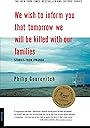
We Wish to Inform You That Tomorrow We Will be Killed With Our Families: Stories from Rwanda
Product ID: 2546207
🌍Global impact & post-genocide analysis
🏆National Book Critics Circle Award winner
📚400 pages of in-depth historical & political insight
Desertcart purchases this item on your behalf and handles shipping, customs, and support to SINGAPORE.
📖 Unlock the untold truths of Rwanda’s past — because history demands your attention.
We Wish to Inform You That Tomorrow We Will Be Killed With Our Families is a National Book Critics Circle Award-winning nonfiction work by Philip Gourevitch. This powerful book chronicles the 1994 Rwandan genocide, offering a detailed exploration of its causes, the horrific events, and the complex aftermath. Through extensive interviews with survivors, perpetrators, political leaders, and aid workers, it reveals the political, social, and psychological challenges faced by Rwanda and the international community. With over 400 pages of insightful analysis, this book is a definitive resource for understanding one of the most devastating genocides in modern history and the resilience of humanity in its wake.
| Best Sellers Rank | #25,608 in Books ( See Top 100 in Books ) #4 in Central Africa History #11 in Historical African Biographies (Books) #11 in African Politics |
| Customer Reviews | 4.6 out of 5 stars 1,532 Reviews |
P**J
Great insight
This book gives a fascinating insight into the Rwandan genocide and associated subjects like the questionable motives & destructive actions of international aid organisations & the UN (and Western governments), the broader conflict in the region in the 1990s and the social and political development of Rwanda itself. The scope of the book is broader than the genocide itself but far from being a meandering detour the post-genocide story of the camps- the Hutu extremist groups reforming in exile and the eventual return is a compelling one in itself and without it any account of the Rwandan genocide is incomplete. Not quite as necessary is the coverage of the relief organisations but I think the issues the author has highlighted are very worthwhile considering. We're used to thinking of relief organisations as infallible, benevolent and also neutral actors in disaster situations and we also take their knowledge of the situation as Gospel, yet accepting the authors views as correct, the various NGOs collectively and their staff individually were creating a very dangerous situation and had a wholly inadequate understanding of what was happening around them. Arguably they were in the process of underwriting and unwittingly facilitating a second genocide before military intervention came. Though it's an allegation not made explicitly, the author hints at a financial motive (not personal corruption I might add) to the various aid agencies continuing their work, describing the work more than once as "lucrative". Also the policies of various Western governments and the UN, whether by design or effect, were heavily pro-Hutu, even following the genocide and this is deservedly highlighted in the book. These aspects are not absolutely necessary to the narrative of the genocide itself but they're certainly not superfluous given the wider scope of the book and I think to be properly informed of the genocide you should be aware of this element of the story. I was surprised to read the criticism of the book detailed on its' Wikipedia page and I fundamentally disagree with it. While not going into a huge amount of detail of the act of genocide itself the book gives a detailed account of the political and social history of Rwanda taking complexities and nuances into account and identifies the trends that led to the genocide. I agree with the author that it's not simplistic to identify as principle villains those who destroyed a society by inducing the majority to hack hundreds and thousands of their neighbours and friends to death with machetes, even in a region as bloody as this. The author generally does take positions on many issues surrounding the conflict, whether you agree with him or not that is to be appreciated in an age when journalists (then, like now) are determined to find the middle ground on many stories even when the narrative that results is clearly ridiculous and itself biased. No doubt the fact the author takes positions will itself be described as "biased" by some but the author makes a very strong case for each of his positions and his own thoughts are not hidden in biased language or questionable assertions. The reader can make up their own mind on the authors views. The author does not delve deeply into the specific details of the killing as a whole, as he points out it was designed to look spontaneous, but you do get a sense of the sheer terror felt by the victims through the many people he interviews. Their accounts are harrowing and the accounts of the violence are bad enough but what I found most shocking was how devious many ostensibly respectable turned out to be. Their duplicity, especially when it came to old friends and neighbours, is difficult to accept on a human level. For example there is the account of a massacre in which it's alleged a preacher encouraged his co-religionist Tutsis, many known to him, to shelter in a particular Church compound before he returned with machete wielding gangs to murder them. This is a truly excellent book, my worst criticism of it would be that some sentences aren't well written and lead to confusion, and I'm glad I read it, it has engendered in me a much greater interest in this part of the world and serves as a jumping off point for many other subjects; 19th century colonialism, pre-European African society, the ongoing conflict that has claimed millions of lives and more broadly subjects like psychology and sociological areas like tribalism, social structure and so on.
W**Y
An extraordinary book!
Knowing I was going to visit Rwanda as a tourist, I wanted to have a better understanding of Rwanda’s recent history. Wow, I had no idea how much one book could contribute to my experience. In less than 400 pages, I felt I learned about as much as one could about the colonial history, the genocide (before, during, and after), as well as the culture, people, and their traditions. During my visit, the knowledge acquired from this extraordinary book allowed me to better appreciate and understand Rwanda today, as well as provided me the ability to have very intelligent and revealing conversations with many Rwandans. This was not just a book of facts and figures, but a comprehensive collection of all that were involved during the Genocide. While there are plenty of first hand accounts from the victims themselves, Phillip Gourevitch was also able to interview both Tutsi and Hutus’s as well as military leaders, clergy, NGO’s, and many others trapped in this insane period. His access to Paul Kagame, currently Rwanda’s very successful President, allowed for a perspective not typically found in historical accounts of the Genocide. The authors insight into the colonial history shows how ethnic differences were effectively manufactured first by Germany than by Belgium as their obsession with dividing and classifying the population to preserve power would culminate into this Genocide that would claim more than one million babies, children, grandparents, mothers, and fathers. Rather than a spontaneous event, the very title of this book makes perfectly clear that this conflict was not only years in the making, but very public with daily radio broadcasts and government communications speaking the necessity of ridding Rwanda of those “cockroaches”. Perhaps though what was most revealing was the deliberate indifference the rest of the world would have. Even after the atrocities, the political fear of the West to actually declare it Genocide as this would require a protocol of help and support. However, nothing quite hits you harder than the very fact that just a few thousand UN Soldiers, that was in fact requested by the commanding officer in charge in Rwanda at the time, would have avoided the majority of the killings. Instead, without even the basic machines and infrastructure of Nazi Germany, over 330 Rwandans would be slaughtered EVERY hour. A fair amount of the book also explains how the global political community post-genocide would allow France to continue to not only fund the Hutu military that kept on slaughtering, but allow these leaders a safe passage out of Rwanda and avoid punishment by establishing refugees camps along the border. Gourevitch’s also carefully writes about how one day teachers, priests, colleagues, family and neighbors that had lived together would, the very next day, slaughter their students, congregation, family members, and people they had worked with for a long time. For one of the most Christian countries in Africa – faith and religion actually expedited the genocide as thousands of Rwandans would flee to local churches where the were easily executed. Finally, the author does spend enough time on one of the few bright spots of humanity, in particular how creative, determined and successful Paul Rusesabagina of the Hotel des Mille Collines (“Hotel Rwanda”), not just saved thousands of lives, but was also one of the only source of information to the outside world. During my visit to Rwanda, it was surreal to be walking/driving on the same roads and visiting the same places that I had read about that just twenty years earlier was covered in bodies and blood. Moreover, having multiple conversations with the very same people that were either victims of dead family members, or the perpetrators of the senseless massacre left me somehow hopeful in humanity as not only was I warmly accepted by all that I met, but I could not sense a desire for revenge.
C**N
Stories of a real horror we should all know and remember
I have various views of this book. First, it is a very important account of one of the great tragedies of our time. It upsets me that we still only speak of this tragedy without enough specificity. It is too often just a conversation about the million killed in Rwanda without enough focus on who did the killing. It wasn't just a tribe against another. It was people hacking others to death. This book gets us to some of those individuals - both those murdered and those murdering - and that is the chief reason to appreciate the book and thank Mr. Gourevitch for it. However, I wish there some images in the book beyond the couple of maps. Yes, Mr. Gourevitch is a fine writer and helps us see with words. But this kind of genocide cries out for photographic documentation. Maybe there isn't any that is appropriate for the book. But I feel the lack just the same. Finally, this is an important document of the Rwandan terror, but it isn't the final story. It isn't the complete story. That has yet to be written. But I found reading this book a strange sort of nightmare. Everything seems real and it has its own frightening impetus, but it is like a dream where you want things to stop but it won't. It is horrifying and even worse because it all happened to real people and in our time. And notice how everyone runs from accountability. It seems like everyone wants to pretend someone else did it and when you find someone who actually can't run away from involvement they want to pretend it was some awful force that made people unavoidably crazy and should therefore be forgotten. What hogwash. Thanks to Mr. Gourevitch for getting these stories in print for us. I hope we burn these stories in our memory.
S**R
Hell on Earth
"For us, genocide was the gas chamber - what happened in Germany. We were not able to realize that with the machete you can create a genocide."- Boutros Boutros Ghali. Gourevitch weaves a work of nonfiction in this title that one is almost tempted to view as fiction. Such is the magnitude of horrors presented. Sadly, each and every piece of information from this Rwandan genocide is documented. Gourevitch explores in gory details the events of 1994 as well as the precursor building up of hostilities during and subsequent to Belgian colonial rule. What you will learn over the course of this book will chill you; each detail is more gruesome than the last. Gourevitch presents this in a clear, concise manner, providing optimal impact. What really struck me, however, about this work was that it is NOT wholly a scholarly, detached study of the crime. It is the story of the individuals who lived through the event, as well as of those who did not. Most striking, to me, was a passage in the opening pages of the book. Gourevitch, newly landed in Rwanda, is walking with an officer of the Rwandan army. This officer accidentally steps on a skull poking through the ground. Gourevitch is disgusted, ready to denounce the man, until he feels a crunch beneath his feet. He too has trodden upon a skull, as the hillside is littered with remains. The Hutu/Tutsi relationship was never particularly warlike. It was only upon the establishment of colonial rule, the subjugation of the majority Hutu, and the subsequent Belgian shift to support these Hutu, that created the tensions that led to the genocide in the power vacuum of post-independence. Rwanda was a tinderbox at this point, as Hutu extremists took to the airwaves, calling upon all to turn upon their Tutsi neighbors with, often, machetes. Once these extremists shot down the president's aircraft, their path was clear, as they knew help for victims would not emanate from Romeo Dallaire's already besieged UN forces (despite his best efforts) or the United States (conflict-wary following Somalia). Murder, thus, was easy in many respects. Gourevitch tells the tale of cold-blood murder, of the failure of the international community to live up to the Genocide Convention and its own humanity, but, most importantly, of the men and women who struggled for their lives in 1994. The cry of "never again" following the Holocaust may have been a false promise, but, through works such as these, we can all attempt to promise, individually, "never again," one individual at a time.
A**S
Thought provoking, and a good read too
An extremely thought provoking book. During three to four months in 1994 (roughly April through June), somewhere between 500,000 and 1,000,000 Rwandans were murdered. This was not random killing, or a declared war. Rather, it was systematic genocide of the Tutsis by the Hutu. Since there were only slightly more that 1,000,000, Tutsi's living in Rawanda when this started, Gourevitch makes a convincing argument that this massacre was far more devastating than was the only comparable event in history, the German attempt to exterminate all Jews during WWII. Several things make these events even more extraordinary (and disturbing). Tutsi's and Hutu's are essentially the same ethnically. The differences are largely class distinctions, imposed by the Europeans who colonized the area, and created a myth that those in the native population who looked more "European" were from a superior racial group. They were then given greater access to education, government jobs, etc. After a couple of generations, the so called Tutsi's became the superior class, because of the favoritism of the powers that be. Nonetheless, Hutu's and Tutsi's continued to intermarry, live together, etc. This leads to the second point, which is that the genocide was largely committed by friends and relatives of the victims. The third, and closely related, point is that this was not a case of high tech, anonymous slaughter. There were no gas chambers, or high altitude bombings here which served to "insulate" the murderers from their victims. Instead, they literally hacked their neighbors to death with machetes. The final thing is that, after the genocide ended, the Tutsi's returned to power. The second half of the book explores the efforts of the new government to strike a balance between justice, the desire for revenge, and the need to move the country toward normalcy. As the author points out, virtually no one in the country was untouched. A very large percentage of the populace was directly involved in the genocide (each victim was often killed by a mob, so there may well have been more killers than victims). Everyone had a close relative who was either murdered or a murderer. This is the first time in history that the murderers and victims have made any attempt to recreate a county in which they have to live and work side by side. The final point is that the international community completely ignored this entire episode, and in fact immediately complained that the victims were "harping" on the genocide instead of "moving on." All of the aid was focused on the surviving murderers, who fled Rawanda to avoid justice, and virtually none (for at least the first 2 years) was given to the survivors. The questions posed, but not really answered, are what makes a person act this way? This question, of course, applies not only to Rawanda, but also to Germany (Hitler's Willing Executioners is an excellent companion to this book). Even more fundamentally, the question applies to slavery, and the subsequent history of race relationships in this country. Only by believing that slaves were somehow not "really" human could the slaveholders justify their own actions, to themselves and to the world. On a broader scale, the question also applies to war in general. Recall how US soldiers were notorious in dehumanizing the Vietnamese--gooks, etc., as a way of allowing them to kill at will. A powerful and thought provoking book.
R**R
Excellent!
I have written only a couple book reviews, you will be able to tell, I’m afraid, but because this book was so profound, I’m trying. I read the book, Left to Tell, by Immaculee Llibagiza, several years ago. This story, written by a survivor of the Rwandan genocide, shocked me and broke my heart. It also alerted me to the power of the media and propaganda to bring out and manipulate the evil in man, even in these modern times. I needed to know more because I realized that those tactics could be being used in our society today. When I saw We Wish to Inform You That Tomorrow We Will Be Killed with Our Families, as a book choice, I bought it, hoping it would help me understand how the Hutus could committ such unimaginable acts of atrocity on their friends, patients, children etc., and what happened in the aftermath. This book was amazing! Philip Gourevitch’ investigative journalism and the depth of his ability to assimilate facts, world view, sociology, psychology, criminology, interviews, and to discern are incredible. He answered my questions. To me, his book was perfect, accept for the title and book cover.
I**T
Meticulously researched and an interesting read
This book was full of facts and the research was impeccable. Might read a bit dry for some. I was never aware of the hijacking phenomena that went on during this time in history. I enjoyed the read, though it did get a bit dry. This is not your typical 'true crime book." Could be handy for research!
D**K
Fantastic non-fiction for those interested in more depth to the Rwandan conflict
This book is extremely well written on many levels. It strikes a delicate balance between history and memoir, giving a fairly complete post-colonial history of Rwanda and the surrounding areas, along with more individualized accounts from survivors of the genocide. What I appreciate the most is the authors fearlessness with which he addresses nitty-gritty of the problem behind the conflict. While the media often uses broad strokes to paint the violence as simple ethnic hatred created by a European based class system, Gourevitch shows there's so much more below the surface. In addition he is one of the first authors I've seen to focus on the dilemma of reconciliation. When the perpetrators of a grave crime make up the majority of the population, how do you deal with them? There's not enough lawyers on earth to prosecute everyone, but failing to provide justice means genocide survivors may be living next to the very people who killed their entire families. These questions are very hard, but they are precisely the issues we need great minds and good people working on. Gourevitch doesn't have all the answers nor does he claim to, but he provides a compelling narrative which is both accessible and deep, and is one of the better non-fiction books I've read all year. -- as a side note, this book is a great companion to dancing in the glory of monsters, which covers the Congo conflicts in some ways directly related to the Rwandan genocide.
マ**ー
ルワンダの大虐殺
1994年のルワンダでの大虐殺についての本です。植民地時代から, 1997年頃までの大虐殺後の混乱(政治的混乱やキャンプやその他で の小規模な虐殺)が続くルワンダと周辺国の情勢について、一通り の知識を得ることができます。 特に,印象的であったのでは,難民ミャンプを支援する援助団体が, ルワンダから逃れてきた犯罪者を結果的に支援することになり,事 件後の混乱を長引かせてしまっていたことです。こういったことは, 我々が持つ「難民」という言葉からはイメージしにくい状態で,新 聞記事で難民ミャンプといわれても,中に武装したグループが力を 付けていったとは絶対に分からないでしょう。この本では,その辺 りのこともうまく描かれており,具来的なリポートならではです。 しかし,この地域は,これからどうなっていくのか。 かつては日本や欧米でも内乱やら虐殺事件等の歴史を経て,現在の なんとか安定した社会を形作ってきたのだと思いますが,アフリカ では今がその安定化した社会への過程なのだろうか?
P**Y
A wonderfully-written book on the Rwandan genocide.
I have been interested in the Rwandan genocide because my Barnard anthropology prof, Miss McLellan told her class in 1960, that there would be a blood bath there. She had done field work in Rwanda several years earlier. Also, I heard Romeo Dallaire speak when he came to Yellowknife about 10 years ago. This book was fascinating to read. The author has gone to great lengths to tell a very in-depth story. I feel so much better informed about this topic now that I have read his history of the genocide.
P**N
Must read
Must read to understand the hard realities of the world. Should be read by everyone to ensure it doesnt happen again, anywhere in the world
L**S
ONE OF THE BEST NON-FICTIONAL ACCOUNTS OF THE 1994 RWANDAN GENOCIDE!!!!!!!
THIS IS ONE OF THE MOST DEVASTATING ACCOUNTS OF THE RWANDA GENOCIDE OF 1994. THE WRITER, PHILIP GOUREVITCH, DOES A LOT FOR THE INCREDIBLE "THE NEW YORKER" MAGAZINE. I CAN'T RECOMMEND THIS ENOUGH - IT'S SO FORENSICALLY DETAILED ABOUT WHY THE HUTU MAJORITY KILLED OVER A MILLION OF THE MINORITY, IN A MERE THREE MONTHS WITH MACHETES!!!!!!!
C**N
Must read
Really good book
Trustpilot
3 days ago
4 days ago