

🔥 Melt like a pro, solder like a boss! 🛠️
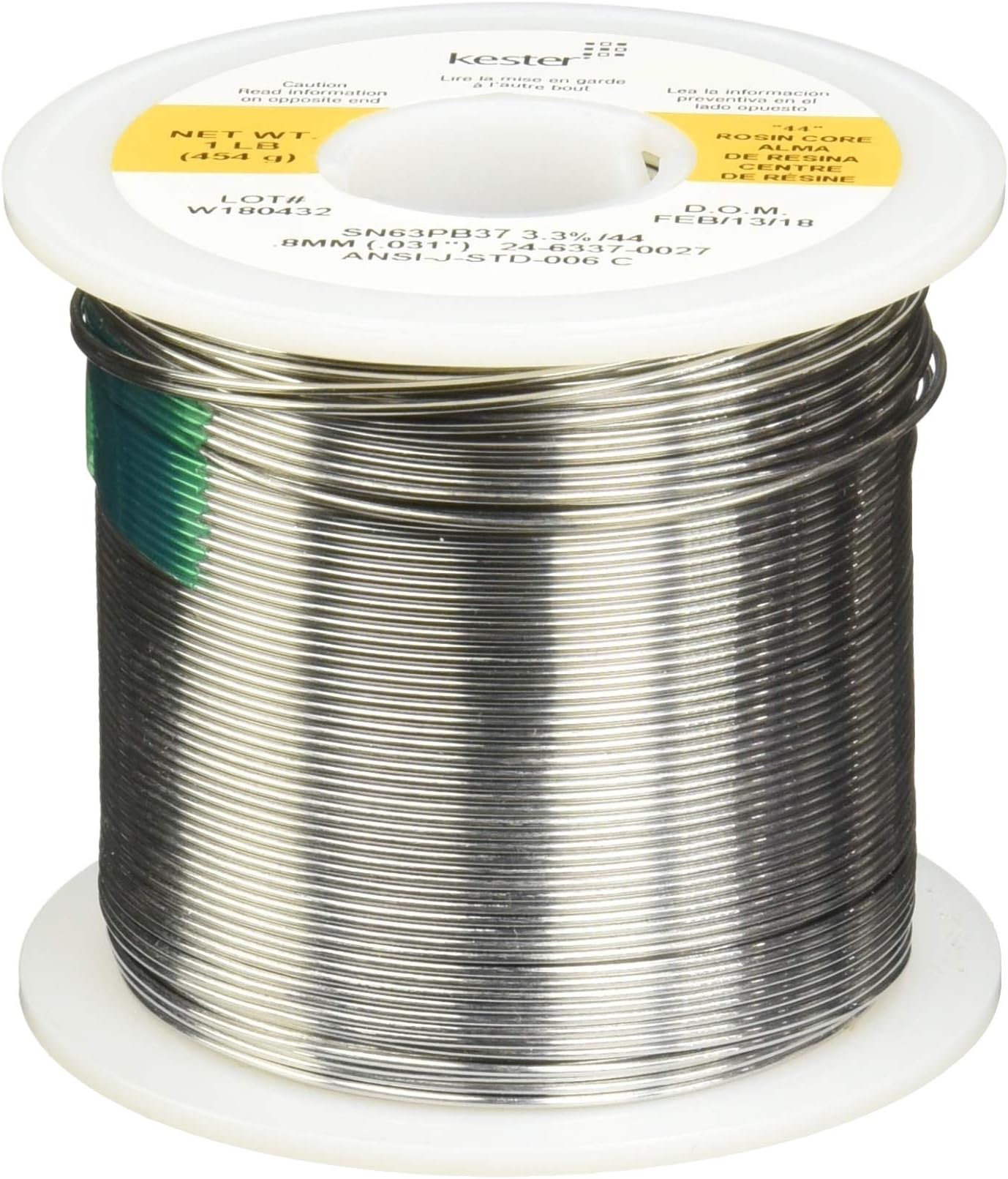
Kester 24-6337-0027 is a premium 63/37 tin-lead eutectic solder roll with a 0.031" diameter core size 66, designed for professional and hobbyist electronics work. Its precise alloy ratio ensures instant melting and solidification for strong, reliable joints, while the large 1 lb spool offers excellent value and longevity for extensive projects.
| Customer Reviews | 4.9 out of 5 stars 862 Reviews |
K**R
Good solder! Buy some!
Great product for RC modelers and electronics hobbyists. This is a good value in a big, economy-sized spool which should last me a year or two. A dispenser is a good idea; this roll is much heavier than a standard hardware store pack and can be hard to manage. Mine likes to jump off of my table and go for a joy ride at the most inconvenient times, rolling across the room trailing wire. I guess another option would be to transfer some to a smaller spool as you use it. This .031" diameter is a pretty good compromise size for cables ranging from 28 to 12 AWG. It will even work on fairly roomy circuit board pads; however, I generally keep a small supply of thinner-diameter solder on hand for that kind of work. When I started out soldering cable harnesses, connectors etc. for my models, I found it pretty frustrating. As we know, the goal is to get the solder nicely liquefied so it will flow freely through the work, then keep things very still while it cools and solidifies. I found that, as I heated the cable and applied solder, it tended to soften, but getting it to melt completely enough to flow into the twisted wires - especially on bigger cables - wasn't easy. Instead I'd get a mushy glob that would sit on the surface without making good penetration. Then, when I was ready to let it cool, it seemed to take forever to solidify, making it hard to keep everything steady. As tempting as it may be, in such cases, to just stick the ends of the wires into a nice big glob of half-melted solder, let that cool and hide the pathetic result under a wad of electrical tape, the end product will NOT be a strong, reliable connection, able to withstand the necessary current without heating up, and may fail completely. Ask me how I know! Well, it turns out that the answer is in the choice of solder. For some reason, none of the instructional materials I studied early on even mentioned one of the keys to happy, safe soldering work. It lies in the concept of a "eutectic" mixture or alloy. For any combination of two or more metals, there is a certain ratio between the amounts of each which, when combined, yields an alloy with the lowest melting point possible. In the case of lead and tin, an alloy commonly used for electrical soldering, that ratio is 63 lead and 37 tin. That's the ratio used in this solder. The practical result, and the reason why a eutectic solder mix works so well, is that when it melts, it goes directly from the solid to the liquid state or "phase". When it cools and solidifies, it does the opposite. The intermediate state, known in technical terms as a "glob", is completely skipped! When it gets hot enough, whoosh! It instantly liquifies, and flows beautifully into the cable ends and/or onto the connectors. (Remember to always heat the cable or connector first, and let it heat the solder!). Remove the heat, maybe blow on it gently for a second, and whoosh! It's back to a nice, shiny (which is what you want) solid. A strong, reliable electrical connection is born. Just try it, you'll like it. Unfortunately, if you look at the labels of the majority of solders sold in hardware stores, you'll find that the lead/tin ratios are 60-40, not the "magic" 63-37. I have no idea why the 60-40 is even made, though if I had to guess, it may be because the "glob" state is desirable for certain types of users - plumbers, for example, or lazy electricians who prefer the "stick wires ends in glob" method described above. Just don't be that guy/gal, unless your fire insurance is paid up, and you're ok with watching smoke pour out of your electric model aircraft in the seconds before impact.
J**P
Great solder!.. And some tips.
I've been soldering off and on since I was 8 years old, and son to an electrical engineer, and now I'm one myself. So I feel qualified to review solder. Firstly, when looking to purchase solder for your electronic projects you want to make sure your solder meets the following criteria: - If using lead based you want either 63/37 or 60/40 for a nice even melt - A flux core or multiple flux cores - A quality brand (Kester, Multicore, etc) You want to avoid the "Won-Hung-Lo" discount brands and bite the bullet and invest into a quality solder product. Your solder joints should be shiny and silver in color. If your solder joints are dull and grey or off silver or pitted.. You are using the wrong solder. I recommend Kester or Multicore solder as they are both consistent performers and both are quality products. I also highly recommend a good temperature controlled soldering iron. It doesn't matter if it's analog or digital but don't skimp on your iron either (Hakko or Weller, and not the type you plug directly into the wall). This particular thickness of solder is suitable to thru-hole and large component soldering. However if you intend to solder surface mount you will want a smaller thickness of solder anything .020 or less is more suited to SMD (or solder paste and a heat gun). You won't be disappointed with the quality of the Kester solder products.
S**E
Plumbum.... A "other Metal" by any other name would smell just as sweet.
Have you ever wanted to solder micro PCB transistors and resistors like a demi god/ robot? Then this solder is for you. Do you want a lead solder with a competent flux that will bond your connections like a champ, and give off fumes with the sweet taste of Bismuth salts and antimony that pairs nicely with a glass of Montepulciano or a Sanghiovese? Then this flux core is for you. Do you want to live as long as possible and keep your sperm count up? Then maybe you'd prefer a Rohs solder, and after throwing it across the room you'll realize: laboratories and electronics are not for you. We all die sometime, we're surrounded by death. No need for the constant reminder from our electronic devices that die before their time, due to inferior Rohs compliant solders. Women like mysterious dangerous men, and what could be more dangerous than a man who breathes fire and lead fumes? Nothing. Take it from me: a scientist; put a roll of this bad boy in your laboratory and watch the panties drop. Now I know what you're thinking: "we have a disparity in the sciences, with too few women taking degrees in the hard sciences thanks to years of uninformed dogmatic gender role ascribing women to careers other than the hard sciences. Now we're paying the price. Do you realize how hard it is to get a lady in your laboratory?" Well, true. And no. I don't. because I use spools of lead solder. Fact: women are drawn to the sweet smell of Bismuth salts and the pheromones excreted by a man with acute lead toxicity coursing through his veins are unmistakably unique. It intoxicates their senses, they're drawn on a genetic level to procreate with you *immediately* because, with lead, there might not be much more time. Pretty sure Darwin mentions the mechanics of this exact biological drive in his work "The Expression of the Emotions in Man and Animals" but I wouldn't know. I'm a real scientist, not a biologist so I've not the time to read such quackery. What I do know about women I've learned from observation and captain Kirk. From observation I can assure you, heat up some of this solder, sit back and watch the women come in droves. Your lab will make Hugh's house look an all boy's academy. Hang another roll from your review mirror. Trust me. This solder will save us from the gender disparity in the sciences. It will save future generations. But, don't wait, copulate. After all, it is lead bearing solder, so there's not much time. I will continue to buy this solder.
J**T
Just get this solder and use it.
So, I had been building electronics, fixing guitars, doing synth work for two decades before I switched to this stuff from various generic other solders (whatever the store had on hand). All I can say is that I would have saved myself some time and work if I had used this and a temp regulated iron from the beginning. It's night and day, life changing, hours saving, and more satisfying in the end (turns out my soldering tech isn't as bad as I had always thought it was. Switch to good tools and I get a solid, good-looking joint every time). I have also tested this with a good quality (goot) non-temp-regulated iron and it's still very good. Just, learn from someone else and buy great tools from the outset or don't solder. Soldering is a way more fun and easy experience with the right tools. This solder is one of those right tools. I don't really see how you could do much better than Kester 44 if you're buying electrical solder in this spec. So, I'm giving it five stars all around.
B**N
Very clean
While using this I noticed how easily it liquifies and flows to the joints. Very clean and professional look. Best solder you can get for the price while having very high performance at the same time.
R**G
Easy to solder, low melting points
Soldering cannot get any easier. I tried other cheap brand and had hard time make it pretty and shiny but failed. Besides I had to turn my iron to 350-380 to work on those. With Kester, at 330c (or even less), you can get shiny joint and you dont even need extra flux since it already provided in the core. Defiantly will only use this
B**K
Works great
I'm not an expert, all I did was reading reviews and watching training videos before picking this brand, type, and diameter of soldering wire. Kester seems to be pretty much the industry standard, or up there with few others, and my experience so far has met those expectations. With a bit of trial&error, I realized that my soldering iron was hotter than it needed to be. I turned it down a notch, and now things work much better: good solders, iron tip stays tinned and doesn't oxidize as quickly, and almost no smoke. At these lower temperatures, I kind of like the smell of the core flux vapors! If the core flux get hot enough to burn, then, yeah, that acrid smoke is really nasty.
D**K
Good stuff 💯
Good brand name known product that performs as expected
Trustpilot
3 days ago
2 weeks ago