The Cigarette: A Political History
Product ID: 115795800
Desertcart purchases this item on your behalf and handles shipping, customs, and support to SINGAPORE.
desertcart.com: The Cigarette: A Political History: 9780674241213: Milov, Sarah: Books Review: The Politics behind Tobacco - Provides a history of the cigarette during past century but more importantly the politics behind big tobacco that led to the dominance of smoking in our society. Although smoking is on a decline, it still remains a number one killer with over half a million deaths from smoking and related lung issues. It’s equivalent to a jumbo jet crashing each day with no survivors for one year. That’s a lot of unnecessary deaths. More people die each year than all the deaths in Vietnam. (50k) As a society we went nuts over the carnage then but say very little about the deaths from smoking & related lung issues like cancer etc. so to find out how complicit government is with regard to smoking and the industry that perpetuates it is both shocking and sad to take heed. This is a must read for anyone who wants to be enlightened about social smoking and its affects upon our society. Review: Big tobacco, farmers, and the government all in one story - what a great idea! - Sarah Milov has crafted what she terms "a political history" of the cigarette, and she has pulled this off with remarkable aplomb. By largely omitting the consumer from her story, Milov has shown us what an ugly business politics can be and how big tobacco and the farmers were in the midst of that political arena. Milov starts with early tobacco industrialization, but really brings home her point when talking about the New Deal - this is where the political action really starts, with one of the AAA (Agricultural Adjustment Act) and how the tobacco subsidies started. Deftly maneuvering through the course of the 20th century, Milov helps the reader to understand how big tobacco and big politics mixed to create the America we saw in the 1980s and into the 90s. She sprinkles in legal cases to help make her point about tobacco becoming mainstream political fodder during the course of the 20th century. By explaining how "non smokers" rights came to be, she provides the reader with plenty of examples of how politics played a huge role in the growth of the tobacco industry. Although we don't yet know what the future of tobacco will be, we know that a much smaller percentage of Americans smoke today than did 75 years ago. We also know that all the money that the big cigarette manufacturers started paying out after the 1998 Master Settlement Agreement has not yet been dedicated largely to the intended purpose of smoking cessation, thus opening the door for the comeback of the cigarette.
| Best Sellers Rank | #1,232,877 in Books ( See Top 100 in Books ) #43 in Agriculture & Food Policy (Books) #138 in Agriculture Industry (Books) #10,899 in United States History (Books) |
| Customer Reviews | 4.2 4.2 out of 5 stars (67) |
| Dimensions | 6 x 0.5 x 9 inches |
| Edition | Illustrated |
| ISBN-10 | 0674241215 |
| ISBN-13 | 978-0674241213 |
| Item Weight | 7.4 ounces |
| Language | English |
| Print length | 400 pages |
| Publication date | October 2, 2019 |
| Publisher | Harvard University Press |
A**N
The Politics behind Tobacco
Provides a history of the cigarette during past century but more importantly the politics behind big tobacco that led to the dominance of smoking in our society. Although smoking is on a decline, it still remains a number one killer with over half a million deaths from smoking and related lung issues. It’s equivalent to a jumbo jet crashing each day with no survivors for one year. That’s a lot of unnecessary deaths. More people die each year than all the deaths in Vietnam. (50k) As a society we went nuts over the carnage then but say very little about the deaths from smoking & related lung issues like cancer etc. so to find out how complicit government is with regard to smoking and the industry that perpetuates it is both shocking and sad to take heed. This is a must read for anyone who wants to be enlightened about social smoking and its affects upon our society.
E**T
Big tobacco, farmers, and the government all in one story - what a great idea!
Sarah Milov has crafted what she terms "a political history" of the cigarette, and she has pulled this off with remarkable aplomb. By largely omitting the consumer from her story, Milov has shown us what an ugly business politics can be and how big tobacco and the farmers were in the midst of that political arena. Milov starts with early tobacco industrialization, but really brings home her point when talking about the New Deal - this is where the political action really starts, with one of the AAA (Agricultural Adjustment Act) and how the tobacco subsidies started. Deftly maneuvering through the course of the 20th century, Milov helps the reader to understand how big tobacco and big politics mixed to create the America we saw in the 1980s and into the 90s. She sprinkles in legal cases to help make her point about tobacco becoming mainstream political fodder during the course of the 20th century. By explaining how "non smokers" rights came to be, she provides the reader with plenty of examples of how politics played a huge role in the growth of the tobacco industry. Although we don't yet know what the future of tobacco will be, we know that a much smaller percentage of Americans smoke today than did 75 years ago. We also know that all the money that the big cigarette manufacturers started paying out after the 1998 Master Settlement Agreement has not yet been dedicated largely to the intended purpose of smoking cessation, thus opening the door for the comeback of the cigarette.
A**N
An American history of the cigarette
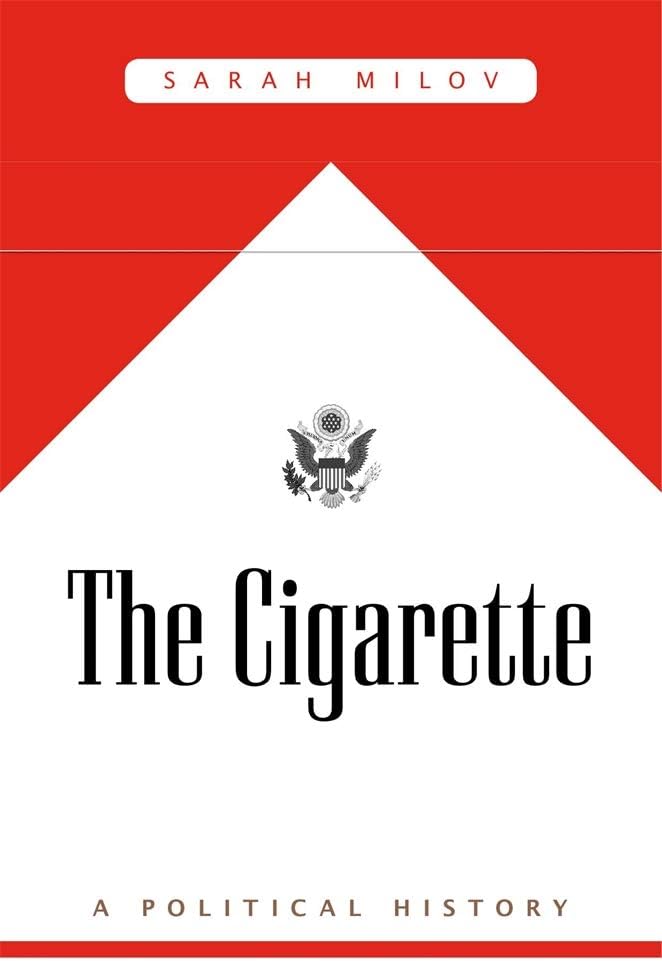
Fresh off reading “The Empire of Cotton,” and having recently digested “Red Meat Republic,” I naturally reached for “The Cigarette.” This is a less ambitious book, with no pretenses of telling the history of capitalism from the angle of a single product. Instead, author Sarah Milov is content to actually tell the history of the cigarette in the US, from its invention in the late nineteenth century and its promotion by the American government, all the way through its demise in the late twentieth century. The book starts in medias res, with the release of the Surgeon General’s Report on Smoking and Health in January of 1964, which marked the peak for the cigarette. This is but a flourish. The history is then mercifully told in chronological order. First you find about how the American Tobacco Company came to dominate its field, establishing a trust as powerful as anything JP Morgan or the Rockefellers ever dreamt of, then (a bit) about the challenge cigarettes faced alongside alcohol from prohibitionists, then about how WWI saved the tobacco industry when cigarettes were included in soldiers’ rations and from there you’re ushered to the main topic and theme of this book, the relationship between the New Deal, the institutions of the New Deal and the cigarette industry: the Iron Triangle of 1. growers and manufacturers (the Tobacco Industry) who provided the votes and campaign contributions 2. Congress, which enacted the necessary legislation and 3. The Bureaucracy that actually made the rules. You find out about the system that was built around the allotments, which became the same thing as a taxi medallion, government-organised price support cartel with its annual referendum, the creation of an international market for American flue-cured tobacco through heavy government intervention and the Marshall Plan. If acronyms of agencies is your thing, you’ve come to the right place. Same if you want an understanding of how politics and business were lumped together during the early days of the Cold War. This dance does get brutally interrupted when cigarettes turn out to be deadly and the book morphs into the story of how it all slowly comes apart. From there you get to know Hill and Knowlton and Jesse Helms, John Banzhaf’s ASH, Clara Gouin’s GASP and nonsmokers’ rights, but also C. Everett Koop, an unlikely crusader against the cigarette. And then, disappointingly, you fast-forward to the settlement with the States. It’s a bit weird, because the amounts concerned make a huge leap from 50 million to 200 billion and it’s clear you’ve missed many episodes. Read this on the plane, chiefly, but I’m pretty sure something happened here and the book was rushed to print. Still, reasonably good and the jacket will never be topped. I always kept a bookmark sticking out the top.
M**D
Fantastic look into the politics of big tobacco.
A thorough look into how big tobacco got big and the people it affected. A solid read.
C**N
Guess I ordered wrong
Thought I ordered cigs but only got a pamphlet.
A**E
Perfection
Very well written with great attention to detail.
V**N
Long and detailed. Hard to read.
A very useful guide to the cigarette story. However, is reads as if it were a Ph.D thesis. The other problem is that the type is very small and light. Thus the contrast with the page is not very much. This make it hard to read. I wonder if the decision not to use a normal normal size type was to keep the book from having more pages. If the book is reprinted I would make it shorter and use a more normal size type.
K**S
Captivating historical account of the rise and fall of the cigarette in US society
This book is a captivating historical account of the rise and fall of the cigarette in US society. Milov writes with such clarity and interest about the inner workings of government support for tobacco dating from before the New Deal, and the successful tactics of the grassroots non-smoker movement, and what each side says about the values of American culture. This book provides many important lessons about how power is structured, which can be applied to many of today's public health battles.
Trustpilot
1 month ago
1 week ago