We remain fully operational. Our teams are working around the clock to ensure your deliveries continue safely.

下载应用程序




Buy anything from 5,000+ international stores. One checkout price. No surprise fees. Join 2M+ shoppers on Desertcart.
Desertcart purchases this item on your behalf and handles shipping, customs, and support to SINGAPORE.
⚡ Power up your monitoring game — never miss a watt or a volt!
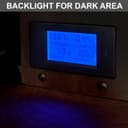
The DROK DC Power Meter is a versatile, high-precision multimeter designed for DC voltage ranges from 8 to 100V and currents up to 100A. Featuring a large LCD display, it simultaneously shows voltage, current, power, and accumulated energy with data retention on power-off. Its customizable over-voltage alarm and switchable backlight make it ideal for RV battery monitoring, solar power systems, and other DC applications requiring reliable, real-time power analytics.



| ASIN | B07KPXVNY5 |
| Best Sellers Rank | #119,633 in Tools & Home Improvement ( See Top 100 in Tools & Home Improvement ) #157 in Multi Testers |
| Brand Name | DROK |
| Color | Blue |
| Customer Reviews | 4.3 4.3 out of 5 stars (1,110) |
| Included Components | no |
| Item Dimensions | 3.53 x 1.95 x 0.96 inches |
| Manufacturer | DROK |
| Measurement Type | Ammeter, Multimeter, Voltmeter |
| Minimum Operating Voltage | 8 |
| Model | 200141 |
| Power Source | Battery Powered |
| Style Name | 100A |
| Unit Count | 1 Count |
J**Y
Great meter, all the information you need.
Works great, tested against another meter and readings are extremely close. Great addition to my 290w 36v solar panels. Mine shuts down around 5.9v, but it remembers the cumulative energy. UPDATE: After 4 months, it started reading wildly high voltages, current was still correct. Finally I contacted DROK, and they wrote me a helpful email within 24 hours. Bonus points for them for being responsive and knowledgeable. The 20A version can be recalibrated. The difficult parts are soldering a switch to the internal contacts on the board and finding a 20.0v 1A power supply and 20 ohm 20w resistor. I did, and it calibrated within about 5 seconds. Dear customer, If it is possible, would you please try to calibrate it with following method. 1. Turn off the power supply. 2. Connecting power supply (20V/1A) and load. 3. Short connect two calibrating spots (Open the back cover, you can find two holes which marked by “W” on the edge of board) 4. Turn on the power supply. 5. When the screen display changed from “CAL---“ into” ---PASS”, that means the calibration is finished. Any more questions, please let us know. Best regards, DROK
J**C
Easy to install works as designed.
Added a 12v RV AC unit and wanted to monitor the amp draw. What a simple and great monitor. Easy to wire and use for battery draw tracking.
H**R
Best cheap shunt on the market.
I've got a few of these in my go boxes and RV. I love that they are simple, basic and just work. I also love that they have a watt hour use meter that can be reset to count again. A feature all shunts should have, but most don't. It's fairly accurate when measured against my Fluke 289 but off a few 10s of mV. It has higher resolution at 10mV and 10mA than most shunts. I wish it had "bi directional" readings so could read charge and discharge and I wish the shunt itself had holes in it to better mount. Lastly the 50A version is no longer available, but great for smaller installs. But even with the small draw backs this is a great shunt for the money. If you are wanting bi directional or SOC (which is never really accurate anyway) this may not be the shunt for you.
D**E
Great value in this inexpensive meter.
The meter works as advertised and for the price it has excellent value. Note that the current meter is in the negative side between DC IN - and Load -. This is important if you use a switch, like I do, to change the meter's polarity between charging and discharging a battery. The current meter will not run backwards. In other words, the meter will only increase its reading when positive current flows in the direction of DC IN + to Load +. Current will flow in the other direction, but the power and current meters will not read negative values, and the Watt-hour meter will not decrease its reading. To use the meter to monitor power from a solar panel to a battery, I connect the solar panel to the DC IN + and DC IN - terminals, and the battery itself to the Load + and Load - terminals. When discharging the battery into the intended load, I reconnect the meter (using a switch) into its conventional connection topology. Since the current meter is in the negative side, DC IN + and Load + are connected together in the unit. In other words, they are the same node. The unit is made to mount in a square hole in 0.032" thick material. I used a thin bead of Silicone adhesive around the bezel to strengthen this mechanical connection. The operation of the screw terminals can be confusing, and can lead to damage if one is not careful. They come tightened down, so to connect a wire first loosen the terminal by turning the screw counterclockwise several turns, insert the wire in the gap that's just been opened, and then tighten the screw in a clockwise direction. I verified that the terminal block will accept 12 gauge wire.
R**S
Worked very well in my portable solar power system
So I bought this as an indicator for a 24 volt solar power system built into a tote. I found that it worked very well although as others have mentioned, it needs some sort of enclosure so I designed and 3D printed a suitable housing for the shunt. This worked great for me. One thing to keep in mind is that the quality of the wire connections to the shunt and the battery are really critical as far as accuracy. The shunt itself is only a few milliohms of resistance and the voltage drop across that is very small, so the slightest bit of extra resistance introduced by a substandard connection on one of the wires will completely throw the readings off. Use really good quality crimp ons and then solder the wires after they're crimped. If you do that and follow the installation instructions to the letter, there shouldn't be any issues with accuracy. I don't know about longevity at this point but for the price this is a really good meter.
M**T
A nice meter
This meter does a good job for my purpose. I bought it to monitor the charging voltage and current for my ebike. You must hookup the wires per the instructions or you will not get a correct reading. I experimented with the hook up to see what would happen and it makes a difference. This meter does not actually monitor the current directly. It measures the voltage drop across the shunt and it is important that the shunt is the last part of the circuit per the instructions. I 3D printed a case to contain all of the wiring and it turned out to be a good tool for my needs.
H**N
Good quality meter for a good price. Works very well when I connected it to my E bike charger.
M**C
c'est mon 3 ou 4ième que je commande et maintenant que le bouton est plus facilement accessible, c'est super.. moi aussi (comme un autre a mentionné) j'aimerais qu'il puisse lire le courant dans les 2 sens (avis aux conepteurs!).. pour ma part, je n'utilise jamais le "Shunt" de 100 amp mais toujours celui de 50 amp (via un autre fabricant si non disponible dans cette version sur Drok) car le "'Shunt" 50 amp est monté sur un support isolant, ce qui est bien plus facile à monter sur un boitier métallique.. dans le menu, après "Clr" en tenant le bouton enfoncé vous verrez "Cur" (pour le courant) qui est configurable 50 ou 100 amp.. mes unités vont toutes bien et la calibration voltage/current est bien précise..
G**G
PROs: Good price. Works great. I love the on/off back-light display. Very accurate numbers (matches very close to my high quality multimeter). I use it on a 12VDC battery/solar powered iPod charger/stereo external speaker amplifier system (camping). The unit itself consumes 0.8mA @12VDC with back-light off and 2.8mA @12VDC with back-light on. I have an external switch so I can monitor solar power in OR load power out. Cons: Only con is that the current unit resolution is too large. The 0-20A minimum current that it reads is 10mA (10,20,30 etc). I would have liked it to have 1mA range, or better yet Selectable: 0-19.999A range with 1mA resolution and a 0-1.9999A range with 0.1mA resolution. (Power and W.Hr to scale by 10 also).
G**E
I love how easy and convenient this device is! There is no setup required at all since the shunt is built in, you just plug in the power and run your load through it and it does the rest for you! It is fairly responsive as well, showing any fluctuations in the ratings in real time.There may not be a mounting bracket, but there are two clips on the sides that will hold it in place if you put it through a slot cut to its size, which isn't too hard to do as its just a simple rectangle. The terminals are a bit close to the clips though so depending how you mount the wires, they might make contact with the surface the device is mounted to.
B**N
Very accurate and easy to read. Highly recommend. Helps to keep your eye on the battery discharge level if you know the capacity of your battery. Good for D.I.Y. E-bikes. For example if the battery is 10 Ah and 36 Volts multiply by 10 = 360 watt hours of energy. If you see on your display 180 Wh your battery power was depleted to 50%. This information can be reset to 00 Wh after the battery was recharged.
TrustPilot
1 周前
5天前