We remain fully operational. Our teams are working around the clock to ensure your deliveries continue safely.

下载应用程序




Buy anything from 5,000+ international stores. One checkout price. No surprise fees. Join 2M+ shoppers on Desertcart.
Desertcart purchases this item on your behalf and handles shipping, customs, and support to SINGAPORE.
🎶 Amplify your sound squad — power, control, and clarity in one sleek amp!
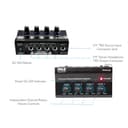
The Pyle PHA40 is a professional 4-channel portable headphone amplifier featuring four balanced ¼” TRS output jacks and a ¼” TRS input. It powers up to four headphones simultaneously with independent volume controls, delivering superior audio quality through ultra-low noise amplification. Compact and lightweight, it’s ideal for studios, live performances, or group listening sessions, offering an affordable yet powerful solution for multi-user audio monitoring.


| ASIN | B003M8NVFS |
| Amplifier Type | Tube |
| Audio Output Mode | Multi-Channel |
| Best Sellers Rank | #47,754 in Electronics ( See Top 100 in Electronics ) #92 in Headphone Amps |
| Brand | Pyle |
| Color | BLACK |
| Compatible Devices | 6.35mm jack |
| Connector Type | 6.35mm Jack |
| Customer Reviews | 4.3 out of 5 stars 2,711 Reviews |
| Enclosure Material | Plastic |
| Global Trade Identification Number | 00068888901468 |
| Item Type Name | 4-Channel Portable Stereo Headphone Amplifier - Professional Multi Channel Mini Earphone Splitter Amp w/ 4 ¼” Balanced TRS Headphones Output Jack and 1/4" TRS Audio Input For Sound Mixer - Pyle PHA40 |
| Manufacturer | DJ Tech Pro USA, LLC |
| Material | Plastic |
| Mfr Part Number | PHA40 |
| Model Name | PHA40 |
| Model Number | PHA40 |
| Output Channel Quantity | 4 |
| Power Source | Corded Electric |
| UPC | 807030494850 163120742103 806293906964 163120507566 809385665329 808112745730 115970698574 763615953610 068888901468 112840354011 887478969103 031111133974 100177379357 012304061106 902215736685 100177371429 809186270425 804066561235 809185813821 151902962160 168141354526 |
| Unit Count | 4.0 Count |
| Warranty Description | 1- YEAR |
J**N
Awesome Amp
So far I have only tested with one of the line outs but I will be testing the other soon with additional headphones and cords. Quality is outstanding, I compared several headphones on output 1 and compared with a Polk Surround Bar, even modest over the ear headphones sound as good or even better then the 300$ Soundbar. I feel the quality of the amp is more then adequate as the audio sounded rich and clean to my ears. Obviously headphone quality varies dramatically and I tested with the Sony MDR ZX300 my old ISymphony Noise Cancelling and the Seinhesier HD 201. The change in headphones was very interesting to pick up the small differences in the similarly priced headphones. I thought the bass response on the Sonys was nice but I like headphones that fully enclose the ears to block out noise, amazingly scenes with thunder and base were very good, better then the subwoofer was producing. Surprisingly the Sonys were not bad for the price still I expected a little more based on the reviews I read. To get much better performance you need to likely spend at least 70$ and I would love to test the Sony 7506's at some point in the future. Back to the Amp, it serves its purpose well, volume only needs to be at 1/3 for the Sony headphones to be loud, plenty of power for all the Cans I tried. Looks nice and volume controls work well being on top. You will likely need 1/4 adapters as this unit takes full size plugs. Really no complaints for the price, I needed an amp to go from my Digital to analogue converter so I could get audio of my TV on headphones, this way the kids can sleep and I can use my new Plasma to watch some movies at night. For now I'm outputting from my Sony Bluray player which has a Coax digital out while I wait for my optical dual output adapter to arrive. Once that's in I will be able to have audio on the sound bar and headphones at the same time from all inputs to the TV. Figured it was better to go dual output then use a Toslink switch. Its surprising to me that some TV's now only have a single digital optical output. Anyways to sum up, for 17 bucks you get an amp that powers four sets of headphones from a single 1/4 stereo jack source, just make sure to buy some adapters and long cords or hook up your wireless headphones and you should be all set. I imagine this unit would also work well for labs and you could also further split with y adapters, I did this briefly so I could compare two headphones side by side, you will need to obviously crank the volume up though if your driving two sets of headphones from a single jack. I imagine ear buds would need very little juice to power, mine were all over and on the ear sets and had plenty of power from the amp.
H**E
Outstanding value - just be aware of its limitations.
I believe several of the negative reviews should be taken with a grain of salt. Likely some of the users are simply not connecting things properly (e.g. several comments about only the left channel working suggest plugs not fully inserted, likely the 3.5mm plug is not completely inserted into the 6.3mm adapter, as many of the adapters require significant force to make the correct connection). I do sympathize with users who have legitimate problems with non-functioning units, as the price is so low as to make shipping costs for repair or replacement hardly worth the bother. But then, we should be happy that the price is so low! This is a low-power unit, not intended for speakers, and not really great with low-impedance (e.g. 8-ohm) headphones. Even with 32-ohm and higher headphones, you will likely be disappointed if you want to really crank up the volume to eardrum-splitting levels, particularly with several headsets. The user guide states that the output impedance is 80 ohms, but in fact it's at least 470 ohms, because there is a 470 ohm resistor in line with each output connector (I made oscilloscope measurements, and opened the mixer to visually confirm the resistance) That will seriously limit the current to the headphones (but that's necessary, because the very tiny integrated circuits could otherwise overheat), and for inefficient headphones with very low impedance, will likely give somewhat muddy bass and noticeable distortion at even moderate sound levels. BUT - what do you think you are getting for less than 20 bucks? This is a very capable device, producing quality sound at moderate levels with appropriate headphones. Mine is well-constructed, no issues at all. I can barely detect a miniscule amount of noise when there is no input and the volume is cranked all the way up, and with 100 ohm headphones the volume level is very satisfactory and the sound is very clean. If I were an audio professional, I might look for something with better capabilities, but I would be paying a lot more for that, and I have no need for it. Five stars.
D**D
Awesome deal with a few nit picks
I am very satisfied with this amplifier, its size and price are definitely deceiving. When I have my headphones plugged in wether I am listening to something or not there is no white noise created by the amp itself. This amplifier is STEREO sound! many amps in this price range/size are mono, and I didnt want mono sound. The sound is not diminished when another pair of headphones is plugged in and all the knobs work as intended (aka when one channel is turned up the other audio channels do not suffer in quality or volume). The knobs themselves dont have any slack and are firmly attached. At first I had a few issues with sound coming through one side only (as some other reviews had mentioned) but it was simply because I didnt have the jack firmly pressed in, once pressed in ALL the way the audio sounds even better coming out then going in. There are a few things to note if you are buying this: 1. This does not come with an input cable, you will have to supply your own. 2. these are 1/4 jacks so if you have a standard pair of headphones or other accessories that have "small" (1/8) jacks you will want these (I got these as well). amazon.com/gp/product/B00PIWB2SO they are good quality, cheap and theres 5 of them so you have one for every port if need be. 3. The AC power cord is rather short, 3 foot, maybe 4 foot max. This made it rather inconvenient for me because my power source is just a bit farther than that. Other than that this is a very well built amplifier that is worth the price you pay for it, I just wish it had a longer cord.
B**E
Headphone Amplifier... NOT a Speaker Amplifier
I have to start off this review by addressing several of the one-star reviews that this device as woefully underpowered for their use. Most of them have apparently tried to connect this device to speakers, which it will not be able to drive at all. This is a **headphone** amplifier and when used as such it will be more than loud enough. If you need a speaker (or PA) system, look at other products. This is only for people wanting to boost and/or split their headphone output. Now, I agree with one-star reviews if you have a channel (it tends to be channel #1) that only provides static when used with headphones and there are a couple of those reviews out there. Luckily, all four channels on my device work flawlessly. If I lose a channel, this review (and the star rating I give it) will be adjusted accordingly. That being said, I'd still give this about four stars with a channel not working because I don't need four channels... I only need two. Anyway, on with the review. BOTTOM LINE - A great little device that amplifies stereo input for headphones (AND) allows you to split the output into four seperate stereo channels, each with it's own volume control. NOTE: This plays very nicely with the Hosa MHE325 Female TRS 1/8-Inch to Male TRS 1/4-Inch Headphone Adaper Cable (25 ft, ~$10) which allows you to position the box where you need it (i.e. near the TV) and gives you extra cord to reach across a room. You'll want one of these cables per channel (unless you want to use a splitter at the end) Pro's - Powerful & Compact - Single-Channel Input to (up to) 4 channel (HEADPHONE level) output - Individual volume controls for each channel - Price - Solid construction - NOT battery powered Con's - Bright Red LED - Always On Review: I purchased this, like a lot of other reviewers to amplify sound from our television's audio out port to headphones. We were using a long cable with a series of adapters and a splitter so we could have two sets of headphones and listen to the television quietly after the kiddos were in bed. Since our TV output is RCA, we needed to convert that to a 1/8" (female) stereo plug and then add in a splitter. Since the audio on the TV was a "line-out" port, we had no control over the volume and it was just barely loud enough to hear anything. I eventually got frustrated with not hearing half of the conversations on our favorite programs and began to look for a full receiver that had a headphone output on the front that I could use. I really didn't cherish having to drop a couple of hundred dollars on a speaker system I'd hardly use. I stumbled across this item by chance and decided at the low price point I'd give it a shot. I was very pleasantly surprised with the outcome. The box is very small and well constructed. It's very powerful (only needed the channel turned up less than a quarter of the way to hear it very loud and clear through our headphones). My only real complaint is the little red LED on the front of the box is so bright, it distracts when the lights in the room are out and we are watching TV. I used a small piece of black electrical tape to cover it up and it's much better. Another minor gripe is the fact that there is no on-off switch so it's always on... but since my DVR is always on, this is a minor concern. We also plugged ours into our surge protector (which is highly recommended when working with sound equipment). All in all, this is a wonderful little device that will definitely work nicely as a headphone amplifier and channel splitter. If you are need of something like this... Pyle has you covered. If you are looking for something to power speakers, don't buy this. Look for a good PA system instead.
P**N
Slam dunk excellent! :-)
I have very high quality Sony wired studio headphones that sound spectacular and they sound exactly the same even when I have them, along with other headphones, plugged into this. I drive them with the quality output from an Apple MacBook Pro M1 Max, btw. There is no hum, buzz, or anything that is detrimental to the quality of sound that I can hear (and I am picky as hell). I purchased this 10 years ago and the value continues to amaze me. They just work extremely well and are in a nice rugged metal enclosure with volume adjustment pots that are smooth and don't 'scratch' when turned.
S**E
Does exactly what it says it does
I bought this headphone amp to split the signal from my audio interface to multiple headphones, and to plug my headphones into my TV. It works perfectly for both applications. Just take the headphone-out from any device (computer, receiver, interface, etc.) and plug it in into the input on the Pyle-Pro with a stereo 1/4 inch cable (or 3.5mm to 1/4 inch adapter). The signal is then split into 4 outputs where you can adjust the volume independently for each. Simple as that. For devices without a headphone jack (such as my TV) an RCA to 1/4 inch adapter can be used to send audio to the Pyle-Pro. Some things I like about the Pyle-Pro are: 1) It's small. Really small. Smaller than my LG cell phone. For those worried about it moving or slipping, a little bit of velcro, or even blue sticky, tack should solve that. 2) The sound. This thing sounds great (maybe not Audiophile-great, but it's quiet and accurate), and it gets LOUD. So loud that I haven't turned the volume to max for fear of going deaf. Even using a pair of Grado Alessandro MS-1s, which are hard to drive, I find it painfully loud at about 3/4 volume. 3)The price. For less than $20 shipped I couldn't ask for anything more. This thing provides a lot of power, splits it 4 ways, and has a small footprint. Definitely worth the money. What I don't like: 1) No on/off switch. It's nothing to nitpick over, but you have to unplug it to power it down. For me it's fine, but for some it may be an inconvenience. 2) The LED. The red light when it powers on is a little bright. Not obnoxious, but a little bright. All in all this is a wonderful purchase. I wouldn't hesitate to buy another one.
T**S
Quality control problems!
When something does not do or be what it is described as being, it only deserves 1 star not 2 or 3. Why? I'll never understand why people give 2 or 3 stars to products that do not live up to what they are stated as being. J-Sigmo says the parts are worth it... but the product is not sold as a collection of parts but as a headphone amp. So 1 star is required! Anything else is a deception put upon others because they will only see the stars and not the details. Ex. restaurant says 100% all beef burgers, you eat there, then find out they are 40 to 60% beef and the rest some other meat. Do you now give 2 or 3 stars? Of course not.It does work, I checked it before I dismantled it for a project of mine... then I found this out. I wanted to see how well it would run at 9 volts instead of its stated 12 volts. I used to have a similar Behringer product which worked fine at 9 volts, removing the power input diode, - .7v, probably helps anyway with a clean power source. J-Sigmo's Dec. 2, 2015 Amazon review observations are very useful here. I have one thing to add while I was checking voltages, I found over 16 volts before the diode. I thought this odd so I checked the included "12v" wall wart power supply, which unloaded was ~18 v. The minimal diode/filter at the power input on the circuit board has a 16v rated 1000mfd capacitor. I realize the 4580 chip's maximum rating is 18 v but a 35% error? Not only that but the little power indicator LED is now passing ^70ma due to its 220ohm current limiting resistor. Now with J-Sigmo's observation that there are 470 ohm instead of designated 47 ohm resistors, I am really wondering what kind of quality control they have here. The power and audio jacks are of very low quality, I threw them away rather than take a chance on them. No wonder some people have problems with this product.
J**O
I think I know why we see varying reviews of this amp
I read a lot of the reviews of this little amp before buying a couple to try out for myself. What struck me about the reviews was that there were a lot of people who gave the unit five stars and were completely satisfied with what you get for the very low price. But then there were quite a few one-star reviews where people said that the amplifier didn't actually amplify the signal at all. There were also various reviews in between those extremes, and complaints that the 1/4" TRS jacks were unreliable or mis-sized such that you couldn't get reliable contact or even had to have the plug inserted partway into the jack to get proper stereo. Further, this amp was, naturally, compared to the very similar Behringer HA400 also sold here on Amazon: Behringer HA400 4-Channel Stereo Headphone Amplifier Many reviewers were perfectly happy with the Behringer, but found the Pyle to be substandard or completely useless for their application. I already had one of the Behringer HA400s and have been using it for several years. But I needed another similar amp and figured I'd give the Pyle a try despite the higher percentage of negative reviews. (The Behringer also has some negative reviews, but they're easier to dismiss for reasons I'll get into further on). Many of the complaints common to both the Behringer and this Pyle are about poor contact with the 1/4" TRS jacks that both of these units have. My experience with the Behringer has been that because I am using it with headphones and an input cable that use 1/8" TRS plugs, I had to purchase adapters to make the transition between the two sized connectors. I tried two different brands/makes of adapters and found both of them to be completely worthless. They were intermittent at best, sized incorrectly on both the 1/4" outsides and their 1/8" insides. It was extremely frustrating to say the least! You'd have to hold the headphones' plug at some angle and pull it out slightly to get it to make contact. Or in some cases there was no way to achieve contact. It was shocking that such adapters would even be sold, for any price, no matter how low. I finally ordered some adapters from Parts Express (another seller here on Amazon), but I had to go directly to them because these adapters were not an item that they sold here (at least at that time). The ones I got there have been flawless. They fit the amplifier perfectly and they fit the headphones and my input cable perfectly as well. And they make good, solid, reliable contact with zero fiddling. Since I got those "good" adapters, I have had zero problems with the Behringer amplifier. And it's done its job very well. I think my application is a lot like many people here have described. I have a cable running from our home entertainment system back to the couch where we usually sit when watching TV or listening to something, and the little headphone amp is there, in a console in the couch, and we have several sets of headphones plugged into it so everyone can set their own listening level. Mostly, my wife and I use this setup when we're watching or listening alone and don't want to disturb the other person when they're sleeping, reading, listening to something else on their tablet, etc. And most people doing this will find that their headphones and whatever they're feeding the amp with will NOT have a 1/4" TRS plug on it. So they'll need adapters. So I attribute many of the bad reviews of both of these amplifiers to the adapters that many of these people are probably using. I know I had burning heck with this issue, but I knew that it was the fault of the adapters because I also had some "real" 1/4" TRS connectors that mated perfectly with the amp itself. Of course, it is possible that people are getting amplifiers with poor 1/4" jacks. So I can't dismiss all of the bad reviews entirely as it really being bad adapters, but, after my bad experience with several different adapters, I suspect that's the problem with many of them. So now we move on to the poor reviews of this amp that claim that the amplifier doesn't actually amplify the signal. And you get clipping before the headphones are putting out a loud enough level. I have disassembled and traced the circuitry for both the Behringer HA400 and this Pyle PHA40, and drawn up schematics of what's inside. I was sort of surprised to find that the circuits are virtually identical! Someone reverse engineered someone else's OR this is a "cookbook" design found in one of the semiconductor manufacturer's datasheets for the OP amp that both unit use (the ubiquitous 4580 dual op amp). The ONLY difference between the two is that one unit uses a 22pF compensation cap from the output to the inverting input of each amp section while the other unit uses 20pF caps. That is purely a matter of that value being more readily available, I'm sure. It would have an almost unmeasurable effect on the performance - the difference is probably less than the tolerance of the parts, actually. Seriously. The circuits are the same. The same OP Amps, the same, exact topology, and the same values of each and every component. BUT... And this is what I discovered in my Pyle unit that makes me think I've found the reason for the "this amp has no gain" type reviews. In both the Behringer and the Pyle, a 47 Ohm resistor is placed between the output pin of the amplifier and the connection to the headphones. This introduces some isolation to protect the amplifier and help assure stability with a variety of loads. These little Op Amps don't really have enough output current capability to properly drive low impedance headphones. They wouldn't be my choice for a headphone amplifier output stage. But they're inexpensive, and this setup does work, even if it's not really the ideal way of doing things. And a lot of other things aren't ideal about this design. But remember that you're getting a four output headphone amplifier with enclosure and wall cube for between $16 and $25 depending on the one you choose. You'd be hard-pressed to buy the enclosure, connectors, pots, and other components, let alone the PCB for that money. So we've got to keep in mind what we're dealing with here. Anyhow, the circuit boards in both units have the component values silkscreened onto them. In the Behringer, the actual values are shown. In the Pyle, the "codes" for the values are shown (this probably makes it easier for anyone assembling the unit to get things right even if they aren't trained to know what those codes found on the components actually mean). In the Behringer amp of mine, these output isolation resistors are, indeed, 47 ohms. But in my Pyle unit, even though the PC board is silkscreened with "470" (which, being the code for the value actually means 47 times ten to the 0 power - or 47 Ohms), the components actually installed are all marked "471" which means 47 times ten to the 1st power or 470 Ohms. And, indeed, when measured with an Ohmmeter, they are actually 470 Ohm resistors. Now, unless someone changed their mind about the design after they laid out the PC board and put "470" on the silkscreen, this is an error. I've got output isolation resistors that are ten times the design value! Now, ideally, any amplifier driving a speaker will have as low of an output impedance as possible in order to have good "damping factor". Damping factor is really the ratio of amplifier output impedance to speaker impedance. And what this tells you is how well the amplifier will be able to control the motion of the speaker cone. The higher the damping factor, the better. We want the amplifier to be able to impress its "will" upon the speaker. The lower the amplifier's output impedance, the more accurately it can control the voltage appearing at the speaker terminals and thus, the current through the speaker voice coil, and therefore, the motion of the speaker. When the amplifier output impedance is high with respect to the speaker impedance, the speaker is more free to move on the basis of its inertia. A speaker is a device that converts current through a coil into movement. And the speaker cone and coil assembly always has some mass. Further, to move air, it must create force with which to push or pull on that air. None of this can be done accurately if the amplifier's output impedance is high. The 47 Ohm resistance is bad enough. But having 470 Ohms in that position is ten times worse. Further, as you might imagine, with ten times the output impedance, the amplifier will be very hard pressed to deliver much voltage to the speaker if that speaker has a low impedance. The combination of this output resistor and the speaker impedance (speaker in the headphones) creates a voltage divider. Let's say we've got a set of headphones with an impedance of 8 Ohms (yes, they exist). The voltage delivered to that 8 Ohm speaker will be 0.0167 times what the amplifier IC is actually trying to put out! So right off the bat, you've only got about 1/60th of the signal level! Of course, even the 47 Ohm (correct) resistor will be creating a divider that is cutting you down to about 1/7th of the voltage that the amplifier IC is trying to put out. Now, if we've got a set of headphones with a higher impedance (as is often the case), then this voltage division will be proportionally less. So people who use this amp with higher impedance headphones may not notice any problem. The unit delivers enough voltage to the headphones to operate them well enough. Of course, another variable is the efficiency of the headphones. Some may not require much power to deliver quite high sound pressure levels to your ears. While others may be very inefficient and require a lot more power to deliver that same sound pressure level. So the impedance along with the efficiency of the headphones someone uses with one of these amplifiers will play a large part in how they perceive both of these amplifiers. But especially if they get one of these Pyles, and it has the 470 Ohm resistors installed. I've got a pair of Sennheiser HD201 headphones that I use for TV watching. These are not high-end phones. They're just what I use to watch TV. I've tried them on both the Pyle and the Behringer, and I got adequate volume level out of them on the Pyle. I'm sure I had to turn it up a bit further, but it was acceptable. These headphones are rated at 24 Ohms, with a sensitivity rating of 108dB SPL. Headphones are rated for sensitivity (efficiency) as the sound pressure level achieved with 1 milliwatt of power delivered to them. Now this gets a bit complex because the impedance of the headphone speaker will enter into the equation to determine the power delivered to that speaker for any given voltage applied across the coil. And this all interacts with the output impedance of the amplifier to determine how loud any given headset will play with one of these amps. But the simple version is this: If you have high sensitivity and high impedance in your headphones, you won't be bothered by the 470 Ohm resistors. The lower the sensitivity and impedance, the more likely you are to find the 470 Ohm output impedance of this amplifier to be a problem. Also, I don't know if someone changed the design of this Pyle amp and didn't change the silkscreen legend on the PC boards, OR if the one I (and perhaps many others) got was actually manufactured incorrectly, and it's really supposed to have the 47 Ohm resistors in that position, the way my Behringer does and the way the PC board legend indicates my Pyle SHOULD have. Beats me, but it seems like a manufacturing error. There are other complexities to all of this as well. In both of these amplifiers (remember, I said the circuits are identical) they use a 100 uF capacitor to block the DC path from the common (sleeve, negative) terminal on each headphone jack from system ground. This cap is, therefore, common to both of the stereo channels. It saves them four capacitors per amplifier over the more traditional capacitor coupling method of using one capacitor on the output of each amplifier channel. But it also introduces some crosstalk at low frequencies between the two stereo channels. Whether you can hear this or not is questionable, however, because we tend NOT to get much location information from low frequencies anyhow, and that is, for example, why you can get away with a single subwoofer in a system. You really don't care where those low frequencies are coming from because you can't really tell anyhow. So this is a sneaky, yet clever way to save some money. But the real point is kind of strange. Because you've got a 100uF cap in the signal path, you've introduced a high-pass filter into the system. But the amount of filtering will depend on, you guessed it, the impedance of the headphones to some extent. And somewhat ironically, using the 470 Ohm output resistor actually lessens the effect of this low pass filtering. The amps that have these "undesirable" 470 Ohm resistors may actually deliver better low bass than the ones with the 47 Ohm resistor because the effect of the capacitive reactance of this small cap will be less of the total signal loss in the systems with the higher value output resistors. But, of course, on the flip side, you've got far worse damping factor, so the bass may be more prominent yet less "well controlled". Anyhow, there's a lot to all of this, and the things I take away from all of this are: These are NOT audiophile amplifiers. But they're not intended to be. They're meant to do a job and do it for cheap. The complaints of no or little gain with these Pyles may very well be due to a manufacturing error where they've put 470 Ohm (marked 471) resistors in the output circuits of some or all of the Pyles. Or the manufacturer may have done this on purpose, but that seems like a bad idea. But in either case, this may well be why we don't see those same complaints of "no gain" in the reviews for the Behringer units. These amps are incredibly inexpensive. And I've gotten great use from the Behringer unit of mine. Now that I know that the circuits are identical, but my Pyle has what appears to me to be the wrong value of output isolation resistors, I may well solder in what I believe to be the correct 47 Ohm resistors in my two Pyles so they'll actually be identical to the Behringer which I've enjoyed for several years. Doing this will obviously void any manufacturer warranty, but really, on a $16 device, do I care? Plus, I know the design works and is reliable with the 47 Ohm resistors in place because my Behringer has worked flawlessly for me over these several years that I've had it. And I leave it on 24/7. So the complaints about these units not having a power switch seem a bit silly to me. The wall wart is likely going to waste more energy due to losses in the cheap transformer even if you DID switch power off at the amplifier anyhow. So either way, if you're trying to save the earth by switching one of these units off, you've got to unplug the wall cube anyhow. I'm too lazy for that. Besides, the "waste" heat all goes into my house anyhow, and its COLD outside right now. So it's not wasted at all. :) I know all of this discussion is going to bring out the desire among us audio nuts to modify these amps to make them sound better. And I fully understand that urge. But I'm not sure I'll do much of anything to mine other than put in the "correct" value resistors in the outputs. If I was going to build a good headphone amp, I wouldn't start with this design, or case, or power supply... So I kind of think this is one of those instances where ignorance is bliss. And leaving well enough alone might make more sense. Then again, I also fully understand the urge to do just a bit of "tweaking" of things to eek out a bit better sound. The photos I've attached show the bottom of the PC board out of the Pyle. One is the overall shot, and the other a close-in crop showing one set of these "incorrect" resistors with the 470 legend silkscreened onto the board but with the 471 resistors installed. Again, the silkscreen for all of the other components on the Pyle PCB show the "code" for the component value. So even though the board says "470" and has a 470 Ohm resistor installed, this still appears to be an error.