
下载应用程序


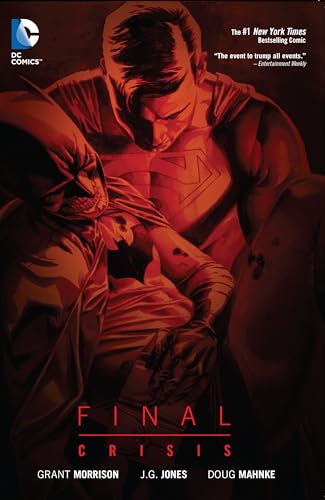

desertcart.com: Final Crisis (New Edition): 9781401245177: Morrison, Grant, Jones, J. G., Mahnke, Doug, Pacheco, Carlos, Clark, Matthew: Books Review: Morrison ponders what makes a hero-and it's not superpowers - It's easy to say that DC Comics' "Final Crisis" crossover deals with supervillain Darkseid's plot to overthrow reality, and the subsequent deaths and corruption of various DC Universe characters. Sure, writer Grant Morrison includes plenty of the epic, property-destroying slugfests that are the hallmarks of events such as these. However, he's got much more on his mind than providing empty spectacle. He's interested in answering the question "What makes a hero?" His answer: Being a hero doesn't require superpowers. It requires not only sacrificing for others, but also doing things that make you uncomfortable-qualities all of us can aspire to. Batman, of course, makes the ultimate sacrifice with his life-though, this being big-time comics, the Dark Knight's death wasn't permanent. (Morrison himself brought Batman back to the land of the living in a subsequent storyline, "The Return of Bruce Wayne.") Superman also risks his life for the DC Multiverse's sake. Indeed, the DC heroes exhibit traits that the villains covet. Darkseid's minions want to steal Batman's "superior physical prowess, strategic acumen and courage"-because those are the qualities that make Batman what he is. (It's not gadgets like Batmobiles or Batarangs. Sorry, toy manufacturers.) How Morrison tells his tale is just as interesting as the questions he addresses in it. All of the concepts in Darkseid's Anti-Life Equation-including loneliness, alienation, fear and despair-equal chaos. Morrison expresses that chaos in the way he tells his story. It's a method that demands much more of the reader's attention and thought than the typical superhero saga, but the payoff is well worth the effort. In Morrison's view, every element of the Anti-Life Equation represents the antithesis of what makes a hero, and the qualities that make heroes what they are-not just self-sacrifice, but also self-confidence and relatability-promote the power of hope in the face of dire circumstances. As Batman's trusty right hand Alfred puts it, "No matter how dark the night...there will be no hiding place for evil." Not even an evil as great as Darkseid, who personifies the hate and the chaos that drive this story. Despite the presence of many different pencillers, the art holds together well throughout. J.G. Jones eventually needed help from Carlos Pacheco and Doug Mahnke to complete the series, and Lee Garbett pencilled two "Batman" issues pertinent to the story. All of the pencillers and inkers, as well as the letterers and colorists, maintain the story's epic scope from beginning to end, and keep everything uniform so the changes in artists aren't so jarring as to take the reader out of the story completely. This capstone to the trilogy that began with "Crisis on Infinite Earths" and continued in "Infinite Crisis" demands careful reading, but both the themes and the storytelling method will reward readers so inclined. Because Morrison expresses the power of both superheroes and storytelling, "Final Crisis" is a work that deserves to be studied and revisited. Review: Brilliant - Another year, another comic mega-event. Or so it would seem that way anyway. Let it be known from this point forward that Final Crisis is definitely unlike any other comic mega-event you'll ever read, mainly thanks to the fact that none other than Grant Morrison (New X-Men, All Star Superman, Batman RIP, Animal Man, Doom Patrol; c'mon, you know the list) is at the helm. With Final Crisis, Morrison offers up a different sort of superhero story that begs the question of just what it really means to be a hero: what happens when evil wins? That's what we learn as Superman, Batman, Wonder Woman, Flash, Hal Jordan, the rest of the JLA, and every other person on the planet enter the darkest hour the world has ever known, as Darkseid brings his denziens of Apokolips to Earth, and everything just seems to go to hell from that point forward. While it certainly helps a little bit being brought up to speed by checking out the side stories, tie-in's, and lead-up's to this event, what makes Final Crisis so good is how different a path it sets itself out on compared to other, more linear mega-events like Infinite Crisis, Secret Invasion, Civil War, and the like. To be honest I wasn't too thrilled the first time I read through Final Crisis when released as single issues, but reading it over again in this collected format has certainly helped make me realize just how grand a canvas Morrison has been playing with here. The artwork from a variety of contributors, including J.G. Jones (whose contributions are sadly not as profound or present as one would hope), Doug Mahnke, Carlos Pacheco, and more besides is wonderful as well, and nicely complements the scale of Morrison's story, even though it should go without saying that Final Crisis is a superhero epic that is definitely not for all tastes. Heroes are resurrected and die, the world crumbles, and good doesn't always end up triumphing over evil; yet in the end, there's still a small glimmer of hope regardless. Something like this is something rarely seen in mainstream superhero comics, which helps make Final Crisis all the more brilliant a work indeed. Stop reading, pick this up.
| ASIN | 140124517X |
| Best Sellers Rank | #207,245 in Books ( See Top 100 in Books ) #572 in DC Comics & Graphic Novels #2,615 in Superhero Comics & Graphic Novels |
| Customer Reviews | 4.3 4.3 out of 5 stars (970) |
| Dimensions | 6.7 x 0.7 x 10.1 inches |
| Edition | Revised ed. |
| ISBN-10 | 9781401245177 |
| ISBN-13 | 978-1401245177 |
| Item Weight | 1.39 pounds |
| Language | English |
| Part of Series | Final Crisis |
| Print length | 352 pages |
| Publication date | April 22, 2014 |
| Publisher | DC Comics |
| Reading age | 1 year and up |
L**Y
Morrison ponders what makes a hero-and it's not superpowers
It's easy to say that DC Comics' "Final Crisis" crossover deals with supervillain Darkseid's plot to overthrow reality, and the subsequent deaths and corruption of various DC Universe characters. Sure, writer Grant Morrison includes plenty of the epic, property-destroying slugfests that are the hallmarks of events such as these. However, he's got much more on his mind than providing empty spectacle. He's interested in answering the question "What makes a hero?" His answer: Being a hero doesn't require superpowers. It requires not only sacrificing for others, but also doing things that make you uncomfortable-qualities all of us can aspire to. Batman, of course, makes the ultimate sacrifice with his life-though, this being big-time comics, the Dark Knight's death wasn't permanent. (Morrison himself brought Batman back to the land of the living in a subsequent storyline, "The Return of Bruce Wayne.") Superman also risks his life for the DC Multiverse's sake. Indeed, the DC heroes exhibit traits that the villains covet. Darkseid's minions want to steal Batman's "superior physical prowess, strategic acumen and courage"-because those are the qualities that make Batman what he is. (It's not gadgets like Batmobiles or Batarangs. Sorry, toy manufacturers.) How Morrison tells his tale is just as interesting as the questions he addresses in it. All of the concepts in Darkseid's Anti-Life Equation-including loneliness, alienation, fear and despair-equal chaos. Morrison expresses that chaos in the way he tells his story. It's a method that demands much more of the reader's attention and thought than the typical superhero saga, but the payoff is well worth the effort. In Morrison's view, every element of the Anti-Life Equation represents the antithesis of what makes a hero, and the qualities that make heroes what they are-not just self-sacrifice, but also self-confidence and relatability-promote the power of hope in the face of dire circumstances. As Batman's trusty right hand Alfred puts it, "No matter how dark the night...there will be no hiding place for evil." Not even an evil as great as Darkseid, who personifies the hate and the chaos that drive this story. Despite the presence of many different pencillers, the art holds together well throughout. J.G. Jones eventually needed help from Carlos Pacheco and Doug Mahnke to complete the series, and Lee Garbett pencilled two "Batman" issues pertinent to the story. All of the pencillers and inkers, as well as the letterers and colorists, maintain the story's epic scope from beginning to end, and keep everything uniform so the changes in artists aren't so jarring as to take the reader out of the story completely. This capstone to the trilogy that began with "Crisis on Infinite Earths" and continued in "Infinite Crisis" demands careful reading, but both the themes and the storytelling method will reward readers so inclined. Because Morrison expresses the power of both superheroes and storytelling, "Final Crisis" is a work that deserves to be studied and revisited.
N**M
Brilliant
Another year, another comic mega-event. Or so it would seem that way anyway. Let it be known from this point forward that Final Crisis is definitely unlike any other comic mega-event you'll ever read, mainly thanks to the fact that none other than Grant Morrison (New X-Men, All Star Superman, Batman RIP, Animal Man, Doom Patrol; c'mon, you know the list) is at the helm. With Final Crisis, Morrison offers up a different sort of superhero story that begs the question of just what it really means to be a hero: what happens when evil wins? That's what we learn as Superman, Batman, Wonder Woman, Flash, Hal Jordan, the rest of the JLA, and every other person on the planet enter the darkest hour the world has ever known, as Darkseid brings his denziens of Apokolips to Earth, and everything just seems to go to hell from that point forward. While it certainly helps a little bit being brought up to speed by checking out the side stories, tie-in's, and lead-up's to this event, what makes Final Crisis so good is how different a path it sets itself out on compared to other, more linear mega-events like Infinite Crisis, Secret Invasion, Civil War, and the like. To be honest I wasn't too thrilled the first time I read through Final Crisis when released as single issues, but reading it over again in this collected format has certainly helped make me realize just how grand a canvas Morrison has been playing with here. The artwork from a variety of contributors, including J.G. Jones (whose contributions are sadly not as profound or present as one would hope), Doug Mahnke, Carlos Pacheco, and more besides is wonderful as well, and nicely complements the scale of Morrison's story, even though it should go without saying that Final Crisis is a superhero epic that is definitely not for all tastes. Heroes are resurrected and die, the world crumbles, and good doesn't always end up triumphing over evil; yet in the end, there's still a small glimmer of hope regardless. Something like this is something rarely seen in mainstream superhero comics, which helps make Final Crisis all the more brilliant a work indeed. Stop reading, pick this up.
U**O
Grande storia, non immediata e richiede una certa conoscenza dell'universo DC post crisi ma Morrison è al top..concordo con un altro recensore sul fatto che la storia è comprensibile se la si legge con attenzione, non è una narrazione semplice ma profonda e ricca di spunti di riflessione sull'evoluzione del medium fumettistico più mainstream..ottimo lavoro
K**E
Some people call this the most confusing piece of work they've ever read, seen, witnessed, layed eyes upon, or experienced. But with a tiny bit of background research, and I mean a quick look at a synopsis of a few graphic novels. I got the grasp of it pretty fast. In fact, I don't think that much 'research' was necessary. The art is fantastic, both by J G Jones and Doug Manhke. The story involves a lot of characters but they all serve the story well. The best thing about this book is the fact that the story as a whole feels extremely large and epic in scale. And that there really is a sense of universal stakes. But while it does all that, there are great personal victories for certain characters. Grant Morrison is known for his wacky and unusual style of writing. But for me, at least, it works wonders. There is so much wackiness to like. And it never feels....Weird? One thing I advise is to pay deep attention at all times. You notice things here and there that will make you go "OHHH". It's really worth it. Amazing plot lines, yes.. PlotlineS. There are a few subplots to keep things interesting but none are wasted. It all comes together perfectly in the end. And Superman's own story, Superman Beyond, is incorporated very well into the story. I'm glad they decided to include it as it wasn't in the planned 7 issues.
E**B
Fan de DC, on ne peux pas passer à côté de Final Crisis ! C'est LA pièce manquante de la grande collection "Grant Morrison présente Batman" chez Urban, cest un tome indispensable dans la continuité du Run du Grand Grant Morrison, à acheter les yeux fermés pour mieux comprendre le lien entre les tomes 3 et 4 du Run !! Magnifiquement écris, magnifiquement dessine ! Un grand Comics !
B**S
Purchased a product that was new but was delivered a second hand version. It wasn't in the shrink wrapping and had a distinct dirty/Dusty smell, that meant it couldn't join my collection. Reminds me that Amazon has a lot of negatives as I can't replace and must wait for my refund.
え**ド
00年代のクライシス三部作第二弾 第一弾はIdentity Crisis 第二弾はInfinite Crisis とはいえ、特に明確なつながりはありませんが。 正義は死に悪が勝利を収める?! 始まりは一発の銃弾だった。神をも貫く銃弾、果たして誰の手によって放たれたのか? 徐々に捜査を進めていくジャスティスリーグだが、あまりにも不審な点や妨害が多く……? バリーフラッシュが死神に追いかけられている!それを知ったバートはバリーを救出するため、バリーのもとへと走り出す! 徐々に悪に浸食されていた世界にとうとうアンチライフ方程式がばらまかれた! これによりヒーローを含むあまたの人物が悪に染まっていく! 果たして、ヒーローたちは再び立ち上がりダークザイドたちに打ち勝つことができるのか? とにかく壮大で圧巻の一言。 おまけでついているSuper Man Beyondも次元にまたがり展開する恐ろしいスケールの物語で、 まさに神をも超越しかねないスーパーマンにただただ脱帽です。 相変わらずモリソンなので何を言いたいかわかりづらいのですが、パーツパーツで見るよりは大雑把にとることを勧めます。
TrustPilot
1 周前
3天前