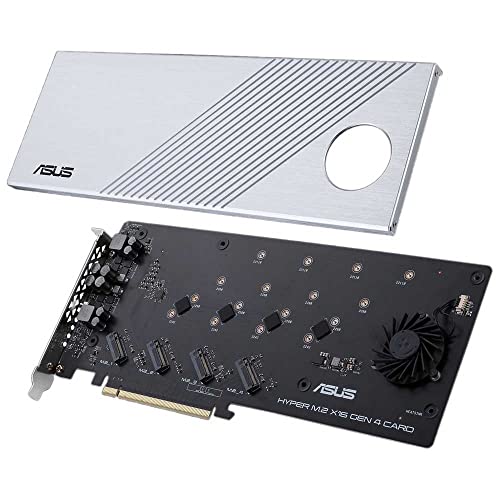

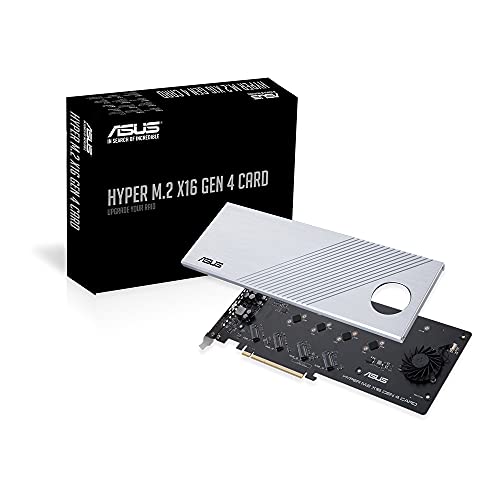


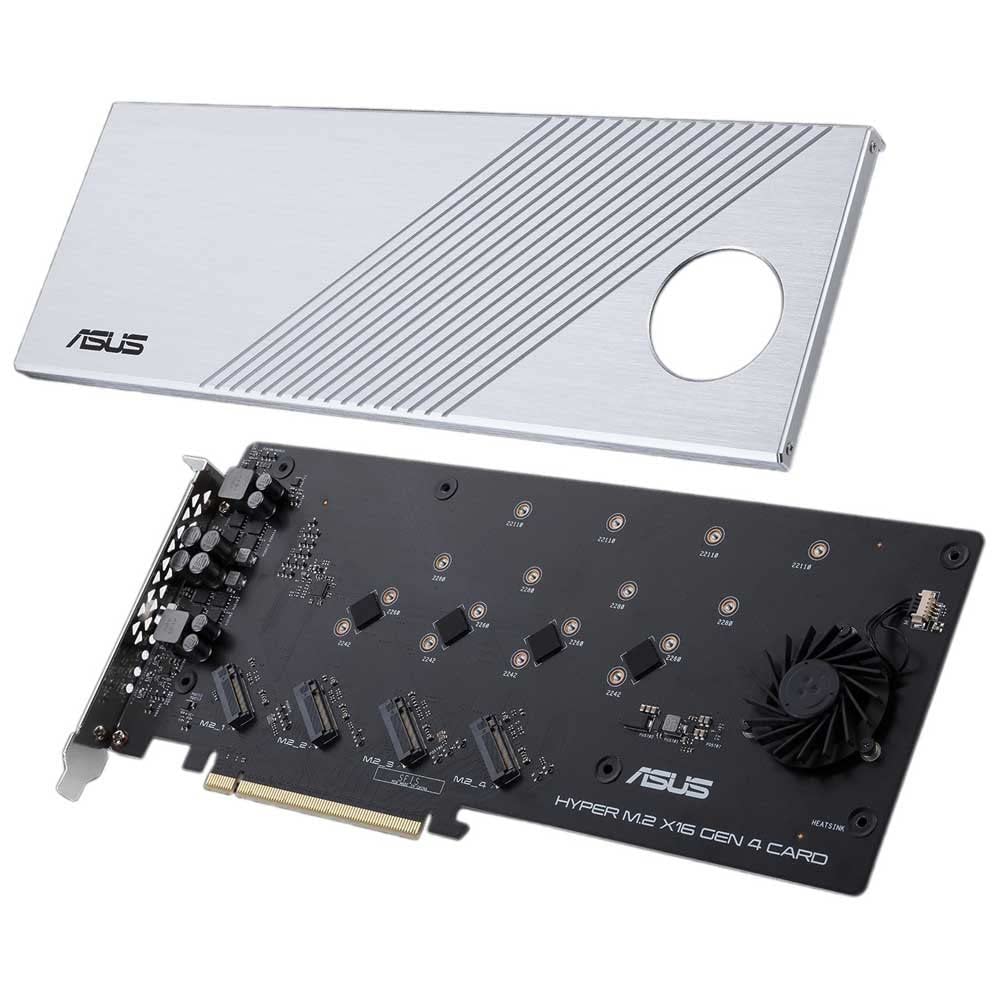

ASUS Hyper M.2 x16 Gen 4 Card (PCIe 4.0/3.0) supports four NVMe M.2 (2242/2260/2280/22110) devices up to 256 Gbps for AMD TRX40/X570 PCIe 4.0 NVMe RAID and IntelR platform RAID-on-CPU functions Two-phase power solution with up to 14-watt output supports the latest NVMe drives Large heatsink and active fan reduces M.2 SSD temperatures for unthrottled transfer speeds and enhanced reliability Adapted server-grade PCB supports up to four PCIe 4.0/3.0 M.2 drives, with up to 256 Gbps bandwidth for smooth data transfers Compatible with AMD TRX40/X570 PCIe 4.0 for NVMe RAID and supports Intel platform RAID-on-CPU functions Also support other vendors" motherboards via PCIe bifurcation in BIOS setting PCIe 4.0/3.0 x16 interface, compatible with PCIe x8 and x16 slots, support data transfer rates up to 256 Gbps. External Connectors Up to 4 x M.2 slots (Key M), type 2242/2260/2280/22110 (supports PCIe 4.0/3.0)* * Supports PCIe M.2 storage devices only. Maximum SSDs support will vary, depends on different motherboard's design. LED & Button 1 x M.2 FAN Power Switch 4 x M.2 access LEDs Features AMD TRX40/X570 Series Motherboard models with PCIe 4.0 support Supports PCIe 3.0 bandwidth for other RAID on CPU models. Maximum numbers of M.2 SSD support will vary, depending on different CPU specs and PCIe bifurcation settings in different ASUS motherboards. Please see the FAQ link for full compatible lists and further information: https://www.asus.com/support/FAQ/1037507 Dimentions 27 (L)*12.2(W) *1.5(H)cm Review: A learning experience. You can load the slots up, but very few motherboards can read all 4. So read the fine print and work out if you can get the most out of this device. Review: Die Karte funktioniert zu 100%! Auch mit 4 SSDs, wenn man weiß was man tut! Vorab, wer ein normales Motherboard (Office-PC, Gaming-PC) hat und auch eine Grafikkarte im System hat, wird es wahrscheinlich nicht schaffen mehr als 2 SSDs ans laufen zu bekommen und das auch nur unter Einbußen der Grafikkartenleistung. Die PCIe Lanes müssen halt aufgeteilt werden. Wer noch nie etwas von "PCIe Bifurcation" gehört hat oder weiß wieviel Lanes die PCIe Slots des Motherboards oder die verbaute CPU kann und wie man diese aufteilt, sollte spätestens jetzt aufhören zu lesen und die Karte nicht kaufen! Die Karte ist halt nichts für Laien! Um die volle Funktionalität der Karte nutzen zu können – insbesondere die Aufteilung des PCIe x16-Slots in vier x4-Lanes (PCIe Bifurcation) – muss dies im BIOS des Mainboards manuell konfiguriert werden. Viele Mainboards unterstützen diese Funktion nicht von Haus aus oder erfordern ein BIOS-Update. Eine falsche Einstellung kann dazu führen, dass die SSDs nicht erkannt werden oder das System instabil wird. Bei mir läuft die Karte unter Proxmox VE absolut stabil, es werden alle 4 SSDs (WD RED SN700) immer erkannt und die Karte erreicht auch einen ordentlichen Durchsatz. Eine SSD benutze ich für Snapshots innerhalb von Proxmox VE. 3 SSDs sind durchgereicht und laufen als Cache Pool im RaidZ1 in einer Unraid VM und das alles ohne Probleme.
| ASIN | B0863KK2BP |
| Batteries Included | No |
| Batteries Required | No |
| Brand | ASUS |
| Compatible Devices | Personal Computer, Laptop, NVMe SSD |
| Computer Memory Type | DDR5 SDRAM |
| Customer Reviews | 4.2 4.2 out of 5 stars (347) |
| Date First Available | 16 March 2023 |
| Graphics Card Interface | PCI Express |
| Hardware Interface | PCI Express x16 |
| Item Dimensions LxWxH | 27 x 12.2 x 1.5 Centimeters |
| Item Weight | 322 g |
| Item model number | HYPER M.2 X16 GEN 4 CARD |
| Manufacturer | ASUS |
| Memory Storage Capacity | 256 GB |
| Model | HYPER M.2 X16 GEN 4 CARD |
| Product Dimensions | 27 x 12.2 x 1.5 cm; 322 g |
| Standing screen display size | 16 Inches |
| Supports Bluetooth Technology | No |
B**N
A learning experience. You can load the slots up, but very few motherboards can read all 4. So read the fine print and work out if you can get the most out of this device.
J**B
Die Karte funktioniert zu 100%! Auch mit 4 SSDs, wenn man weiß was man tut! Vorab, wer ein normales Motherboard (Office-PC, Gaming-PC) hat und auch eine Grafikkarte im System hat, wird es wahrscheinlich nicht schaffen mehr als 2 SSDs ans laufen zu bekommen und das auch nur unter Einbußen der Grafikkartenleistung. Die PCIe Lanes müssen halt aufgeteilt werden. Wer noch nie etwas von "PCIe Bifurcation" gehört hat oder weiß wieviel Lanes die PCIe Slots des Motherboards oder die verbaute CPU kann und wie man diese aufteilt, sollte spätestens jetzt aufhören zu lesen und die Karte nicht kaufen! Die Karte ist halt nichts für Laien! Um die volle Funktionalität der Karte nutzen zu können – insbesondere die Aufteilung des PCIe x16-Slots in vier x4-Lanes (PCIe Bifurcation) – muss dies im BIOS des Mainboards manuell konfiguriert werden. Viele Mainboards unterstützen diese Funktion nicht von Haus aus oder erfordern ein BIOS-Update. Eine falsche Einstellung kann dazu führen, dass die SSDs nicht erkannt werden oder das System instabil wird. Bei mir läuft die Karte unter Proxmox VE absolut stabil, es werden alle 4 SSDs (WD RED SN700) immer erkannt und die Karte erreicht auch einen ordentlichen Durchsatz. Eine SSD benutze ich für Snapshots innerhalb von Proxmox VE. 3 SSDs sind durchgereicht und laufen als Cache Pool im RaidZ1 in einer Unraid VM und das alles ohne Probleme.
C**/
I bought this to free up some PCI slots in my Dell Precision T7810 where I have GPU, Soundcard and multiple individual PCI NVMe disks installed. The card is well made with metal housing, included Thermal heat pads for each of the four NVMe drives and a fan to ensure good airflow inside the card housing. I have four 1Tb SSD drives installed, two are Samsung and two Sabrent and there's no issue with mixing disk brands. Installation was easy, but keep in mind this is a long PCI card so check you have enough room in the case. It's something of an exotic device aimed mostly at those with PC's capable of booting and running NVMe drives, but that are not new enough to have onboard dedicated M2 slot on their mainboard. This was the case with our Precision T7810 towers which run really well on NVMe disks but have a BIOS NVMe boot capacity limit of 1Tb meaning I cant simply put in a single or pair of 2Tb or higher NVME disks and be done. I opted then to install this card and after searching for and confirming that the T7810 will support the card went ahead and bought a couple of extra 1Tb Sabrent NVMe cards over Black Friday. You'll be best placed if you ensure you have the latest BIOS update installed first before migrating to this card. On the Precision T7810 it's a bit of a hit and miss process getting the system to power up and reach BIOS output on the monitor and we experienced long black screen issues at first, largely due to the number of different controllers on this Workstation and the huge scan time for the 64Gb ECC memory installed. After a bit of tweaking and a few hard power off cycles with the power button we eventually got to a working BIOS output on the monitor where the individual cards have to be configured in the drive and boot menu. Oddly as is normal for this card you can often find that at first full boot to Windows there will only be 2 of the 4 drives connected and visible in Device Manager. You just need to keep re-booting and refreshing Device manager. There are a couple of website guides telling you how to tweak the settings to overcome the two issues I've mentioned here. Once you have them installed and detected in Windows this card performs well, runs cool and allows you to avail of four high speed NVMe drives in either a RAID format, or as individual drives. In our case after reading up on the reliability of performance gains of pairing up the drives into a RAID 0,1 5 configuration we simply run them as standalone drives. The general consensus being that there's not a lot of improvement in real use performance with a RAID array but that it comes with much higher risk of catastrophic drive failure and data loss. The general feeling was that if you want higher disk throughput that you should move up to PCIe Gen 4 or PCIe Gen5 motherboards and that most of these come with pre-installed NVMe slots with a BIOS capable of booting from disk capacity greater than the 1Tb restriction on the Precision T7810. For the work we are doing the T7810 is now more than capable of whizzing through renders, design work and other high throughput operations without any really obvious delay to the user. We felt it's not worth upgrading to a PCIe Gen5 system as yet as the price premiums are very high as of Feb 2024 so we'll wait another few years until Gen 14 Intel i7 or i9 CPU machines with DDR5 and PCIe5 are much more affordable. So this ASUS card gives us all the space and throughput we need on our bombproof Dell T7810's and at a massive cost saving against going through another system upgrade cycle in the near future.
L**L
Arrived in a timely manner and works great. Really sped up my data transfer rates since my motherboard didn't have inboard m.2 slots.
M**Z
Benim anakart ve işlemci pci express portunda z490 anakart i5 11400f işlemci ile sadece tek port çalışıyor normalde anakart ve işlemci pci slotu destegi varsa 4 ssdye kadar tanıyor bende 1 port çalıştı bu benim suçum işlemci desteğine bakmadan satın aldım .tek port çalışınca iade etmek zorunda kaldım
TrustPilot
2 周前
2 周前