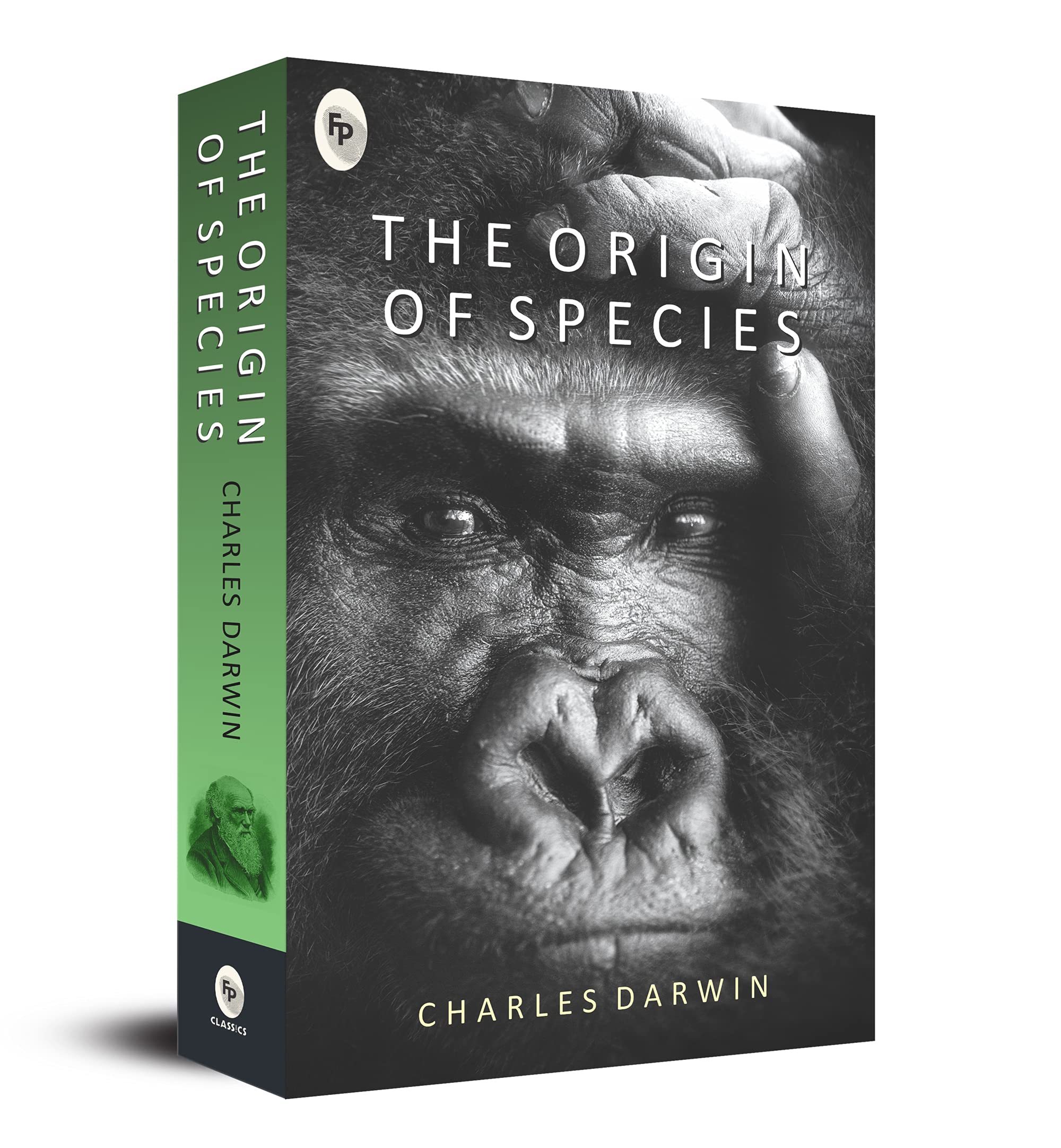
The Origin of Species : Charles Darwin: desertcart.in: Books Review: Where do we come from?? - I have read about 175+ books in last two years and not exaggerating that almost every tenth book mentions either Darwin's theory or the book in question one way or the other. So much so that I was very curious for almost last two years to pick it up myself and read what actually he had written way back in 1859. I was shocked the way it gets mention not only in Non Fiction (mostly), but also in Fiction and even in a love story (Imagine it gets mentioned in a Jojo Moyes book too). But when I read Yuval Noah Harari's (Sapiens) and followed it with a book written way back in 60's about a court case where they debated over Bible Vs Darwin, it was simply too much for me to resist it anymore :). And then, my favorite Dan Brown came out with his new book called "Origin" exploring "Where do we come from" and "Where are we going". Curiosity actually killed the cat and I picked it up some 15 days ago, mind it, it isn't an easy read like any other book but way too interesting. Specially if you have any interest in "Origin", History, Geography, Biology and even Science, this is a must must read. Even if those subjects do not interest someone, it can be read for its literary merit too, I totally loved it. Although after reading I can claim that this book is actually a summary of his findings and these 700 pages are way too short to explain everything, going by his writing I am doubly sure that the actual theory must not be any less than 10000 pages for sure as he mentioned at so many places that he wasn't going in great details due to space constraints. On top of it, his findings weren't finished by the time he started writing this and as his health wasn't too good, his good friends and colleagues forced him to come out with this. Unbelievable that is to know and surprising is the entire book. I had no idea before reading the book that what I was getting into, this isn't just a book or a theory given by the great Charles Darwin but an encyclopedia of knowledge about the origin of life on planet earth. How everything came to be and moved from one place to another, mind-blowing is his research, theory and conclusions which he kept open to debate with people and imagine even after 150 years, we are still debating on it. I just couldn't imagine what kind of Lab he must have at that time and how far and wide he must have traveled to gather the data he has put in his theory, unbelievable. Another fantastic thing about Darwin was, not once he was afraid of giving credit to so many of his colleagues, eminent scientists and professors as he kept mentioning their names with what they thought and how it helped him to come to the conclusions that he had drawn, simply too good. Starting from the bacteria's to germs to insects, birds, animals, humans and even dinosaurs, he hasn't left anything which doesn't gets a detailed mention in this book. I really wonder how deep and terrific would be his actual detailed findings which may not be available for us lesser mortals but the scientific community must have access to those works. Although those details may not make any sense to us unscientific and god fearing people, but he was always open to other parallel theories too and never made fun of them. The way it covers the Human Origin timeline and the life on planet earth is just superb. Darwin was sure that no one can predict the exact time how long life has been here on this planet (at that time). The way he calculates the life as well as what data do we have in our hands as of now a mere negligible that we haven't yet explored an iota of what is actually there on this planet is simply mind-blowing and convincing too. This will now be one book that I am going to force every teenager that I know to read without fail, more than for sure Blyton's and Dahl's. Its an amazing encyclopedia that everyone should read. I am glad and sad both to have read a Kindle version of the book. Glad that I could actually access the meanings immediately by tapping on the terms that I had never previously heard and sad that it didn't had any of the diagrams that he made which should be available on a paperback :(. Also, now, I guess I have to go ahead and read Yuval Noah Harari's "Homo Deus" which takes it all to couple of steps ahead where Darwin left it. Surprisingly when I bought this book (almost a year ago) it was absolutely free on desertcart (for Kindle). If you have read this, do let me know how you like it, if not, you've got to read this without fail. This will now-onward be one of my all time favorite Non-Fiction for sure. A very highly recommended back for all. Review: An Affordable Classic: Charles Darwin's "Origin of Species" in Paperback - When it comes to the world of science and evolutionary biology, few works have left as profound an impact as Charles Darwin's "On the Origin of Species." This seminal text has revolutionized our understanding of the natural world, and it remains a must-read for anyone interested in the field. If you're looking for a wallet-friendly version of this literary masterpiece, then the paperback edition I recently acquired has proven to be a valuable gem. This particular edition of "Origin of Species" offers remarkable value for money. The first thing that struck me was the affordable price point. It's a fantastic option for students, casual readers, or anyone who wants to explore Darwin's theories without breaking the bank. One of the standout features of this edition is its exceptional value. The book's cover is a sturdy paperback that, while not overly extravagant, provides adequate protection for the pages within. The binding is robust, ensuring that your copy will stand the test of time, even with repeated readings. But what truly sets this edition apart is the attention to detail paid to the typography. The font used is easy on the eyes, making it a joy to read even during long sittings. The text is clear, well-spaced, and free from typographical errors, enhancing the overall reading experience. The quality of the paper itself is commendable. It strikes a balance between thickness and weight, ensuring that the book feels substantial without being overly cumbersome. The pages have a pleasant texture, adding a tactile dimension to the reading experience. What really matters, though, is the content within these pages. Charles Darwin's groundbreaking ideas on natural selection and evolution continue to be as relevant today as they were in the 19th century. This edition faithfully reproduces the original text, providing readers with a direct connection to the thoughts and discoveries that shaped the field of biology. In conclusion, this affordable paperback edition of Charles Darwin's "On the Origin of Species" is a true treasure for those who seek both intellectual stimulation and value for money. With its durable binding, well-chosen fonts, and crisp text, it is the perfect companion for anyone embarking on the journey of understanding the origin of species. Whether you're a student, a curious mind, or a passionate scholar, this edition is a valuable addition to your library.


| Best Sellers Rank | #1,872 in Books ( See Top 100 in Books ) #15 in Biology Books #109 in History (Books) #169 in Religion & Spirituality (Books) |
| Country of Origin | India |
| Customer Reviews | 4.5 4.5 out of 5 stars (9,049) |
| Dimensions | 21.49 x 2.79 x 14 cm |
| ISBN-10 | 8172344880 |
| ISBN-13 | 978-8172344887 |
| Importer | Prakash Books India Pvt Ltd |
| Item Weight | 393 g |
| Language | English |
| Net Quantity | 1 Count |
| Packer | Prakash Books India Pvt Ltd |
| Paperback | 500 pages |
| Publisher | Fingerprint! Publishing; First Edition (1 January 2013); Prakash Books India Pvt Ltd, 113A, Ansari Road, Daryaganj, New Delhi-110002, +9111-23265358 |
| Reading age | Customer suggested age: 14 years and up |
R**A
Where do we come from??
I have read about 175+ books in last two years and not exaggerating that almost every tenth book mentions either Darwin's theory or the book in question one way or the other. So much so that I was very curious for almost last two years to pick it up myself and read what actually he had written way back in 1859. I was shocked the way it gets mention not only in Non Fiction (mostly), but also in Fiction and even in a love story (Imagine it gets mentioned in a Jojo Moyes book too). But when I read Yuval Noah Harari's (Sapiens) and followed it with a book written way back in 60's about a court case where they debated over Bible Vs Darwin, it was simply too much for me to resist it anymore :). And then, my favorite Dan Brown came out with his new book called "Origin" exploring "Where do we come from" and "Where are we going". Curiosity actually killed the cat and I picked it up some 15 days ago, mind it, it isn't an easy read like any other book but way too interesting. Specially if you have any interest in "Origin", History, Geography, Biology and even Science, this is a must must read. Even if those subjects do not interest someone, it can be read for its literary merit too, I totally loved it. Although after reading I can claim that this book is actually a summary of his findings and these 700 pages are way too short to explain everything, going by his writing I am doubly sure that the actual theory must not be any less than 10000 pages for sure as he mentioned at so many places that he wasn't going in great details due to space constraints. On top of it, his findings weren't finished by the time he started writing this and as his health wasn't too good, his good friends and colleagues forced him to come out with this. Unbelievable that is to know and surprising is the entire book. I had no idea before reading the book that what I was getting into, this isn't just a book or a theory given by the great Charles Darwin but an encyclopedia of knowledge about the origin of life on planet earth. How everything came to be and moved from one place to another, mind-blowing is his research, theory and conclusions which he kept open to debate with people and imagine even after 150 years, we are still debating on it. I just couldn't imagine what kind of Lab he must have at that time and how far and wide he must have traveled to gather the data he has put in his theory, unbelievable. Another fantastic thing about Darwin was, not once he was afraid of giving credit to so many of his colleagues, eminent scientists and professors as he kept mentioning their names with what they thought and how it helped him to come to the conclusions that he had drawn, simply too good. Starting from the bacteria's to germs to insects, birds, animals, humans and even dinosaurs, he hasn't left anything which doesn't gets a detailed mention in this book. I really wonder how deep and terrific would be his actual detailed findings which may not be available for us lesser mortals but the scientific community must have access to those works. Although those details may not make any sense to us unscientific and god fearing people, but he was always open to other parallel theories too and never made fun of them. The way it covers the Human Origin timeline and the life on planet earth is just superb. Darwin was sure that no one can predict the exact time how long life has been here on this planet (at that time). The way he calculates the life as well as what data do we have in our hands as of now a mere negligible that we haven't yet explored an iota of what is actually there on this planet is simply mind-blowing and convincing too. This will now be one book that I am going to force every teenager that I know to read without fail, more than for sure Blyton's and Dahl's. Its an amazing encyclopedia that everyone should read. I am glad and sad both to have read a Kindle version of the book. Glad that I could actually access the meanings immediately by tapping on the terms that I had never previously heard and sad that it didn't had any of the diagrams that he made which should be available on a paperback :(. Also, now, I guess I have to go ahead and read Yuval Noah Harari's "Homo Deus" which takes it all to couple of steps ahead where Darwin left it. Surprisingly when I bought this book (almost a year ago) it was absolutely free on Amazon (for Kindle). If you have read this, do let me know how you like it, if not, you've got to read this without fail. This will now-onward be one of my all time favorite Non-Fiction for sure. A very highly recommended back for all.
K**.
An Affordable Classic: Charles Darwin's "Origin of Species" in Paperback
When it comes to the world of science and evolutionary biology, few works have left as profound an impact as Charles Darwin's "On the Origin of Species." This seminal text has revolutionized our understanding of the natural world, and it remains a must-read for anyone interested in the field. If you're looking for a wallet-friendly version of this literary masterpiece, then the paperback edition I recently acquired has proven to be a valuable gem. This particular edition of "Origin of Species" offers remarkable value for money. The first thing that struck me was the affordable price point. It's a fantastic option for students, casual readers, or anyone who wants to explore Darwin's theories without breaking the bank. One of the standout features of this edition is its exceptional value. The book's cover is a sturdy paperback that, while not overly extravagant, provides adequate protection for the pages within. The binding is robust, ensuring that your copy will stand the test of time, even with repeated readings. But what truly sets this edition apart is the attention to detail paid to the typography. The font used is easy on the eyes, making it a joy to read even during long sittings. The text is clear, well-spaced, and free from typographical errors, enhancing the overall reading experience. The quality of the paper itself is commendable. It strikes a balance between thickness and weight, ensuring that the book feels substantial without being overly cumbersome. The pages have a pleasant texture, adding a tactile dimension to the reading experience. What really matters, though, is the content within these pages. Charles Darwin's groundbreaking ideas on natural selection and evolution continue to be as relevant today as they were in the 19th century. This edition faithfully reproduces the original text, providing readers with a direct connection to the thoughts and discoveries that shaped the field of biology. In conclusion, this affordable paperback edition of Charles Darwin's "On the Origin of Species" is a true treasure for those who seek both intellectual stimulation and value for money. With its durable binding, well-chosen fonts, and crisp text, it is the perfect companion for anyone embarking on the journey of understanding the origin of species. Whether you're a student, a curious mind, or a passionate scholar, this edition is a valuable addition to your library.
P**L
Good Book for reading+science lovers.
Read it if you want to get a better understanding of biology and evolution in general. Good book. Easy to understand.
K**R
It is the best book to understand biology and the evolution of organism on our planet
I would like to recommend this book to people who wanted to understand how our world came into existence and the evolution of organisms on our planet
S**M
The Origin of Species - Review
To be honest, I'm not really a fan of books in the field of biology; I'm more inclined toward physics and mathematics. However, this book is a good starting point for someone who has no prior knowledge of evolution. Of course, it doesn’t cover the entire theory of evolution, but it’s a solid introduction. As you can see in the picture, the book is in quite good condition, except for one noticeable flaw.
K**A
Everyone should read this❤️
Read it or not, but you can’t change it. Theory of evolution is just an eye opener for them who thinks god has created everything. After reading this book, I realized one thing that in Hindu scriptures (Puranas mostly) I read stories which tells us that we all belongs to Mother Nature. When I was small, I used to enjoy listening to all the stories told by the old people, but when I started understanding science a little bit, I understood what they meant and what they were trying to teach us. Whenever we read Vishnu Purana or Shiv Purana, we only understand that the one who came out of the sea first in Amritmanthan was a marine creature, then why are we not able to protect that same creature today. That is why the theory of evolution is so important.
T**.
Nice book
Paper is soft and smoth warm but the text are little bit small to read.
D**K
Text size
Good book and at good price, but because of price constraints text is bit smaller, quite small. overall fine.
R**L
Very interesting read. It's funny to notice that our modern understanding of this subject is superior to the very guy who created the theory and was at the forefront of his field in his days. He hasn't the slightest clue about the "laws of ihneritance" (that we call genetics today) or notions that any high school student will easily grasp nowadays. Anyway, the way he builds his reasoning to defend his ideas with the limited resources he had is of great value! We can see history unfolding when reading those lines, we can see that it's the kind of scientific progress that was made available after we started exploring the world overseas. If there wasn't a Darwin, probably some other guy would come up with the same conclusions sooner or later, because we started collecting more data about living creatures geographically separated for ages. I recommend reading it while immagining yourself in his skin during his travels. I'm sure he would be very happy to see the progress humanity has achieved in this field.
J**O
Bom livro
G**R
Supuestamente el texto es el mismo de la edición original. Es una lectura muy pesada, (hay que considerar que es un ingles británico de hace casi 200 años, con algunos términos, técnicos o no, que ya no se usan hoy en día y con referencias a muchas especies animales/vegetales que pueden ser desconocidas para la mayoría) independientemente de si tienes o no conocimientos avanzados de ciencias (aunque saber algo de biología básica al menos podría ayudar); Darwin describe no solo su teoría, sino también decenas o incluso cientos de pruebas a su teoría (principalmente escribe mucho acerca del porqué esas pruebas apoyan su teoría, mas que describir las pruebas o experimentos per se) y hasta se molesta en incluir y discutir sobre los aspectos "negativos" o controversiales de su propia teoría, todo esto en su conjunto hace que el lector tenga una vision mucho más amplia y reconozca la importancia de esta obra de un modo que no se puede apreciar por lo poco que se enseña en cursos básicos de biología o ciencias naturales.. Para la población general no recomendaría la lectura de este libro, en su lugar ya hay actualmente otros que por un lado explican la teoría en términos más sencillos o mejores, sobretodo ayudados por el extenso avance de la ciencia moderna que no ha hecho más que aportar innumerables pruebas extras a favor de la teoría de Darwin (por mencionar una de las más importantes, la genética y los mecanismos de la herencia, que en tiempos de Darwin no se conocían). Para especialistas o personas interesadas en temas evolutivos si que debería ser una lectura obligatoria, aunque advertidos quedan de que deben ser pacientes con la lectura de esta obra.
J**R
I finally got around to reading this famous scientific work. I have to say that I'm impressed with his clarity, logic, and scientific ability. He's blessed with a curiosity that is unbounded and the ability to test out all kinds of things using the scientific method. It's interesting how research worked back in the mid-19th century. He didn't have Google and even if he did, most scientists back then hadn't asked the questions he was asking. For example, he wondered how seed could be transported across oceans; he concocted experiments to see if seeds would float in the ocean for a long period of time and still germinate. He also wondered if mud on birds feet would contain seeds; so he captured some birds and checked out the mud on their feet. There are many other examples where he did this sort of thing. He also structured this book to answer all of the possible criticisms to his theories and did a very good job. He effectively cited the work of other scientists. I found this book a joy to read and see how the mind of a great scientist works. It's refreshing to see a scientist go against the consensus and powerfully support his radical new theory. This book is highly recommended for everyone. It is eminently readable and convincing. This book is controversial since there are many people that feel it is anti-God. I don't think so; to me, it simply shows that God did not create each and every species from 'nothing'. God is more like a farmer than a conjurer. I would think that the amazing versatility of life and its ability to adapt shows something that seems hard to imagine coming together by mere chance.
S**X
This great work is available in so many formats that choosing which one to buy is itself a challenge. My own priority was to have a reprint of the first edition (it went through six during Darwin's lifetime), in hardback, and as well typeset and printed as can be expected in modern publishing, which often cuts corners and quality. This landmark edition fits the bill and is a beautiful object in itself. It ought to go without saying that the work itself is universally acclaimed as a triumph of the human intellect, but sadly that is not the case. That Darwin's masterpiece is not so acclaimed is largely down to the degrading effects of a certain kind of religious belief, one that celebrates faith and ignorance over reason and evidence and truth. (I was once accosted on a street in south London by a woman who said she could prove Darwin wrong. I checked for signs of Nobel Prize winning science but the bible was all she had.) Most scientists think that accepting evolution doesn't necessarily turn you into an atheist. Many Christians also hold to this view. In God is Not Great: The Case Against Religion Christopher Hitchens, not noted for his reluctance to champion the atheist corner, thinks that "symptoms of old-style between-the-lines encoded concealment are to be found throughout the first edition" of the Origin. Famously, the word "evolution" never appears while "creation" crops up all over the place. Was Darwin unsure of his ground and hedging his bets? Hardly. There are indeed many references to creation, and they are all unfriendly! Darwin was not afraid of pitting evolution and creation head to head and seeing which came out on top. Again and again he describes facts about the world that can only be explained by natural selection and not by special creation, and he draws analogies to hammer home the point. As "modern geology has almost banished such views as the excavation of a great valley by a single diluvial wave, so will natural selection, if it be a true principle, banish the belief of the continued creation of new organic beings, or of any great and sudden modification in their structure." Here, Darwin is not only suggesting that we banish belief in creation but is also reminding us that the evidence of geology refutes the literal interpretation of another well-known biblical story. Discussing the clustering of subordinate groups within any class he writes (p. 123): "On the view that each species has been independently created, with all its parts as we now see them, I can see no explanation. But on the view that groups of species have descended from other species, and have been modified through natural selection, I think we can obtain some light." Observing that "nature is prodigal in variety, but niggard in innovation", he asks (pp. 177-78): "Why, on the theory of Creation, should this be so? Why should all the parts and organs of many independent beings, each supposed to have been separately created for its proper place in nature, be so invariably linked together by graduated steps? Why should not Nature have taken a leap from structure to structure? On the theory of natural selection, we can clearly understand why she should not; for natural selection can act only by taking advantage of slight successive variations; she can never take a leap, but must advance by the shortest and slowest steps." There is a widespread calumny against the scientific mind that it has somehow sacrificed all appreciation of beauty in order to arrive at its truths about the world. Feynman could see the beauty of a flower as well as his artist friend, but he could also see a deeper beauty. Darwin too was enthralled by nature: "He must be a dull man who can examine the exquisite structure of a [honey]comb, so beautifully adapted to its end, without enthusiastic admiration." Time and again, after describing some structure or behaviour in the natural world, Darwin asks: "What can be more extraordinary than these well-ascertained facts?" Like Feynman, of course, he doesn't stop there, open mouthed but close minded. He seeks further understanding, from whatever source is available: "We hear from mathematicians that bees have practically solved a recondite problem, and have made their cells of the proper shape to hold the greatest possible amount of honey, with the least possible consumption of precious wax in their construction." And the deepest explanation lies within his own theory: "Beyond this stage of perfection in architecture, natural selection could not lead; for the comb of the hive-bee, as far as we can see, is absolutely perfect in economising wax... that individual swarm which wasted least honey in the secretion of wax, having succeeded best, and having transmitted by inheritance its newly acquired economical instinct to new swarms, which in their turn will have had the best chance of succeeding in the struggle for existence." Darwin was well aware of what we now call confirmation bias, the natural human instinct to pay attention only to what suits our ideas and to ignore what is inconvenient. As a good scientist, he was neither arrogant nor complacent but alert to weaknesses or new ways to test his theory. This may come as a surprise to those who have been taught that evolution cannot be tested: Darwin himself writes that the construction of combs "can be tested by experiment" and describes the results, and today there is a wealth of experimental evidence (see, for example, The Greatest Show on Earth: The Evidence for Evolution ). Later, in discussing insect communities, he focuses on "one special difficulty" that "at first appeared to me insuperable, and actually fatal to my whole theory". The challenge for natural selection was to account for the presence of sterile females, and he was able to provide a convincing account. Despite his reputation for reclusiveness later in life, he corresponded widely and valued the work and opinions of others, and apportioned credit where it was due, all the while not granting any individual absolute authority. "Although fully trusting to the statements of Huber and Mr. Smith, I tried to approach the subject in a sceptical frame of mind, as any one may well be excused for doubting the truth of so extraordinary and odious an instinct as that of making slaves." Contrast this with the passage in Luke where, if we accept its historical truth, Jesus demonstrates his compassion by advising us that there are some slaves who should not be beaten as hard as other slaves. Where are those creationists, or even evolution-believing Christians, who will admit that Darwin trumps Jesus on this moral question? This is a book that anyone willing to work a little can read. No degree in biology is needed. It is rare in science to have such a genuinely groundbreaking work still so accessible to the lay reader. Having said that, even some fans of Darwin confess it hard going in parts, and there is no doubt that most readers will flag over some passages - but it is worth persevering. And, to satisfy your curiosity over Mr Brent and his tumbling Glaswegian pigeons and other obscure references, there is a handy bibliographical register and a glossary at the end.