We remain fully operational. Our teams are working around the clock to ensure your deliveries continue safely.

下载应用程序


📖 Unlock the future’s past—read the dystopia everyone’s talking about!
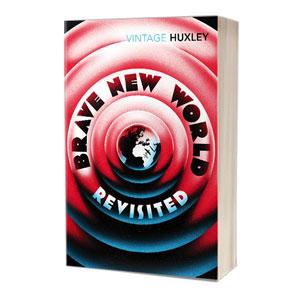
Brave New World: Vintage (Vintage Classics) is Aldous Huxley’s seminal 1932 dystopian novel exploring a genetically engineered society obsessed with stability and artificial happiness. With over 44,000 reviews and top rankings in Genetic Engineering Fiction and Dystopian categories, this literary classic challenges readers to rethink freedom, technology, and human nature in a rapidly evolving world.
| Best Sellers Rank | 1,906 in Books ( See Top 100 in Books ) 5 in Genetic Engineering Fiction 21 in Dystopian 37 in Fiction Classics (Books) |
| Customer Reviews | 4.3 out of 5 stars 44,925 Reviews |
H**H
A Brave New World
A Brave New World" by Aldous Huxley is a literary masterpiece that has stood the test of time, offering a chilling yet thought-provoking glimpse into a dystopian future. Huxley's vivid imagination and keen insight into human nature create a world that is both fascinating and horrifying. Set in a technologically advanced society where individuality and personal choice have been sacrificed for stability and uniformity, "A Brave New World" challenges our fundamental notions of freedom, happiness, and the pursuit of truth. The novel explores the consequences of a world where science and technology are used to control every aspect of human life, from reproduction to emotions. One of the most striking aspects of the book is Huxley's ability to create a world that feels eerily plausible. His vision of a society obsessed with pleasure, instant gratification, and the suppression of dissenting ideas resonates with our modern concerns about the impact of technology on human behavior and the erosion of individual autonomy. The characters in "A Brave New World" are complex and serve as vehicles for the exploration of the novel's themes. Bernard Marx, an outcast in this utopian society, provides a lens through which we witness the inherent flaws and contradictions of the world Huxley has crafted. Meanwhile, the enigmatic figure of John, the Savage, introduces an intriguing contrast between the values of the "Brave New World" and the primitive, but genuine, emotions of the natural world. Huxley's prose is both elegant and incisive, drawing the reader into the narrative with its rich descriptions and sharp observations. His ability to convey complex ideas through engaging storytelling is nothing short of remarkable. What sets "A Brave New World" apart is its ability to spark deep reflection on the nature of human existence. It prompts readers to question the trade-offs between individual freedom and societal stability, between genuine emotion and artificial happiness. The novel's message is as relevant today as it was when it was first published, serving as a warning about the potential dangers of unchecked technological progress. In conclusion, "A Brave New World" is a must-read for anyone interested in dystopian literature, speculative fiction, or philosophical contemplation. Aldous Huxley's vision of a future society serves as a powerful cautionary tale, urging us to consider the ethical implications of our pursuit of progress. This book is a testament to the enduring power of literature to challenge and inspire generations to come.
Y**B
A world where people are engineered to fit into society
This is a book that I have been wanting to read for years but never got to it. I finally decided to give it a go. I was only aware of the basics of this book and I hadn't read any other reviews about it. What I discovered is quite a bizarre story that became quite addictive. It does have a strong literary fiction feel to it. At times the writing is poetic, at others disjointed and overall a story that gradually got under my skin. The world that Huxley has created is one where people are expected to be happy, they are brainwashed into feeling this. There is no mother, father or in fact any type of family connection. Each person has been produced in a test tube, each person has been altered at a genetic level to become what is required for Huxley's world to function. There is a layered social system where people are born to be what they are engineered to be, so someone with a lowly job will be content with that job. They don't aspire to be anything more than what they are supposed to be. Creating this world, the author then throws an anomaly in the system, this is something that shows that even with the use of technology there will be a time when nature intervenes, or it may be a simple human mistake. Either way, this is where the characters that start to question the system have a more important role. In the second half of the book, there is a move from the system to that of the outside world, this is more what we know today. Parents, relationships and unique traits and characteristics. This for me is where the story then takes an even more addictive turn. The comparisons built up between those in the system and those out of it are great. By the end of the book, I found I was very much interested in some of the characters. The ending, well that was a shock! This is a fabulous book to read, and I did struggle to find the flow at the beginning. I did read it in two sittings. The first sitting was a bit wobbly and at 33% I decided to have a break, this turned out to be a great time to pause and then coming back to it the following night. I then found myself unable to put this book down and finished it. This is a book that has loads of reviews, has loads of opinions and there are probably theories and it will have been analysed in every aspect. I read for the pleasure of it, so for me, this book was one that intrigued me. It did feel disjointed, to begin with, but it grew on me. I enjoyed this and I am very glad that I have read this book. For a book that was written in 1931 and published in 1932, it has some brilliant imagination and foresight into a possible future. A world where people are engineered to fit into a hierarchical society. It is a very good book and it is one I would happily recommend.
D**E
A dystopia veiled as a utopia
If 1984 represents the worst possible future for humanity, Brave New World is the future we are already going down. Unlike 1984, which doesn’t even try to hide the nightmare it is to live within its pages, Brave New World gives a more alluring (and strangely more sinister) dystopia of limitless drug-induced pleasure, total harmony, sickness and old age are solved, and sexual pleasures are always met with no strings attached. It is also a world where eugenics determines the fate of humanity, genetic classicism is reality, state indoctrination is your childhood, individuality is a taboo, poetry and philosophy are discarded as dead, and mothers and fathers are replaced by the all-seeing state. Humanity are simply sheep, who live in near total comfort, but also live without real meaning, introspection or individuality. This is the cost for so-called paradise. Already in our world, we are aiming for a world with no pain, sickness or old age, a world of total comfort (with no way to learn), and where all our questions are answered for us (with no way to become wise). A society with no way to become human. The only way of escape presented in this book is to leave civilisation itself to be a “savage” (where you are free, but must live in poverty, experience pain and despair, and be drowned in superstition and blood sacrifice). You must either choose to live as a “savage” or live as a sheep in an inhuman “utopia.” It is left to the reader to which path they would find prefer.
D**S
Fab book, appalling proofreading
The story is fabulous, an absolute, well deserved classic. I read it many years ago as a school text and found it just as well-written and thought provoking this time around as I did in the 70's. So why the 3 stars? Well this kindle edition is appalling. So many typos some sections are almost impossible to read, my "favourite" is mis-naming Lenina to Lenin. Apostrophes are often replaced with question marks and words are jumbled. I seriously considered buying it again in another format just to make it legible. 5stars for the story, zero stars for proofreading.
J**E
Should have read this way earlier...
Brave New World depicts a simple, light-hearted and perfectly content society, where, through conditioning from the moment you burst into life in the test tube to your irrelevent death, no-one suffers, no-one complains, and no-one is ever alone. A world where you are constantly stimulated by synthetic machinery, and require nothing but one or two pills to escape a stray emotion here or there, or induce a mental holiday to avoid the possiblity of facing them. No worries. And also no art, no literature or true creation of any kind. No gods or spirituality, no adventure or surprises or passion of any kind, ever. No parents or families or friends or intimacy. No scientific advancement. No private thoughts. Everyone is for everyone else. Your time must be shared. You can never experience solitude and reflection. You can never have autonomy. Your words are not your own. Your body is not inviolate. If you are not like this you are shipped off to an island with the few other defective members of society who are like you. Whether that is lucky or unlucky is a matter of perspective. Effing frightening stuff if ever I heard it. I loved this book more after I finished than when I was reading, because the challenge wasn't in accepting the world the characters inhabited, as it was really easy to digest because of its intentional tone (extraordinarily light, as if you're on a drug inducing you to be that way the entire time, hint hint), but accepting the world around me as being frighteningly familiar to it in some unsettling ways. It deosn't wholly reflect the world right now, but when it does it is in big ways. Though short it feeds enough into the psyche about our society as a whole, how we need suffering for heroism, mutual passion for love, pain and rejection for inspiration, and loss to understand the value of life - without these things creativity and progression are impossible. In Brave New World they are unwanted. Even sitting here now I'm remembering things that have so much more meaning after digesting than they did at the time. I suppose that's a good sign, being able to think... Having been released in the 40s (and so forgiveness must be given for some more outdated things in it), I'm sure it was a frightening vision of the future like its fellow 1984. Nowadays, maybe it doesn't always get the same reception because we're slipping into a distracted world and are conditioned to not see it coming...even like it... There are so any things I could write now the layers are springing up, but I would probably write an essay. Or a book. It'd probably be something very much like this one. As an added bonus, there was was also that moment I realised the film Demolition Man was clearly inspired by this book. That was a revelation.
A**F
Masterpiece of Dystopian Literature
Huxley’s masterpiece was long overdue in my reading list. Being a fan of Orwell and Ray Bradbury’s classics, ‘Brave New World’ has always been at the back of my mind as one of those books I DEFINITELY had to read, just ‘not now’. I regret waiting for so long. It is just my opinion, but I don’t think ‘Brave New World’ is perfect – hence, the 4-star rating. It’s unbalanced, the pace feels too dragged at times, and it loses itself in minor details and situations that don’t bring much to the plot. 1984 makes a much better job in that sense: it strikes the reader with violence. Brave New World does it, and does it well, but there are a few characters who feel flat, and a few others who have a stunning (d)evolution. It is a classic of dystopian literature, inspiring and mind blowing in the disturbing details of its society. And that is why I love it so much. Writing anti-utopia stories properly is not easy. Huxley did it, in a way that will probably stick with me forever. And if you look beyond the story, you might see a few disturbing similarities with today’s society too – not too many. But they’re enough to make you startle as you approach the ending and its beautiful monologues on culture, freedom, and happiness. But if you love dystopian literature and its classics, you MUST read ‘Brave New World’. The way it puts religion and ‘fordism’ in contrast, so different in their similarities, is pure genius and food for the mind. Read it if you like the genre, give it a chance regardless if you don’t.
G**R
Class system based on chemicals in testtubes
How might life be in around 600 years' time? Aldous Huxley makes a satirical stab at guessing, with his class system based on chemicals and the amounts of them placed in testtubes before babies are hatched. Depending on this you could either be an elite alpha, surrounded by privilege and luxury and in with a shout at running the world, or an in-between beta or gamma through to a delta or epsilon, there to perform menial tasks only. Which ever you end up as, any stresses, anxieties or anger are relieved with large doses of an instant-happiness wonder drug called Soma. And, as "everyone belongs to everyone else", sex with as many partners as possible as often as possible, with childbirth a thing of the past. Even chronological toddlers get in on the act as they're taught erotic play and sex games at a tender age. The most interesting characters are Lenina Crowne, the lead female, an alpha and healthy woman "already showing signs of Lupus", Bernard Marx, a top psychologist, with the brain of an alpha and the physical stature of a delta - the result of a chemical imbalance pre-hatching - and John "The Savage", the son of Linda, a Beta mother who took a trip with a top director to the world outside the "civilised" bubble and ended up being left behind when she got lost, accidentally became pregnant by the alpha director and gave birth. When Lenina and Bernard bring John back with them to "civilisation", following a similar visit, each is mutually fascinated by the other until Lenina demonstrates to John that she's instantly available to him, horrifyng him, ultimately with tragic results. To me, as a reader, this vision of a dystopian worldwide society - inspired by Henry Ford's newly automated factories and the advent of the consumer society - is abhorrent, reminding me, as it does, of things I've read and seen on TV about Nazism and mass brainwashing. But I found this book to be a riveting, absorbing page turner - pure quality in a short novel.
M**K
Such an interesting read
A fascinating and unsettling read. Aldous Huxley’s vision of the future is both imaginative and disturbingly plausible, and the themes about society, control, and technology still feel incredibly relevant today. The writing is clear and engaging, and the story raises big questions without ever feeling preachy. It’s the kind of book that sticks with you long after finishing, making you reflect on the world around you. Thought-provoking, clever, and definitely a classic for good reason.