We remain fully operational. Our teams are working around the clock to ensure your deliveries continue safely.

下载应用程序


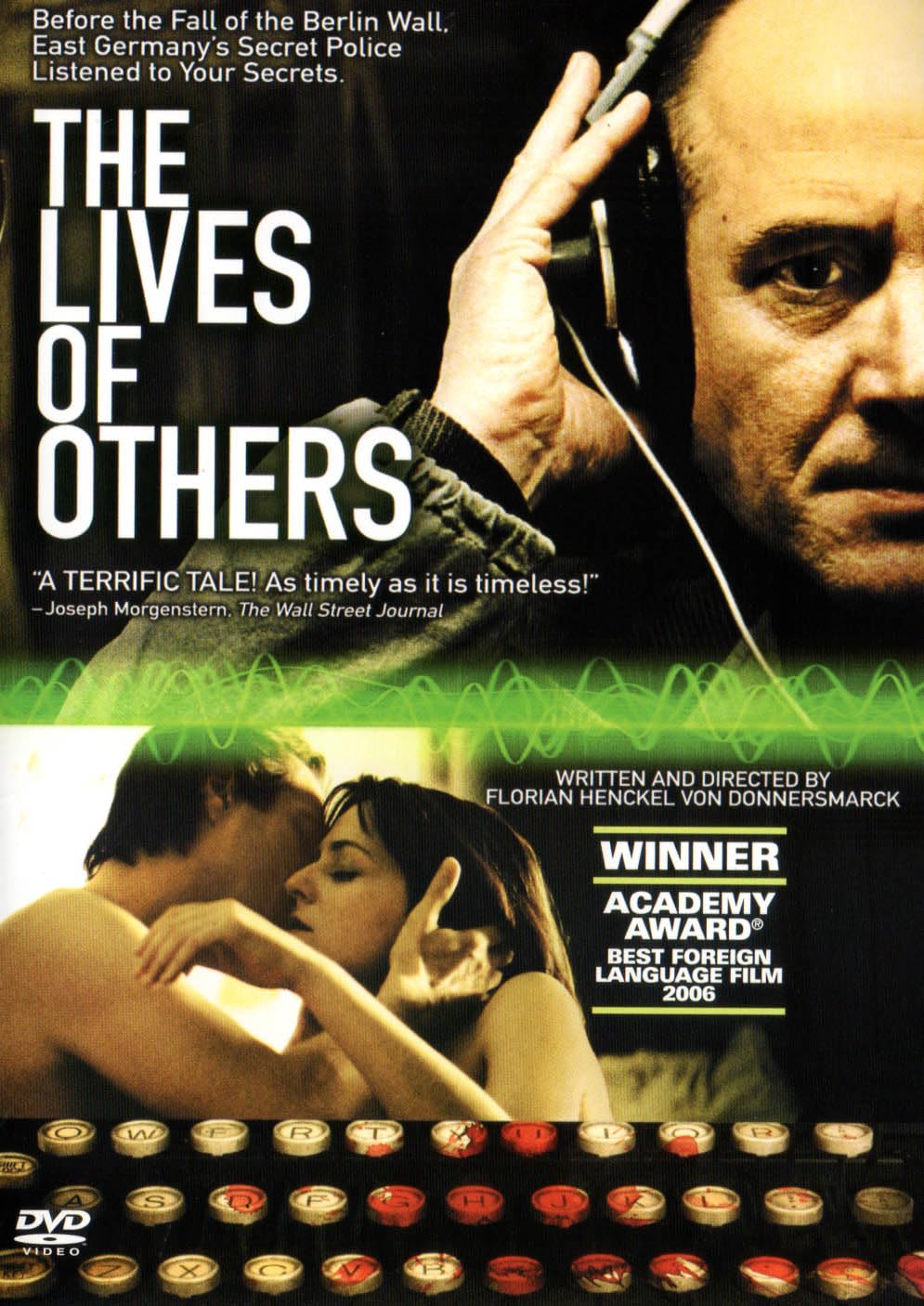
This critically-acclaimed, Oscar®-winning film (Best Foreign Language Film, 2006) is the erotic, emotionally-charged experience Lisa Schwarzbaum (Entertainment Weekly) calls "a nail-biter of a thriller!" Before the collapse of the Berlin Wall, East Germanys population was closely monitored by the State Secret Police (Stasi). Only a few citizens above suspicion, like renowned pro-Socialist playwright Georg Dreyman, were permitted to lead private lives. But when a corrupt government official falls for Georgs stunning actress-girlfriend, Christa, an ambitious Stasi policeman is ordered to bug the writers apartment to gain incriminating evidence against the rival. Now, what the officer discovers is about to dramatically change their lives - as well as his - in this seductive political thriller Peter Travers (Rolling Stone) proclaims is "the best kind of movie: one you cant get out of your head." Nominated for a Best Foreign Language Film Oscar, this is a first-rate thriller that, like Bertolucci's The Conformist and Coppola's The Conversation , opts for character development over car chases. The place is East Berlin, the year is 1984, and it all begins with a simple surveillance assignment: Capt. Gerd Wiesler (Ulrich Mühe in a restrained, yet deeply felt performance), a Stasi officer and a specialist in this kind of thing, has been assigned to keep an eye on Georg Dreyman (Sebastian Koch, Black Book ), a respected playwright, and his actress girlfriend, Christa-Maria Sieland (Martina Gedeck, Mostly Martha ). Though Dreyman is known to associate with the occasional dissident, like blacklisted director Albert Jerska (Volkmar Kleinert), his record is spotless. Everything changes when Wiesler discovers that Minister Hempf (Thomas Thieme) has an ulterior motive in spying on this seemingly upright citizen. In other words, it's personal, and Wiesler's sympathies shift from the government to its people--or at least to this one particular person. That would be risky enough, but then Wiesler uses his privileged position to affect a change in Dreyman's life. The God-like move he makes may be minor and untraceable, but it will have major consequences for all concerned, including Wiesler himself. Writer/director Florian Henckel von Donnersmarck starts with a simple premise that becomes more complicated and emotionally involving as his assured debut unfolds. Though three epilogues is, arguably, two too many, The Lives of Others is always elegant, never confusing. It's class with feeling. -- Kathleen C. Fennessy Beyond The Lives of Others Films from Germany Other Cold War Films More Arthouse Selections from Sony Pictures Classics Review: The Man In the Grey Flannel Life - Made on a shoestring budget of $2 million, The Lives of Others is the most suspenseful psychological thriller I've seen in a long time, ranking with Francis Ford Coppola's The Conversation and John Frankenheimer's The Manchurian Candidate. What's more, it presents one of the strongest pro-individual, anti-collectivist themes of any movie I've ever seen--all the more surprising because it hails from, of all places, Germany. Its key lies in its title, which seems at first glance drippingly altruistic. The year, appropriately, is 1984, and Captain Gerd Wiesler (Ulrich Mühe) is in his twentieth year as an agent of East Germany's dreaded Ministry for State Security, commonly known as "Stasi." The "shield and sword" of the Socialist Unity Party, 100,000 Stasi agents and 200,000 paid informers hold the small Soviet satellite nation in a death grip, monitoring and controlling the lives of its 17 million citizens. Captain Wiesler is a meticulous interrogator, ruthlessly wearing down suspects until they confess. An instructor at the Stasi academy, he trains future agents always to be on guard. "The best way to establish guilt or innocence is non-stop interrogation," he instructs his students. "The enemies of the state are arrogant. Remember that. " A humorlessly menacing man, Wiesler leads a lonely, Spartan existence in an antiseptic, sparsely furnished apartment in a concrete high-rise that houses many fellow agents. One day at the academy, his former classmate and current boss, gregarious Lieutenant Colonel Grubitz (Ulrich Tukur), drops in with an assignment right up Wiesler's alley. One of their artists appears to be straying from the flock, and Wiesler has been assigned to watch him. However, the subject in question is no dissident, but the most celebrated playwright in East Germany, Georg Dreymann (Sebastian Koch)--a citizen so loyal to the Party that he believes his is "the greatest country on earth." Later that evening, spying from a balcony seat with opera glasses, Wiesler detects the mark of subversiveness on Dreymann's face as he watches the actors onstage performing his play. As Georg beams with proprietary approval, rising to applaud, Wiesler quietly utters to himself a one-word indictment that seals the dramatist's fate: "Arrogant." Georg lives with longtime companion Christa-Maria Sieland (Martina Gedeck)--a radiant brunette who is as celebrated an actress as Georg is a writer (and to whom Wiesler clearly takes a fancy). While they are out of their flat, Wiesler's technical team descends upon their home, bugging the place. "Operation Lazlo" is now in full swing, and Wiesler and his partner monitor their subjects around the clock from the apartment building's empty attic. At first, the surveillance of Georg and Christa appears fruitless. At a dinner party they host, a hysterical theatrical colleague (Hans-Uwe Bauer), who's suffered detention and psychological torture at Berlin's infamous Hohenschönhausen prison, accuses another director of being a Stasi informer. Georg is quick to defend the man against the accusation. Yet, through the course of his work, Wiesler makes some rather ugly discoveries about the investigation. He learns that it was ordered at the behest of national Culture Minister Bruno Hempf (Thomas Thieme), a porcine bureaucrat who's extorted sexual favors from Christa under the threat of blacklisting her. Wiesler also eventually finds his friend Grubitz's schmoozing to be a cover for vicious social climbing and discovers that Grubitz is complicit with Hempf's scheme to use Stasi as a cat's paw to eliminate Georg, his romantic rival. Within Wiesler stirs a realization previously kept repressed: that his unquestioning faith in his country has enabled not his ideal of the perfect socialist state, but the hideous arrogance of avaricious thugs who run everything in the "workers' utopia." Where once was the heel-clicking impersonality of a robot, a conscience begins to grow. Wiesler comes to view Georg and Christa and their circle of bohemian friends not as specimens under a microscope, but as real individuals, with hopes and dreams, loves and heartbreaks. Having grown a conscience, he soon also yearns for a heart, as he silently assesses the utter emptiness of his own life. Swept up in his subjects' personal lives, Wiesler's detached spying turns into voyeurism. But it isn't a perverted voyeurism, because, for the first time, the lonely captain catches a glimpse into a world of beauty, poetry, and music that is alien to his two-dimensional existence. Sympathetic to the predicament of these enemies of the state, Wiesler begins covering for them, faking his reports, and remaining silent about Georg's gradual disillusionment with the DDR after an old director friend (Volkmar Kleinert) commits suicide. He overhears an argument in which Georg confronts Christa with knowledge of her affair with Hempf. Christa--already insecure about her talent--explains that she fears being blacklisted if she breaks it off. Wiesler feels compelled to protect her: He accidentally-on-purpose runs into her in a bar, pretending to be a fan, and tells her that her performances have inspired him. "Many people love you for who you are," he says, sincerely. "You are even more yourself onstage than you are in real life." Christa dismisses his compliment, telling Wiesler he can't really know her. "Did you know that I would sell myself for art?" she asks. "But you already have art," he counters. "That would be a bad deal; you're a great artist." Though his simple compassion, he gives Christa the strength to believe in herself and renounce her extorted affair with Hempf. But in doing so, Wiesler unintentionally sets into motion a nail-biting series of events that leads inexorably both to tragedy and redemption. The Lives of Others is a superb film, top-drawer in every regard. Cathartic and ennobling, it recalls Fahrenheit 451 and We the Living in its presentation of tragic heroes forced to examine their deepest-held yet deeply mistaken principles. Hagen Bogdanski's cinematography is compelling; through subtle differences in lighting he gives Silke Buhr's sets an additional dimension that places the characters in emotional context. Shot with tungsten-balanced film, Georg and Christa's incandescently-lit apartment radiates warmth; yet by capturing with daylight film the omnipresent, fluorescent-lit settings of the Stasi world, Bogdanski renders it cold and bloodless. Gabriel Yared's simple, haunting soundtrack is the perfect evocative counterpart for the action onscreen. The acting is realistic, but never naturalistic. Martina Gedeck is a pleasure to watch, not merely because of her physical beauty, but for her impressive emotional range. Ulrich Tukur's capacity to turn on a dime from regular guy to cold-blooded manipulator is simply scary. And Sebastian Koch combines a physically imposing presence with a gentle, almost fatherly manner, reminding me of a younger Rutger Hauer. But Ulrich Mühe steals the show as Wiesler. I have never seen an actor convey such a broad range of feelings within such narrow parameters. Where a Pacino or a Steiger would explode with ferocity, Mühe underplays, moving the audience with the sudden shift of an eyebrow, the drawing-in of a cheek muscle, or the quiet fall of a teardrop that betrays his sphinx-like façade. Mühe began his acting career in communist East Germany. When government records were opened to the public after German reunification, he learned that his actress wife had been informing on him to the Stasi during the entire six years of their marriage. Clearly, he drew upon this reservoir of traumatic betrayal for this role. The Lives of Others is flawlessly crafted, completely engaging the heart and mind. Most impressive is the fact that it's Henckel von Donnersmarck's feature film debut, released while he was still at the relatively young age of 32. In a recent interview, von Donnersmarck--who saw life behind the Iron Curtain first-hand when he visited family in East Germany as a child--spelled out his thoughts on communist repression as well as independent filmmaking: "The [phrase] 'Independent film' makes sense to me only if it means that the director has full artistic control. How could a film be independent otherwise? ... I know that very well from East Germany: Until the Wall came down, the Dictatorship of the Proletariat had Final Cut on everything: novels, plays, films, even paintings. Make no mistake: hardly ever did they actually censor anything. But looking back at the art of those four decades, you can still feel the state in everything, and most of the art of that era is very impersonal and boring. Because the artists censored themselves, often without knowing it." Imagine my surprise, then, when the PC crowd at the recent Academy Awards ceremony--who feted environmental scam-artist Al Gore for his global warming crock-umentary--also bestowed the Best Foreign Language Film award upon The Lives of Others, rather than upon heavily favored Pan's Labyrinth. (I think Lives deserved the nod for Best Motion Picture overall, but I'm not unhappy that the Academy gave that award to director Martin Scorsese's The Departed, a consolation prize for snubbing him so many years.) This cinematic masterpiece is a cause for celebration. Rarely has a filmmaker burst on the scene in such total command of his material. As a directorial debut, The Lives of Others belongs in the same company as Orson Welles's Citizen Kane. I can only hope that Florian Henckel von Donnersmarck has a Touch of Evil yet to come. Review: Exceptional - This is an exceptional film. Don't let the fact that it's subtitled keep you away. The dialogue is at an easy pace. This film doesn't waste a single moment. It's a story within an historical time that everyone, especially today, should see. Very well done. Bravo.
I**P
The Man In the Grey Flannel Life
Made on a shoestring budget of $2 million, The Lives of Others is the most suspenseful psychological thriller I've seen in a long time, ranking with Francis Ford Coppola's The Conversation and John Frankenheimer's The Manchurian Candidate. What's more, it presents one of the strongest pro-individual, anti-collectivist themes of any movie I've ever seen--all the more surprising because it hails from, of all places, Germany. Its key lies in its title, which seems at first glance drippingly altruistic. The year, appropriately, is 1984, and Captain Gerd Wiesler (Ulrich Mühe) is in his twentieth year as an agent of East Germany's dreaded Ministry for State Security, commonly known as "Stasi." The "shield and sword" of the Socialist Unity Party, 100,000 Stasi agents and 200,000 paid informers hold the small Soviet satellite nation in a death grip, monitoring and controlling the lives of its 17 million citizens. Captain Wiesler is a meticulous interrogator, ruthlessly wearing down suspects until they confess. An instructor at the Stasi academy, he trains future agents always to be on guard. "The best way to establish guilt or innocence is non-stop interrogation," he instructs his students. "The enemies of the state are arrogant. Remember that. " A humorlessly menacing man, Wiesler leads a lonely, Spartan existence in an antiseptic, sparsely furnished apartment in a concrete high-rise that houses many fellow agents. One day at the academy, his former classmate and current boss, gregarious Lieutenant Colonel Grubitz (Ulrich Tukur), drops in with an assignment right up Wiesler's alley. One of their artists appears to be straying from the flock, and Wiesler has been assigned to watch him. However, the subject in question is no dissident, but the most celebrated playwright in East Germany, Georg Dreymann (Sebastian Koch)--a citizen so loyal to the Party that he believes his is "the greatest country on earth." Later that evening, spying from a balcony seat with opera glasses, Wiesler detects the mark of subversiveness on Dreymann's face as he watches the actors onstage performing his play. As Georg beams with proprietary approval, rising to applaud, Wiesler quietly utters to himself a one-word indictment that seals the dramatist's fate: "Arrogant." Georg lives with longtime companion Christa-Maria Sieland (Martina Gedeck)--a radiant brunette who is as celebrated an actress as Georg is a writer (and to whom Wiesler clearly takes a fancy). While they are out of their flat, Wiesler's technical team descends upon their home, bugging the place. "Operation Lazlo" is now in full swing, and Wiesler and his partner monitor their subjects around the clock from the apartment building's empty attic. At first, the surveillance of Georg and Christa appears fruitless. At a dinner party they host, a hysterical theatrical colleague (Hans-Uwe Bauer), who's suffered detention and psychological torture at Berlin's infamous Hohenschönhausen prison, accuses another director of being a Stasi informer. Georg is quick to defend the man against the accusation. Yet, through the course of his work, Wiesler makes some rather ugly discoveries about the investigation. He learns that it was ordered at the behest of national Culture Minister Bruno Hempf (Thomas Thieme), a porcine bureaucrat who's extorted sexual favors from Christa under the threat of blacklisting her. Wiesler also eventually finds his friend Grubitz's schmoozing to be a cover for vicious social climbing and discovers that Grubitz is complicit with Hempf's scheme to use Stasi as a cat's paw to eliminate Georg, his romantic rival. Within Wiesler stirs a realization previously kept repressed: that his unquestioning faith in his country has enabled not his ideal of the perfect socialist state, but the hideous arrogance of avaricious thugs who run everything in the "workers' utopia." Where once was the heel-clicking impersonality of a robot, a conscience begins to grow. Wiesler comes to view Georg and Christa and their circle of bohemian friends not as specimens under a microscope, but as real individuals, with hopes and dreams, loves and heartbreaks. Having grown a conscience, he soon also yearns for a heart, as he silently assesses the utter emptiness of his own life. Swept up in his subjects' personal lives, Wiesler's detached spying turns into voyeurism. But it isn't a perverted voyeurism, because, for the first time, the lonely captain catches a glimpse into a world of beauty, poetry, and music that is alien to his two-dimensional existence. Sympathetic to the predicament of these enemies of the state, Wiesler begins covering for them, faking his reports, and remaining silent about Georg's gradual disillusionment with the DDR after an old director friend (Volkmar Kleinert) commits suicide. He overhears an argument in which Georg confronts Christa with knowledge of her affair with Hempf. Christa--already insecure about her talent--explains that she fears being blacklisted if she breaks it off. Wiesler feels compelled to protect her: He accidentally-on-purpose runs into her in a bar, pretending to be a fan, and tells her that her performances have inspired him. "Many people love you for who you are," he says, sincerely. "You are even more yourself onstage than you are in real life." Christa dismisses his compliment, telling Wiesler he can't really know her. "Did you know that I would sell myself for art?" she asks. "But you already have art," he counters. "That would be a bad deal; you're a great artist." Though his simple compassion, he gives Christa the strength to believe in herself and renounce her extorted affair with Hempf. But in doing so, Wiesler unintentionally sets into motion a nail-biting series of events that leads inexorably both to tragedy and redemption. The Lives of Others is a superb film, top-drawer in every regard. Cathartic and ennobling, it recalls Fahrenheit 451 and We the Living in its presentation of tragic heroes forced to examine their deepest-held yet deeply mistaken principles. Hagen Bogdanski's cinematography is compelling; through subtle differences in lighting he gives Silke Buhr's sets an additional dimension that places the characters in emotional context. Shot with tungsten-balanced film, Georg and Christa's incandescently-lit apartment radiates warmth; yet by capturing with daylight film the omnipresent, fluorescent-lit settings of the Stasi world, Bogdanski renders it cold and bloodless. Gabriel Yared's simple, haunting soundtrack is the perfect evocative counterpart for the action onscreen. The acting is realistic, but never naturalistic. Martina Gedeck is a pleasure to watch, not merely because of her physical beauty, but for her impressive emotional range. Ulrich Tukur's capacity to turn on a dime from regular guy to cold-blooded manipulator is simply scary. And Sebastian Koch combines a physically imposing presence with a gentle, almost fatherly manner, reminding me of a younger Rutger Hauer. But Ulrich Mühe steals the show as Wiesler. I have never seen an actor convey such a broad range of feelings within such narrow parameters. Where a Pacino or a Steiger would explode with ferocity, Mühe underplays, moving the audience with the sudden shift of an eyebrow, the drawing-in of a cheek muscle, or the quiet fall of a teardrop that betrays his sphinx-like façade. Mühe began his acting career in communist East Germany. When government records were opened to the public after German reunification, he learned that his actress wife had been informing on him to the Stasi during the entire six years of their marriage. Clearly, he drew upon this reservoir of traumatic betrayal for this role. The Lives of Others is flawlessly crafted, completely engaging the heart and mind. Most impressive is the fact that it's Henckel von Donnersmarck's feature film debut, released while he was still at the relatively young age of 32. In a recent interview, von Donnersmarck--who saw life behind the Iron Curtain first-hand when he visited family in East Germany as a child--spelled out his thoughts on communist repression as well as independent filmmaking: "The [phrase] 'Independent film' makes sense to me only if it means that the director has full artistic control. How could a film be independent otherwise? ... I know that very well from East Germany: Until the Wall came down, the Dictatorship of the Proletariat had Final Cut on everything: novels, plays, films, even paintings. Make no mistake: hardly ever did they actually censor anything. But looking back at the art of those four decades, you can still feel the state in everything, and most of the art of that era is very impersonal and boring. Because the artists censored themselves, often without knowing it." Imagine my surprise, then, when the PC crowd at the recent Academy Awards ceremony--who feted environmental scam-artist Al Gore for his global warming crock-umentary--also bestowed the Best Foreign Language Film award upon The Lives of Others, rather than upon heavily favored Pan's Labyrinth. (I think Lives deserved the nod for Best Motion Picture overall, but I'm not unhappy that the Academy gave that award to director Martin Scorsese's The Departed, a consolation prize for snubbing him so many years.) This cinematic masterpiece is a cause for celebration. Rarely has a filmmaker burst on the scene in such total command of his material. As a directorial debut, The Lives of Others belongs in the same company as Orson Welles's Citizen Kane. I can only hope that Florian Henckel von Donnersmarck has a Touch of Evil yet to come.
M**R
Exceptional
This is an exceptional film. Don't let the fact that it's subtitled keep you away. The dialogue is at an easy pace. This film doesn't waste a single moment. It's a story within an historical time that everyone, especially today, should see. Very well done. Bravo.
R**N
'1984' REVISITED...AND TODAY 2013
It's almost unreal to think that on 11/9/89 the Berlin Wall fell. I watched it that night - LIVE -via satellite, as the victims of Communism and its little sister Socialism cheered, kissed and sat on the wall, and took sledge hammers to it...the same wall that for 30 years separated Freedom from Slavery...on this night brothers and sisters, fathers and children crossed over and through the Wall and embraced in Freedom. I remembered in the early 1960's watching on the evening news as women and men were machine-gunned trying to climb the barbed wire fence erected prior to the concrete one. How soon we forget. I imagine no adult today under 40 has any memory or knowledge of this event. Or else why would they now be worshiping Socialism in our Universities and High Schools, and in our 'mainstream media' and in our very Government and in the White House. The Socialists in our Congress - openly 'serving'and subverting our Republic; and the Socialists in our Media - Belafonte, Glover,Asner etc; the Leftists in our broadcast media...can they all be so stupid? This movie should be required watching in all public schools. But no, it would be called 'hate speech' or 'extremist propaganda...Tea Party fear-mongering'. 'The truth will set you free' - as a famous 'philosoper' once said. But 'great lies' will keep you bound. If you think this will never happen again, read and watch CSPAN: IRS, NSA, GOOGLE, the tools of today's Dictator Barrack Hussein Obama and his criminal Attorney General Eric Holder. How thick are their files of their enemies?...as shown in this movie with the Stasi Files - no, their digital files are in the Utah facility...every email, 'friend' on facebook and twitter...their email address book. Watch this movie...it is brilliant in every way. It is scary, and it is emotional. Read the Reviews here by people who lived it. Make your kids watch it...and then discuss it. If you have never read or seen '1984' do so. It is no accident this movie takes place in the real 1984. Big Brother is watching us today. And he is not about 'hope and change'. He is about 'the fundamental transformation of America'- he said it, and he means it. I would like to send this movie to him; would he watch it? Or would the FBI come knocking at my door. As he said at the White House Correspondents Dinner: "I am not the strapping young Muslim Socialist I was then...". No,he is older but no wiser, and still a Socialist. Why do Leftists not learn from the failure of 100 years of a failed ideology, 72 million dead/starved/tortured/executed? Is that not the definition of insanity? Watch this film; you will learn much and never forget it.
R**K
Really good!
Excellent film about the last years of East Germany when it was socialist. Great acting, well written, well directed and the music works well too. Highly recommended.
D**R
Great movie
Excellent acting, script, pace and production. Great movie.
D**R
No English Subtitles
I bought this film because I really enjoyed it when it was released, and I also like to watch German language films so that I don’t entirely forget the 4 semesters of German that I took in college. So, I purchased this film with the hopes of rewatching a great film and hearing the language. However, there are no subtitles whatsoever on the disc. I will just consider it a challenge for my vocabulary, but given that most Americans speak only English, you will be disappointed if you purchase this, expect English subtitles, and you don’t understand any German. To be fair, I did not notice that there were no subtitles in the product’s description when I read it, and I assume that many others will not notice that either.
J**K
"Can anyone who has heard this music--I mean truly heard it--really be a bad person?"
"The Lives of Others" is the best film I've seen in the last decade. Possibly in my life. And it's in German. This is the single most powerful, profound and complete commentary on how a government not only governs people--it determines the course of their lives, pursuits, even their thoughts--that I've ever seen. It is a treasure, and I can't even pronounce half the names of the characters properly. I can't think of many other movies it resembles. The director mentions Dr. Zhivago in the commentary, though only as an example of a similar genre (both are historical fiction). Maybe Reds, or The Conversation. In the world of literature, fans of Milan Kundera and Thomas Mann will be kindred to this film; it strikes a similar political-social tone, asks those Big Questions, and delves into how our daily expectations (of which politics are inextricably tied) affect who we are. And, at the same time, it lays bare the lies of fascism--of any system that claims the choices we make don't matter. Set in East Germany, the main characters (the late Ulrich Mühe, playing the spy HGW, most of all) are condemned to be human--that is, to have free will and be aware of it--in a world where State power is arbitrary, rights imagined, and the moral order absolutely equivocal. In short, to possess life when life itself is superfluous, a life that exists for the state, and never the other way around. But this is far more than a political think-piece, it is a genuine edge-of-your-seat thriller. The plot is remarkably well-paced, and strikes a perfect balance of deliberate stillness and action-oriented coincidence. Lots of moving parts, but they work together well and, ultimately, believably. In fact, some of the most harrowing parts of the plot, about a spy (Mühe) monitoring the lives of a writer, Georg (Sebastian Koch), and his actress girlfriend (Martina Gedeck), mirror Mühe's real life. In the terrific director's commentary, Henckel von Donnersmarck tells us that Mühe himself discovered, after the wall fell, that several of his fellow actors were spies planted by the Stasi, and his own wife (and mother of his child) was an informant against him and his friends for 6 years. I don't know how his own history affected him while filming, all I can say is, Mühe delivers one of the most layered, subtle and compelling performances I've ever seen, and his death breaks my heart because it reflects an immeasurable loss of talent, experience and humanity. The entire cast shines: in sensual vulnerability (Gedeck's Christa is incredible), comedy (Udo), even in alarming dourness (Georg's neighbor). There are white hats (Georg and his brave friends), and black hats (the slimey Minister) that drive the action along, but it is really the people who are far from heroic, yet who have, at times, "truly heard this music" (HGW, Christa)--they are the ones who make this film so indelibly rich and fulfilling. Condemned to make impossible choices, they don't always act honorably--and you can't take your eyes off them for a second. In addition to the superb director's commentary, the DVD includes a 30-min interview with the director, a 20-min "making of" featurette, and several deleted scenes. Subtitles can be turned off, or turned on in English, French or Spanish.
K**R
1984 GDR emulates Orwell's Big Brother world
When the Berlin wall fell, chaos ensued and the East German people were shocked by the number of Stasi agents and pawns (up to 500,000 of them) who had compiled notes, photos, and both audio and video surveillance on them. This movie ends shortly after the Wall came down. However most of the action ensues in 1984 (a hat-tip to the Orwell novel) when a horny GDR official wants more sex from a prominent actress and "suggests" that she and her lover be thoroughly monitored to ensure allegiance to the GDR and hopefully provides said official with more leverage with the actress.. Thus a loyal Stasi soldier is put in charge of watching and listening to the writer and the actress as they live out their lives. It is the man who is "Big Brother" in this case who finds himself living vicariously through the couple. Consequences for both watched and watcher ensue that are so human you forget this is a movie and you believe these people are real. Yes, the dialogue is German and subtitles are necessary but you do not find them annoying because you are thrust into the moment...there is sex without being gratuitous. We get the chance to view the life that was 1984 in Communist GDR in this artful documentary-style film. So powerful and so pitiful and absolutely unforgettable! Note: West Germans were appalled at the number of two-cycle Trabant autos that came across the border and would often give them a swift kick (which would often put a hole in the poorly-made GDR vehicles). East Germans came to Stasi headquarters to view the records that had been compiled about them. The Stasi began to shred documents when the wall fell, but there were so many and the fear of being beaten or even killed by the public caused them to abandon the records building and seek anonymity. The GDR would use friends and family and lovers to report on each other. The Lives Of Others might be fiction yet is is also truth.