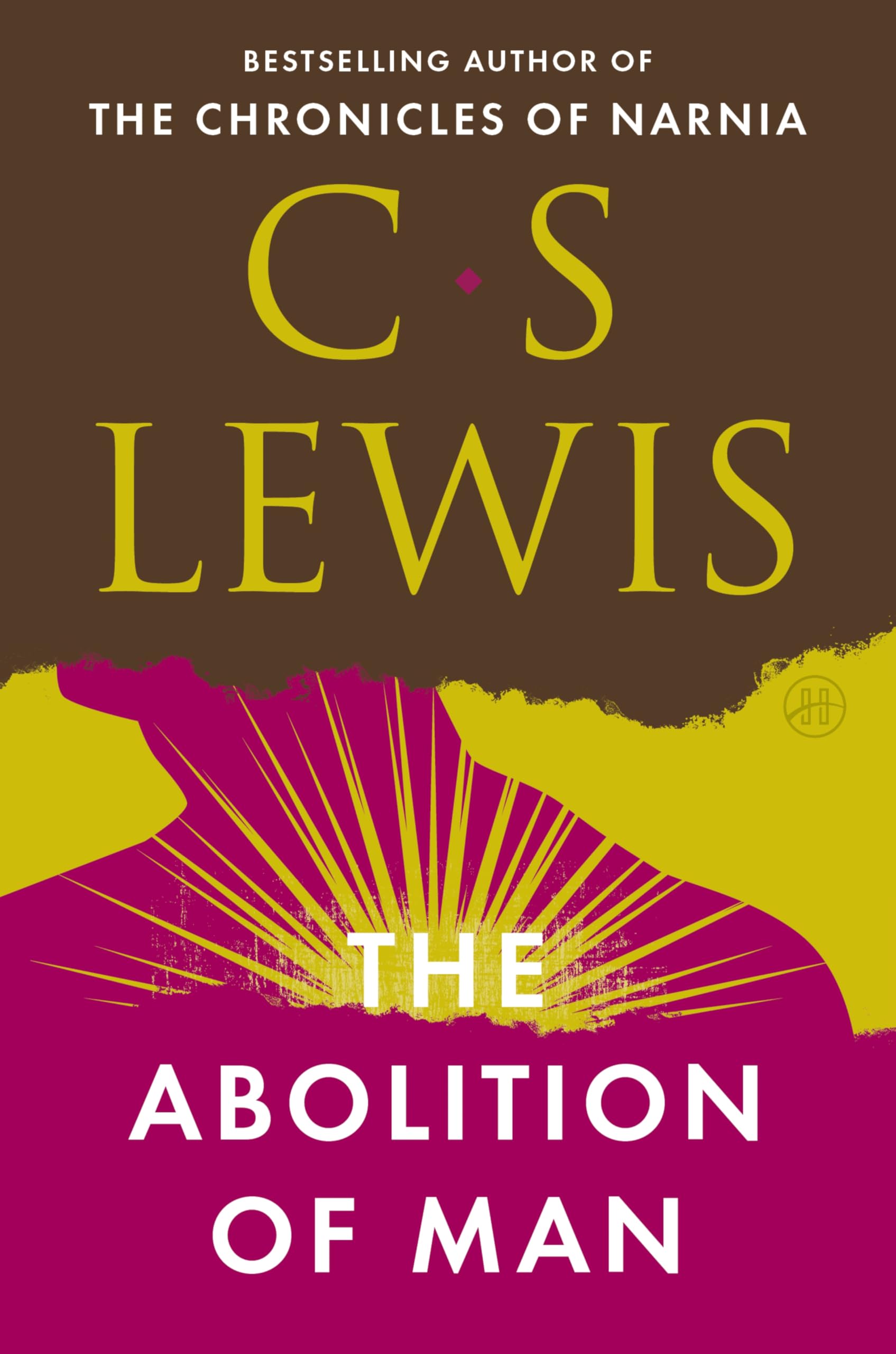
The Abolition of Man [Lewis, C. S.] on desertcart.com. *FREE* shipping on qualifying offers. The Abolition of Man Review: On First Things - This was just really enjoyable to read. Quick, certainly, but, oh, such excellent writing! And even clearer philosophy. I feel I must approach the Master with great humility, for his style and thoughts are so much clearer than my own. What right have I to critique him? I'll do it anyway. This would be an excellent introductory book to a class on religions. Lewis displays a convincing argument for the existence of morality, using resources from many different traditions, not just his own Christian one. He is to be commended however for also stating his own tradition, that we might know his biases. (The only flaw is a lack of Islamic sources, perhaps because Lewis tended to know less about that particular religion than others.) It is hard to walk away from the book still convinced that there are no ethics, or that an aethitical system is possible. Those who have read other Lewis works will see echoes here, such as the essay On First Things from God in the Dock, That Hideous Strength, and the Magician's Nephew. Lewis uses his knowledge of literature to show us that morality is necessary if we are to speak realistically at all; that an amoral system of ethics is by nature moral; and that one absent of any morality at all is reduced simply to animal instincts. In this last unit, he preaches of the fear that science will reduce humanity into mere object, rather than into a glorious creation. In no way is this anti-scientific diatribe- but rather cautionary tale of the dangers of excess, if we continue in our current vein of thought. A couple flaws bring the book down. Early on, he takes a swipe at pacifism by implying that there is something wrong with those who argue that men are more righteous if they value peace over war. Happily, this is only momentary. And secondly, he consistently uses the word "man". Lewis is a product of his times, yes, but he also strongly argued against inclusive language or women in the pulpit, and his language reflects this. And so the book's title. As well as the use of the term "redskin" when referring to ancient Native American beliefs at the end of the book. Lewis is at his best when demolishing arguments, using the arguments of his opponents. He does this with tact and compassion, not even mentioning the opponents by name, and constantly complimenting on what they have said- but not being afraid to point out the great tragedy that would result if students of a particular "Little Green Book" were to take the authors seriously. If followed, we would lose something deep within us, the capacity to have passion, and enjoy life, out of which morality springs. For following the guidelines of the Little Green Book, we would no longer be able to say something was good in and of itself, but only that it felt good, as everything is now subjective. But there is an alternative, the Tao, the Way, which we find in all cultures everywhere, and in all religious traditions. The morality, as Lewis has said many times before in many other places, is basically the same in all religious systems; there is only the smallest of differences between them. And this morality is the guiding principle, or can be, or should be, for us all. It is inherent in our . . . very nature. Review: Extraordinary book, but the formatting of the $3 edition I bought is flawed. I got a pdf instead. - The Good: First and foremost--the content of this little volume is profound and important. Don't let the following comments deter you from reading this book. Just be forewarned that this particular edition/format has some problems that made me find another source. Second--the Kindle format is a bonus. It makes it easy to quickly find those passages that need to be reviewed and reflected upon. It makes it simple to jot your own thoughts about the questions raised. It makes it a cinch to share. The Bad: Nevertheless, the formatting in the Kindle edition that I bought for three bucks has so many problems that I'm going to try and return it for a refund since there is a pdf available of the text. It is not so messed up that I can't read it, but it is messed up enough that I have to copy certain sections and paste them into Google to find out where sentences end, where commas or highlighting are omitted and where there are other strange goofs. Capitalization, for instance, is almost arbitrary: "The most determined effort which i know" or "dr i. A. Richards". The list includes chunks of misplaced text, and so on. The Final Analysis: In any format this book requires a slow read, so maybe it is just as well that the formatting is so messed up in this particular edition. It has made me read it even more slowly. Still, there is room for improvement, even for three bucks. Read it in this format or in some other format, but definitely give it a read and give it serious thought.



| Best Sellers Rank | #8,641 in Books ( See Top 100 in Books ) #12 in Christian Apologetics (Books) #77 in Inspirational Spirituality (Books) #169 in Christian Spiritual Growth (Books) |
| Customer Reviews | 4.5 out of 5 stars 3,104 Reviews |
J**I
On First Things
This was just really enjoyable to read. Quick, certainly, but, oh, such excellent writing! And even clearer philosophy. I feel I must approach the Master with great humility, for his style and thoughts are so much clearer than my own. What right have I to critique him? I'll do it anyway. This would be an excellent introductory book to a class on religions. Lewis displays a convincing argument for the existence of morality, using resources from many different traditions, not just his own Christian one. He is to be commended however for also stating his own tradition, that we might know his biases. (The only flaw is a lack of Islamic sources, perhaps because Lewis tended to know less about that particular religion than others.) It is hard to walk away from the book still convinced that there are no ethics, or that an aethitical system is possible. Those who have read other Lewis works will see echoes here, such as the essay On First Things from God in the Dock, That Hideous Strength, and the Magician's Nephew. Lewis uses his knowledge of literature to show us that morality is necessary if we are to speak realistically at all; that an amoral system of ethics is by nature moral; and that one absent of any morality at all is reduced simply to animal instincts. In this last unit, he preaches of the fear that science will reduce humanity into mere object, rather than into a glorious creation. In no way is this anti-scientific diatribe- but rather cautionary tale of the dangers of excess, if we continue in our current vein of thought. A couple flaws bring the book down. Early on, he takes a swipe at pacifism by implying that there is something wrong with those who argue that men are more righteous if they value peace over war. Happily, this is only momentary. And secondly, he consistently uses the word "man". Lewis is a product of his times, yes, but he also strongly argued against inclusive language or women in the pulpit, and his language reflects this. And so the book's title. As well as the use of the term "redskin" when referring to ancient Native American beliefs at the end of the book. Lewis is at his best when demolishing arguments, using the arguments of his opponents. He does this with tact and compassion, not even mentioning the opponents by name, and constantly complimenting on what they have said- but not being afraid to point out the great tragedy that would result if students of a particular "Little Green Book" were to take the authors seriously. If followed, we would lose something deep within us, the capacity to have passion, and enjoy life, out of which morality springs. For following the guidelines of the Little Green Book, we would no longer be able to say something was good in and of itself, but only that it felt good, as everything is now subjective. But there is an alternative, the Tao, the Way, which we find in all cultures everywhere, and in all religious traditions. The morality, as Lewis has said many times before in many other places, is basically the same in all religious systems; there is only the smallest of differences between them. And this morality is the guiding principle, or can be, or should be, for us all. It is inherent in our . . . very nature.
H**H
Extraordinary book, but the formatting of the $3 edition I bought is flawed. I got a pdf instead.
The Good: First and foremost--the content of this little volume is profound and important. Don't let the following comments deter you from reading this book. Just be forewarned that this particular edition/format has some problems that made me find another source. Second--the Kindle format is a bonus. It makes it easy to quickly find those passages that need to be reviewed and reflected upon. It makes it simple to jot your own thoughts about the questions raised. It makes it a cinch to share. The Bad: Nevertheless, the formatting in the Kindle edition that I bought for three bucks has so many problems that I'm going to try and return it for a refund since there is a pdf available of the text. It is not so messed up that I can't read it, but it is messed up enough that I have to copy certain sections and paste them into Google to find out where sentences end, where commas or highlighting are omitted and where there are other strange goofs. Capitalization, for instance, is almost arbitrary: "The most determined effort which i know" or "dr i. A. Richards". The list includes chunks of misplaced text, and so on. The Final Analysis: In any format this book requires a slow read, so maybe it is just as well that the formatting is so messed up in this particular edition. It has made me read it even more slowly. Still, there is room for improvement, even for three bucks. Read it in this format or in some other format, but definitely give it a read and give it serious thought.
P**S
Print on demand copy
The book itself is good but be aware this is an Amazon print on demand version , not the original bookstore edition.
T**M
Succinct, objective, incredible
So many highlights and notes made. Out of few pages unfold an eternity of wisdom. Thought provoking and an incredible work.
J**E
Beware modern day moral relativism nonsense.
The Abolition of Man, by C.S Lewis. Let this be your guide in moral philosophy. Beware moral relativism. There has been, IS TODAY, and must always be objective Natural Law, moral order. The Tao…call it what you will. These are Universal truths, universal “good”….across time, across cultures. Drift and question that fact at your own peril…
D**N
Don’t read unless you want to be challenged
Lewis elegantly articulates the need for an objective position that man draws his reasoning from and what the end state of a man without that position is. Lewis doesn’t challenge the religion of a man in this book, he challenges his reasoning to affirm or deny one while demonstrating the destruction of moral subjectivism on mankind. This writing reflects a divide in culture that we see today as new and reminds us that there is now new ideologies, only repackaged ones.
T**N
Lewis Deserves A Better Editor
The original work by C.S. Lewis offers a marvelous challenge to the contemporary trend that sees all value judgments as purely subjective — as matters of mere emotion, rather than reactions to features of the world, which can be objectively right or wrong. Unfortunately, this edition is horribly edited, with frequent typos and even large sections of missing text. I found myself having to go online to find a more accurate version of the text. So by all means, read the book, but not in this edition by Valde Books.
D**L
A Defense of Objective Values
This is a different book than C.S. Lewis' others. First of all, it is academic, sprinkled with Latin phrases and footnotes. Secondly, it is not a Christian book, but rather a defence of the idea that certain moral values are objective. Lewis is making a critique of moral relativism by showing that taken to its logical end it destroys the basis for making any value judgments whatsoever. It is similar to the first part of "Mere Christianity," though there Lewis argues from the existence of a universal moral law to a lawgiver. Here he simply argues that this law, or Tao as he calls it, should be treated as one does the axioms, the self-evident but unprovable truths upon which math is based. For a short book it is profound and you may find yourself putting it down from time to time to think about what you've just read. At the end Lewis has compiled evidence for aspects of the Tao from a wide range of sources, from Sumerian to Egyptian to Roman to Chinese to American to Australian Aboriginal ethics. Very illuminating.