
下载应用程序



Full description not available
R**K
Assigned it for a class.
Oxford is the way to go.
A**R
Had a great time reading!
A great companion for dry formal/mathematical logic texts- makes it vivid and enjoyable!
S**S
Good for the care and feeding of your brain cells
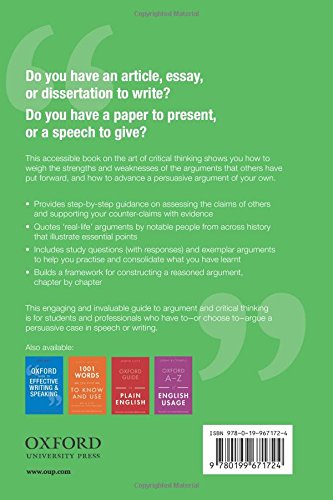
This is one of the few practical texts on critical thinking which does not get bogged down with the formulaic preoccupations of philosophy and so is accessible for undergraduate university students in other disciplines and for readers in general. The quest to find a critical thinking text of this nature is long and difficult, as I know in looking for a book for my own students in journalism. The only other comparable critical thinking text, though quite different and somewhat idiosyncratic, is Critical Thinking by Richard W. Paul and his wife Linda Elder. The Paul and Elder text is much more thorough and lengthy, but it is this extensiveness, as well as its complexity, that make it impractical to use with students. The Swatridge guide is therefore a better choice for undergraduates and general readers. The Swatridge text has its own sly Socratic flavour because it teases the reader into thought rather than simply dominating the reader with pronouncements. In other words, the text tries to stimulate critical thinking in the reading of the text rather than just passive understanding. The British background of the author is also a welcome break from the dominance of United States texts with their strong U.S. national focus. Where both Swatridge and Paul fall short is the applicability of their approach to critical thinking, which is my focus in trying to help my own students. It seems that critical thinking has become a kind of academic knowledge through the education system, instead of a behaviour of mind and personality. I remember the moment of sitting as a guest in the philosophy class of a fellow faculty member and hearing him tell students that he could not be expected to internalize in himself what he was teaching in the course. In any event, among the forest of texts in critical thinking that take the reader deeper into the preoccupations of the discipline of philosophy and farther away from practical applications, the Swatridge text is a good first choice, followed by Paul and Elder for deeper submersion. The moderate length of the Swatridge text and the relative shortness of the chapters are nicely geared to the pacing of reading. The general reader who is sincerely interested in grappling with critical thinking will probably find this book a good choice. Read this book to stimulate your brain cells the way they want to be stimulated.
M**D
Five Stars
As described.
TrustPilot
1 周前
1天前