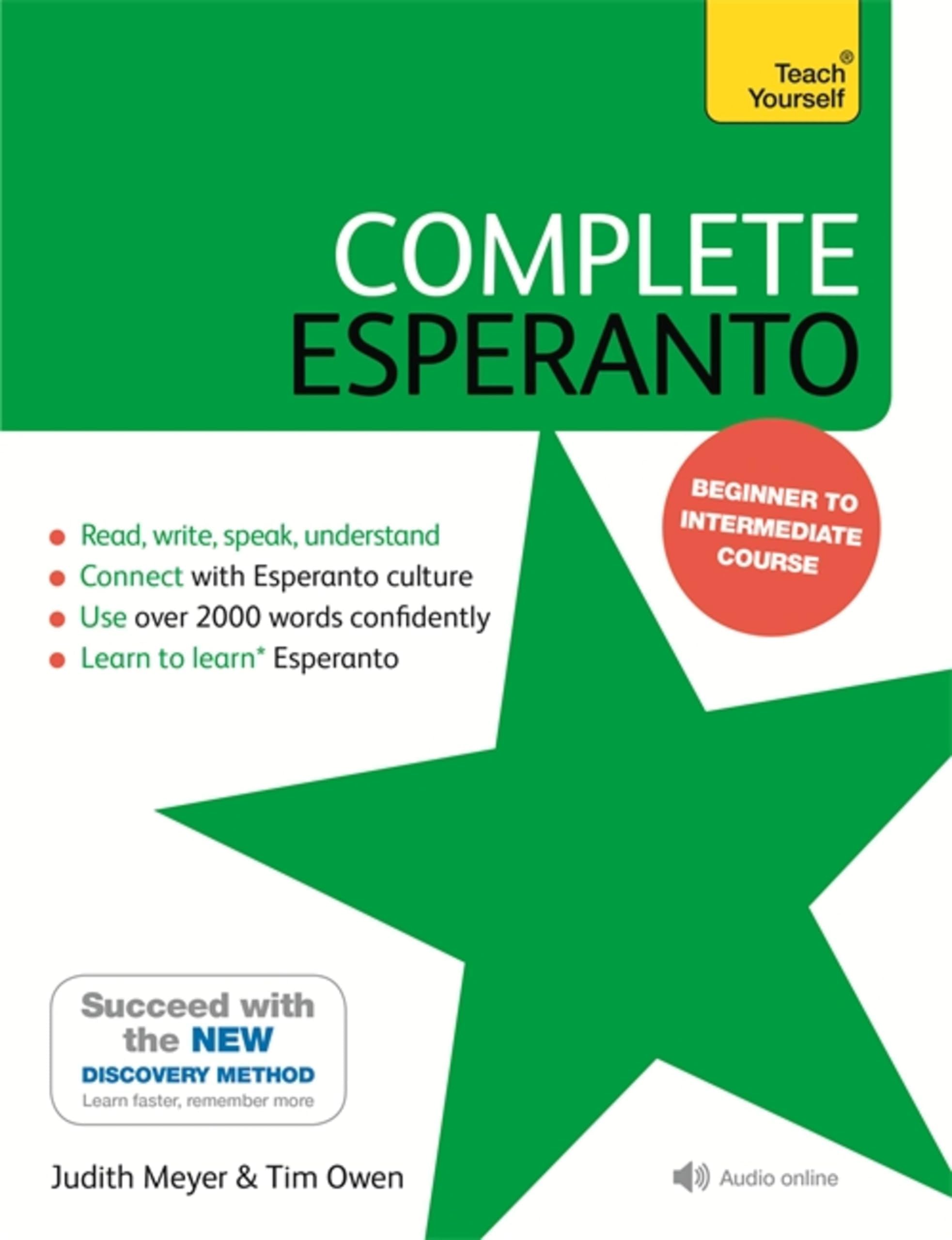
Complete Esperanto: Learn to read, write, speak and understand Esperanto (Teach Yourself)
Product ID: 85697331
Desertcart purchases this item on your behalf and handles shipping, customs, and support to SINGAPORE.
desertcart.com: Complete Esperanto: Learn to read, write, speak and understand Esperanto (Teach Yourself): 9781473669185: Owen, Tim: Books Review: This is the book you want - Update: Thanks to the material in this book, I was able to successfully pass the B1 CEFR exam in Esperanto, six months after having virtually no experience in the language. And I was told that my level was actually closer to B2 at the time. So, when the book says you can get to B1-B2, believe it! Simply put: if you want to learn Esperanto as it is used today, this is the book you want. There are lots of free Esperanto language learning resources out there. Some are decent, some are terrible, and some were decent in their day but are not good for learning modern Esperanto. Here you have a book that is excellent and teaches modern Esperanto. If you're balking at paying for an Esperanto learning resource, here's how I looked at it: I'm going to spend a bunch of hours learning Esperanto. Shouldn't I try to get the most benefit from those hours? So, what’s good about the book? First, the language is current and authentic. The dialogues tell a story of a young language learner from her first online experiences with other Esperantists to her ultimate trip to Bratislava for the Universala Kongreso. It’s not full of old terms that were current in the 1920s but not today. (Esperanto is a living language! Who knew? Not me, at first.) I especially like the “new expressions” sections. You could easily make a set of flash cards with just these. The other thing I really like about this book is that it represents Esperanto Culture. Critics of the language like to argue that Esperanto has no culture, arguing that music and dances aren’t the majority (or most important parts) of a language's culture. They’re right about that, but totally mistaken that Esperanto culture consists primarily of music and dancing. Music and dancing are NOT what Esperanto culture is. No, Esperanto culture is about delighting in other cultures and especially in people who are different from us. It's about communicating with people who just might not think the same way we do. My experience in Esperantujo so far has been mostly wonderful, talking to people who have quite different points of view from mine. Yes, such communication doesn’t always happen perfectly... as my son said, people can hate each other even if they do speak the same language... but that’s due to individual esperantists, not Esperanto or its culture. This book manages to present that culture, including the important concept of the gufujo. The book isn’t perfect, of course. There’s a few minor errors, there’s no index (but it does have a good bidirectional dictionary). But this is the first edition. The author (Tim) is active on the Duolingo Facebook forum and can be easily contacted with corrections. Finally, the app works but I will admit that it isn’t very easy to use: particularly, I don't like how the app increases the volume to max every time you start it up. I've had my ears blasted out more than once. :-( The Andoid app is a little buggy. And quite honestly, I think the chapter navigation is hard to use. However, it's totally usable, and in any case, these are not the book's fault. The same app is used for all the publisher's books. Complaints should go to the publisher, not the book author. In any case: Minor problems. Decide whether you really want to learn the language. If so, buy the book. Review: Fantastic for Language Lovers - I've always had a lust for learning languages. When I found out about the history of Esperanto, I ordered this book right away. I've used tons of language books for Spanish, French, Afrikaans, and Chinese, but this one is by far the most simplistic and helpful when it comes to understanding the language. It doesn't try to make you memorize words, instead it teaches you the rules of Esperanto along with its prefixes, infixes, and suffixes along with root words in order to give you a complete understanding of the book's conversation sections as well as the language as a whole.
| Best Sellers Rank | #131,106 in Books ( See Top 100 in Books ) #203 in Foreign Language Instruction (Books) |
| Customer Reviews | 4.7 out of 5 stars 209 Reviews |
G**Y
This is the book you want
Update: Thanks to the material in this book, I was able to successfully pass the B1 CEFR exam in Esperanto, six months after having virtually no experience in the language. And I was told that my level was actually closer to B2 at the time. So, when the book says you can get to B1-B2, believe it! Simply put: if you want to learn Esperanto as it is used today, this is the book you want. There are lots of free Esperanto language learning resources out there. Some are decent, some are terrible, and some were decent in their day but are not good for learning modern Esperanto. Here you have a book that is excellent and teaches modern Esperanto. If you're balking at paying for an Esperanto learning resource, here's how I looked at it: I'm going to spend a bunch of hours learning Esperanto. Shouldn't I try to get the most benefit from those hours? So, what’s good about the book? First, the language is current and authentic. The dialogues tell a story of a young language learner from her first online experiences with other Esperantists to her ultimate trip to Bratislava for the Universala Kongreso. It’s not full of old terms that were current in the 1920s but not today. (Esperanto is a living language! Who knew? Not me, at first.) I especially like the “new expressions” sections. You could easily make a set of flash cards with just these. The other thing I really like about this book is that it represents Esperanto Culture. Critics of the language like to argue that Esperanto has no culture, arguing that music and dances aren’t the majority (or most important parts) of a language's culture. They’re right about that, but totally mistaken that Esperanto culture consists primarily of music and dancing. Music and dancing are NOT what Esperanto culture is. No, Esperanto culture is about delighting in other cultures and especially in people who are different from us. It's about communicating with people who just might not think the same way we do. My experience in Esperantujo so far has been mostly wonderful, talking to people who have quite different points of view from mine. Yes, such communication doesn’t always happen perfectly... as my son said, people can hate each other even if they do speak the same language... but that’s due to individual esperantists, not Esperanto or its culture. This book manages to present that culture, including the important concept of the gufujo. The book isn’t perfect, of course. There’s a few minor errors, there’s no index (but it does have a good bidirectional dictionary). But this is the first edition. The author (Tim) is active on the Duolingo Facebook forum and can be easily contacted with corrections. Finally, the app works but I will admit that it isn’t very easy to use: particularly, I don't like how the app increases the volume to max every time you start it up. I've had my ears blasted out more than once. :-( The Andoid app is a little buggy. And quite honestly, I think the chapter navigation is hard to use. However, it's totally usable, and in any case, these are not the book's fault. The same app is used for all the publisher's books. Complaints should go to the publisher, not the book author. In any case: Minor problems. Decide whether you really want to learn the language. If so, buy the book.
E**O
Fantastic for Language Lovers
I've always had a lust for learning languages. When I found out about the history of Esperanto, I ordered this book right away. I've used tons of language books for Spanish, French, Afrikaans, and Chinese, but this one is by far the most simplistic and helpful when it comes to understanding the language. It doesn't try to make you memorize words, instead it teaches you the rules of Esperanto along with its prefixes, infixes, and suffixes along with root words in order to give you a complete understanding of the book's conversation sections as well as the language as a whole.
W**S
Great Source
Great Esperanto source!
B**S
Very good to learn from
Its grew my esperanto skills ten fold la libro estas bonega
L**G
Can listen to audio on-line
There is a lot of information to learn in each chapter. For example, some of the material I learned in chapters 7 and 8 in "Esperanto: Learning and Using the International Language," was covered in the first lesson in this book. A lot of vocabulary is given in each chapter, but the way it is presented makes it easier to learn. I found out that by going to library.teachyourself.com and creating an account with them, I could download this book for free and listen to the audio portion in my "library" with them. By the way, the audio at this site was available at least a month before the book became available here in the U.S.A. I agree, I can't seem to figure out how to get the app to work, but I have no problems listening to it online at the above website. I do wish this book was available in hardback, and definitely on Kindle!
G**S
Great book so far!!!
I just received the book today and I immediately love it! The format is easy to follow, the teach yourself series is one of only a couple that have stood the test of time. Combining a traditional approach to learning Esperanto with a modern feel and updated vocabulary, I know that this will be a great addition to my language library! I have waited a long time for this book to come out and excited to dive into it!
B**Y
Great Book for the Entire Family
We're using this book to teach Esperanto to the entire family one unit per week. The units are concise and contain an immense amount of vocabulary and phrases to keep everyone busy for the week while we practice the lessons. The children are engaged in the lessons and seem to learn rather quickly via this book's approach as opposed to their attempt with Duolingo. I highly recommend this book to learn Esperanto, a good intro language, quickly.
B**R
Nice try...
There is a lot of info in this book...that's nice. It looks like a high school project: the faint, sans serif font makes me wonder if the publishers grew up in the computer age and had never actually seen a real book before. Some pages look like they are the winners of a 'how many boxes, bullets, paragraph variations, and font types can you get on one page' contest. The visual obstacles aren't appreciated in a book of already challenging material. Also, another 'computer age' issue is that one pretty much has to study this book in front of a computer or with 'smart' phone in hand, at least at first. Maybe it's not so bad for younger folks who are used to the look, and studying with a phone (don't know any better.)
Trustpilot
2 months ago
1 month ago