Selected Stories Of Philip K. Dick
Product ID: 8199706
Desertcart purchases this item on your behalf and handles shipping, customs, and support to SINGAPORE.
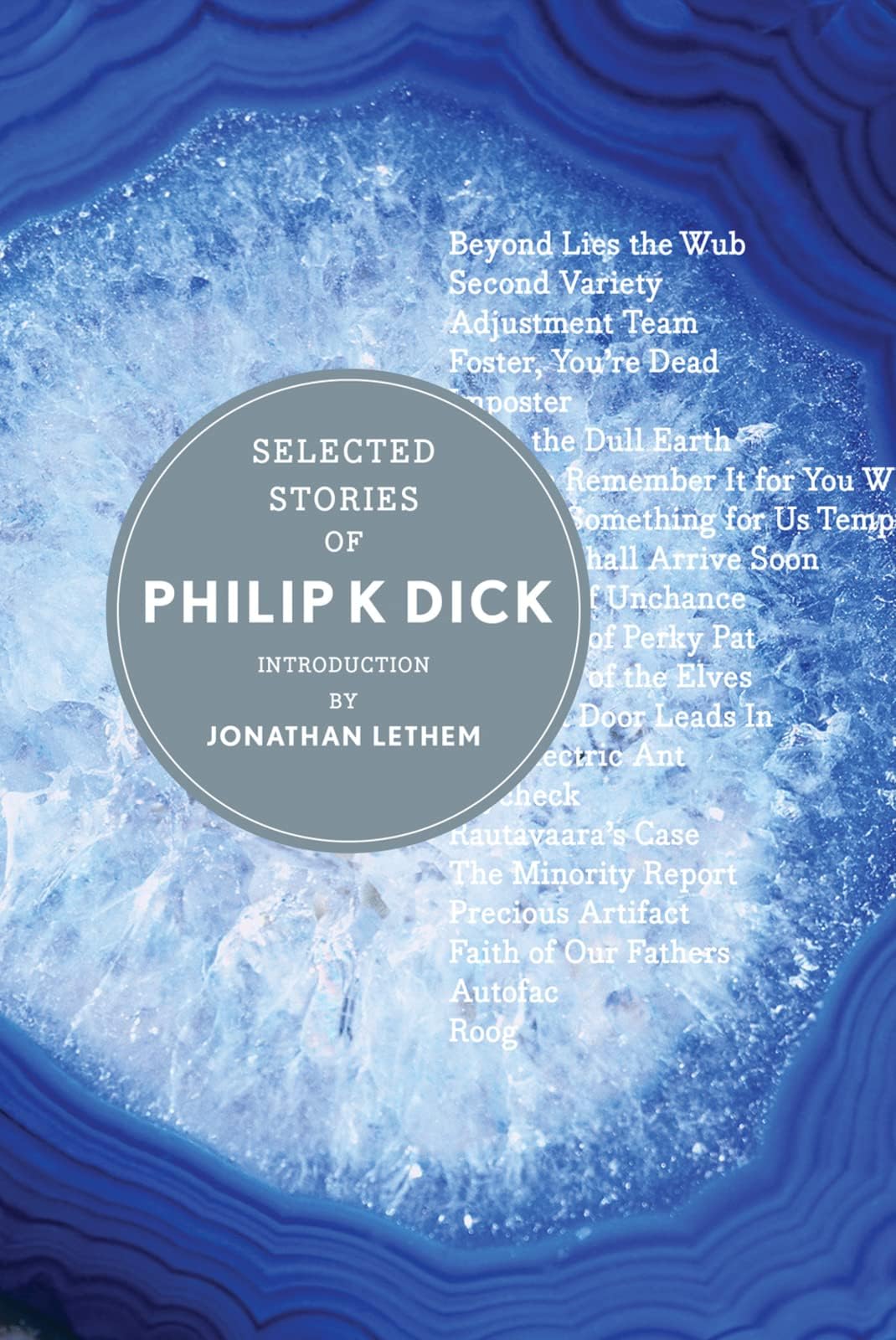
Selected Stories of Philip K. Dick contains twenty-one of Dick’s most dazzling and resonant stories, which span his entire career and show a world-class writer working at the peak of his powers. In “The Days of Perky Pat,” people spend their time playing with dolls who manage to live an idyllic life no longer available to the Earth’s real inhabitants. “Adjustment Team” looks at the fate of a man who by mistake has stepped out of his own time. In “Autofac,” one community must battle benign machines to take back control of their lives. And in “I Hope I Shall Arrive Soon,” we follow the story of one man whose very reality may be nothing more than a nightmare. The collection also includes such classic stories as “The Minority Report,” the basis for the Steven Spielberg movie, and “We Can Remember It for You Wholesale,” the basis for the film Total Recall . With an introduction by Jonathan Lethem, Selected Stories of Philip K. Dick is a magnificent distillation of one of American literature's most searching imaginations. Review: A treasure trove from sci-fi's great master - I might as well admit this at the beginning of the review: I am not generally a fan of short stories. I'm not making any sort of universal statement here so much as saying that I think the form tends to elevate shallow writing that is built around some sort of twist or reveal at the end. Bradbury is a bete noire of mine because of this very tendency, but he shares with many science fiction writers that genre's tendency toward writing about ideas instead of emotions or relationships, which has tended to turn a lot of people off of this particular genre as it can be difficult for a lot of people to connect with that approach. The genre does have its natural strengths: people are always interested in progress and the future, and moreso than many genres, sci-fi lends naturally to the exploration of social, political, and moral issues in its stories. I'm admittedly a huge sci-fi nut for those reasons, though I can understand why a lot of people are scared away. It's those people, though, who would get the most out of Philip K. Dick. Dick falls into almost none of the pitfalls that I mentioned previously. His short stories are excellent examples of the form, with strong ideas and surprisingly rich themes to boot. Dick's work has obviously been adapted to the screen many times, and a good handful of stories from the book are recognizable from their film adaptations, but the original stories are frequently more interesting and more substantive than the feature films they inspired! So, the average-ish Ben Affleck thriller Paycheck turns out to have been inspired by a story not only about seeing the future, but also about commercial-government tensions and its character turns out to be an anti-hero, motivated by corporate greed. Minority Report was a more successful (and much better) film than Paycheck, and it too is vastly different from its film. The basic ideas (precogs, arresting murderers before they commit their crimes) but in the story, the protagonist has to stop a military coup in Washington (and it lacks the film's sappy ending, too, which is a plus). There are, of course, lots of cool stories here that have not been made into movies, like the post-apocalyptic "Second Variety", in which a few remnants of humanity have to fight against an army of rebellious androids that come in three varieties, as well as some of Dick's more trippy writing, like a story in which an elderly man is asked to become the "king of the dwarves" in their battle against the gnomes, in which it certainly seems like he's going crazy, but the story is told from his perspective and it leaves some ambiguity. It's scary, fascinating, sad, and brainy, but also a little funny in a darkly comic way: that's the Dick trademark, I suppose. Most science fiction writers who become successful are good at coming up with nifty concepts and cool ideas, and Dick obviously has those, but even more impressive to me is the emotional component that Dick brings to his writing. This is a lot harder for me to deconstruct, but suffice it to say that Dick has that little extra something that turns a good story into a great one. When a story is supposed to be tragic, it almost always is. When the writing is supposed to be exciting, Dick pulls it off. His ability to define characters briefly and thoroughly certainly helps here, but Dick simply just knows how to engage the heart as well as the head, which is likely what has won him such an exalted place among science fiction writers over the years. That place is well-merited. I highly recommend this book to everyone. Review: A quite underappreciated short story writer. - Widely known and praised by his long string of novels, Philip K. Dick was also a prolific (if underappreciated) writer of short fiction. This 2002 anthology published by "Panteon Books" serves as a perfect introduction for the neophyte wishing to delve into the main obsessions and recurrent themes of an author who has persistently remained in the outer fringes of the literary canon. This book showcases some of the abilities of PKD in the difficult art of the short story form. The 21 stories reprinted here are taken both from early, middle and late periods of his literary career. A representative (if not exhausting) treasury of Dick's best and most influential fictions. The reader unacquainted with Dick will soon realize while reading this book the big debt that most modern action and science fiction films owe to this author. As with all anthologies, the materials here featured are somewhat uneven, and not all the stories have the same level of brilliance. My personal favourites are "Imposter", "Second Variety", "The Exit Door Leads In" and "Rautavaara's Case", all of which have struck me as literary masterpieces. Other quite good stories are the famous "The Minority Report, "Paycheck", "We Can Remember It for You Wholesale", "Foster, You're Dead", "Upon the Dull Earth" and "Adjustment Team". Unfortunately, there are a few "duds" as well, being "The Days of Perky Pat", "Faith of Our Fathers", "A Game of Unchance" or the awful "The King of the Elves" some of the worst in the pack. The rest of the stories are alright, not great nor bad, just entertaining. Some of the plot details used in them have become slightly dated though, such as the Cold War, the atomic war craze, Eastern versus Western bloc, etc. But by the same token, other themes like consumerism, classism, cultural conflicts or corporate control are still relevant today and smartly dealt with in these pages. Although PKD was far from being a great literary stylist, I think that his short stories tend to be fresher and better written than his novels (which for me are rather dreadful) and because of their short length they are usually able to convey Dick's recurrent themes of paranoia and unreality more proficiently. At his best, Dick can be extremely subversive and ingenious, and the thought-provoking quality of stories such as "The Exit Door Leads In" or "Rautavaara's Case" shouldn't be underestimated. He can be tragic, humorous, caustic, terrifying, extravagant, sadistic or just plain hallucinatory (sometimes all of it at once). Perhaps not a GENIUS in the strict sense of the word, but a worthy figure nonetheless that deserves the attention of anyone interested in literature with philosophical substance. The material quality of the book is top-notch; the volume is a beautiful solid hardback printed on white (not recycled) paper. The font size of the text does not strain the eyes and the cover also comes with a dust-jacket plus an excellent binding. This printing is the kind of book that goes from one generation to another if proper care is taken about it. Three stars for the overall contents of the book, plus one more for the quality of the edition.
| Best Sellers Rank | #73,971 in Books ( See Top 100 in Books ) #201 in Science Fiction Anthologies (Books) #270 in Fantasy Anthologies #382 in Time Travel Fiction |
| Customer Reviews | 4.6 out of 5 stars 1,113 Reviews |
A**.
A treasure trove from sci-fi's great master
I might as well admit this at the beginning of the review: I am not generally a fan of short stories. I'm not making any sort of universal statement here so much as saying that I think the form tends to elevate shallow writing that is built around some sort of twist or reveal at the end. Bradbury is a bete noire of mine because of this very tendency, but he shares with many science fiction writers that genre's tendency toward writing about ideas instead of emotions or relationships, which has tended to turn a lot of people off of this particular genre as it can be difficult for a lot of people to connect with that approach. The genre does have its natural strengths: people are always interested in progress and the future, and moreso than many genres, sci-fi lends naturally to the exploration of social, political, and moral issues in its stories. I'm admittedly a huge sci-fi nut for those reasons, though I can understand why a lot of people are scared away. It's those people, though, who would get the most out of Philip K. Dick. Dick falls into almost none of the pitfalls that I mentioned previously. His short stories are excellent examples of the form, with strong ideas and surprisingly rich themes to boot. Dick's work has obviously been adapted to the screen many times, and a good handful of stories from the book are recognizable from their film adaptations, but the original stories are frequently more interesting and more substantive than the feature films they inspired! So, the average-ish Ben Affleck thriller Paycheck turns out to have been inspired by a story not only about seeing the future, but also about commercial-government tensions and its character turns out to be an anti-hero, motivated by corporate greed. Minority Report was a more successful (and much better) film than Paycheck, and it too is vastly different from its film. The basic ideas (precogs, arresting murderers before they commit their crimes) but in the story, the protagonist has to stop a military coup in Washington (and it lacks the film's sappy ending, too, which is a plus). There are, of course, lots of cool stories here that have not been made into movies, like the post-apocalyptic "Second Variety", in which a few remnants of humanity have to fight against an army of rebellious androids that come in three varieties, as well as some of Dick's more trippy writing, like a story in which an elderly man is asked to become the "king of the dwarves" in their battle against the gnomes, in which it certainly seems like he's going crazy, but the story is told from his perspective and it leaves some ambiguity. It's scary, fascinating, sad, and brainy, but also a little funny in a darkly comic way: that's the Dick trademark, I suppose. Most science fiction writers who become successful are good at coming up with nifty concepts and cool ideas, and Dick obviously has those, but even more impressive to me is the emotional component that Dick brings to his writing. This is a lot harder for me to deconstruct, but suffice it to say that Dick has that little extra something that turns a good story into a great one. When a story is supposed to be tragic, it almost always is. When the writing is supposed to be exciting, Dick pulls it off. His ability to define characters briefly and thoroughly certainly helps here, but Dick simply just knows how to engage the heart as well as the head, which is likely what has won him such an exalted place among science fiction writers over the years. That place is well-merited. I highly recommend this book to everyone.
S**R
A quite underappreciated short story writer.
Widely known and praised by his long string of novels, Philip K. Dick was also a prolific (if underappreciated) writer of short fiction. This 2002 anthology published by "Panteon Books" serves as a perfect introduction for the neophyte wishing to delve into the main obsessions and recurrent themes of an author who has persistently remained in the outer fringes of the literary canon. This book showcases some of the abilities of PKD in the difficult art of the short story form. The 21 stories reprinted here are taken both from early, middle and late periods of his literary career. A representative (if not exhausting) treasury of Dick's best and most influential fictions. The reader unacquainted with Dick will soon realize while reading this book the big debt that most modern action and science fiction films owe to this author. As with all anthologies, the materials here featured are somewhat uneven, and not all the stories have the same level of brilliance. My personal favourites are "Imposter", "Second Variety", "The Exit Door Leads In" and "Rautavaara's Case", all of which have struck me as literary masterpieces. Other quite good stories are the famous "The Minority Report, "Paycheck", "We Can Remember It for You Wholesale", "Foster, You're Dead", "Upon the Dull Earth" and "Adjustment Team". Unfortunately, there are a few "duds" as well, being "The Days of Perky Pat", "Faith of Our Fathers", "A Game of Unchance" or the awful "The King of the Elves" some of the worst in the pack. The rest of the stories are alright, not great nor bad, just entertaining. Some of the plot details used in them have become slightly dated though, such as the Cold War, the atomic war craze, Eastern versus Western bloc, etc. But by the same token, other themes like consumerism, classism, cultural conflicts or corporate control are still relevant today and smartly dealt with in these pages. Although PKD was far from being a great literary stylist, I think that his short stories tend to be fresher and better written than his novels (which for me are rather dreadful) and because of their short length they are usually able to convey Dick's recurrent themes of paranoia and unreality more proficiently. At his best, Dick can be extremely subversive and ingenious, and the thought-provoking quality of stories such as "The Exit Door Leads In" or "Rautavaara's Case" shouldn't be underestimated. He can be tragic, humorous, caustic, terrifying, extravagant, sadistic or just plain hallucinatory (sometimes all of it at once). Perhaps not a GENIUS in the strict sense of the word, but a worthy figure nonetheless that deserves the attention of anyone interested in literature with philosophical substance. The material quality of the book is top-notch; the volume is a beautiful solid hardback printed on white (not recycled) paper. The font size of the text does not strain the eyes and the cover also comes with a dust-jacket plus an excellent binding. This printing is the kind of book that goes from one generation to another if proper care is taken about it. Three stars for the overall contents of the book, plus one more for the quality of the edition.
J**E
One of the best "overviews" of PKD's work and career
Back in college, I read through all five volumes of Philip K. Dick's short stories, so there wasn't necessarily anything new in Selected Stories of Philip K. Dick so much as a chance to revisit some of the short fiction of one of the all-time great science-fiction authors. Moreover, to read Dick's short stories - especially if you're only familiar with his novels, particularly some of his more philosophical ones - is to remember how great the man was at executing a pulp premise. The hook of "Paycheck" is so flawlessly executed that I'm just in awe of it - and how the rest of the story delivers on that hook is a treat to watch unfold. The same could be said about so many here - "We Can Remember It For You Wholesale," "The Minority Report," "Adjustment Team," and many more - but what I appreciate about this collection is that it's not just the great pulp tales. No, what makes this collection a fantastic primer for the newcomers is that it feels like a chronological plunge through Dick's development as a writer, starting with his pulp stories and ending with his fascination with the afterlife and Gnostic ideas. And along the way, you get his takes on society, religion, capitalism, and more, with the book serving double duty as both an essential collection of Dick's tales and a superb overview of his career, including the fun and the heartbreaking (I can't let this review go without mentioning the astonishing and quietly horrifying and devastating "A Little Something for Us Tempunauts") as points on the continuum. I'm already in the tank for PKD, so you can factor that into my review, but as a fan, this is probably one of the most solid "overview" collections out there I've found.
K**C
The greatest
The greatest of the stories and novellas
J**T
An Amazing Author
As a lover if all things sci-fi, I had heard Philip K. Dick's name many times but I never got around to reading any of his material until this book. I hadn't realized how many of his short stories had been made into movies! Some were great movies, although there were a few that stunk *cough*Imposter*cough*. This of course was due to the screenwriters, not the source material. Anyway, I'm reviewing the book, not the movies. The book itself was great. There's so many more of his stories that I think would make great movies or at least great episodes in a sci-fi Outer Limits kind of show (such as "Autofac"). His stories are both captivating and unique, while at the same time teaching a moral in one way or another. Although a lot of his themes seem commonplace in sci-fi today, the reader must keep in mind that a lot of these stories were written many years ago and that Dick was in fact the first author to put forth some of them. I'm not sure, but I think he was the first sci-fi author to talk about nanites. I would suggest this books to anyone who loves sci-fi. If you buy it you will certainly not be disappointed.
Y**N
Great Set of Stories
I picked this up because I saw a few movies based on Philip K. Dick's work (Blade Runner, Minority Report, Total Recall) and wanted to see how the source material compared to the films as well as what else Dick has to offer. He is not a great author in terms of writing ability, but I don't think that is what he's famous for. His imagination and sense of the future is, however, unmatched. Predicting things like androids, nuclear apocalypse, and mind control drugs he defined the science fiction of the present. One wonders if some of things he thought of would even exist if he hadn't imagined them first. Very good set of stories that will give you a good idea of what Dick is about. I also suggest his novel Do Androids Dream of Electric Sheep? (Blade Runner) as more good science fiction reading. This book features the following stories: 1. Beyond Lies the Wub 2. Roog 3. Paycheck (Paycheck) 4. Second Variety (Screamers) 5. Imposter (Impostor) 6. The King of the Elves 7. Adjustment Team 8. Foster, You're Dead 9. Upon the Dull Earth 10. Autofac 11. The Minority Report (Minority Report) 12. The Days of Perky Pat 13. Precious Artifact 14. A Game of Unchance 15. We Can Remember It For You Wholesale (Total Recal) 16. Faith of Our Fathers 17. The Electric Ant 18. A Little Something For Us Tempunauts 19. The Exit Door Leads In 20. Rautavaara's Case 21. I Hope I Shall Arrive Soon
D**N
A book for readers interested in AI, memory, consciousness, and control
Many films, including Total Recall, Minority Report, Screamers, Paycheck, Impostor, and the Adaptation Bureau, were inspired by or based on the stories in this book. Philip K. Dick truly feels ahead of his time. His stories do more than imagine future technology; they delve into questions about what reality really is, long before virtual reality became commonplace. In his works, humans can even be depicted as androids, highlighting the complex relationship between humans and technology. He discusses technology as a potential threat well before it becomes a reality, making his insights remarkably prescient. I really enjoyed the short story format; each one has a charming plot that draws you in. Philip K. Dick is such an underrated writer who truly deserves more recognition!
J**2
boring stories and characters but they are based around some interesting ideas.
Eh. I am a moderate sci-fi reader. I've read most of orson scott card, a fair bit of Heinlein and Asimov, and a handful of anthologies with random authors featured. I've also seen tons of sci-fi movies and television series (star trek, bsg, firefly, star wars, back to the future, etc.). I was trying to get into more of the classic authors, and Mr. Dick seems to be on everyone's must read list. I realized only after I started reading how many movies feature his stories, so he clearly has a lot of fans. I was not that impressed. I couldn't get into many of the stories, enough so that I still have a couple at the end I didn't finish. To be honest, Minority Report and the adjustment bureau (both featured in this collection) were better movies than short stories. Don't get me wrong, the man had some interesting ideas that were clearly before his time. However, in my opinion, he's not a very good story teller. I know these are short stories, but the characters are dull and hard to like. They seem to mostly be the same main character in most of the stories, even though they are clearly supposed to be different characters. This main character is a dull, usually middle class white man, who has decent morals except when it comes to his treatment of women, and who drinks and smokes way too much. Of course, part of this is an artifact of the era, but other sci-fi authors were more forward thinking in their treatment of gender equality, race, etc. Even if you can get past the 50s era thinking and the homogeneity of the characters, the stories move slowly. They are short, and I often read entire books in one sitting, but for these I could only read the entire story in one sitting maybe for one or two of the stories. My suggestion is find a different sci-fi author if you are not yet a Dick fan.
J**N
Great read
Bought this book about 11 years ago and you don’t realize how much this guy influenced many sci fi concepts and movies. Highly recommend.
A**R
Love Dick? Buy this....
Great collection of PKD's short stories and lesser known works. Well worth the money..
H**6
Interessante Sammlung von Kurzgeschichten, von denen einige als Filmvorlagen dienten.
Ich beziehe mich hier auf die englische Originalversion. Mit meiner Überschrift ist eigentlich schon alles gesagt. Die meisten Geschichten sind nachdenklich machend, anregend, oder spannend. Nicht zuletzt sind einige Stories als Ideenvorlagen in nicht ganz unbekannten Spielfilmen verwendet worden (Total Recall, Blade Runner, Minority Report, Adjustment Team). Man hat den Eindruck, Philip K. Dick war (und ist?) erste Wahl, wenn die Ideen für eine Science Fiction-Verfilmung, die nicht unbedingt eine Space Opera werden soll, gesucht werden.
T**W
Kindred spirit
I bought this as a Xmas present for my son. I was a keen reader of this author myself when I was younger. My son was very pleased with the book, as was I for being able to obtain it at relatively short notice, at a reasonable price with what was an amazingly quick delivery. Would most definitely recommend this book and the Seller to other customers.
R**I
映画化された短編を集めたような本
映画化されているディックの作品、"Paycheck","We Can Remember It for You Wholesale","The Minority Report" が読める本になっています。どれもそれほど長くないので、映画を楽しんだ後にそれほど苦戦せずに原作が読めます。
Trustpilot
2 months ago
1 week ago