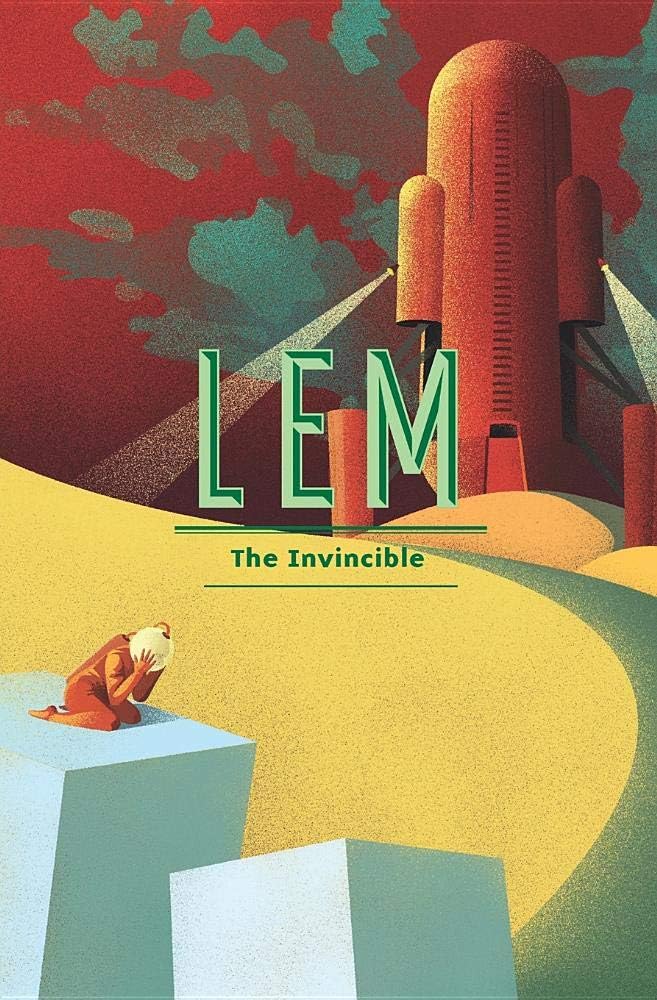
The Invincible
Product ID: 54152314
Buy The Invincible by Lem, Stanislaw, Johnston, Bill from desertcart's Fiction Books Store. Everyday low prices on a huge range of new releases and classic fiction. Review: Incredible 'Invincible'! - NOTE: THIS REVIEW REVEALS SOME DETAILS OF THE PLOT, IN ITS DESCRIPTION The story begins in the void, with the mighty Earth ship Invincible - 18,000 tonnes of Class II Cruiser, and temporary home to a crew of 83 - having spent several long months travelling a parsec from its base in the constellation of Lyra. Journey's end is Regis III - an ageing planet, feebly lit by an equally aged and reddening sun; the crew's objective - to discover the fate that has befallen their sister ship, the Condor... From the outset, Regis III proves to be something of a baffling and contradictory world: the continents are deserts, seemingly devoid of life - and yet the atmosphere contains a sizeable proportion of methane, suggesting the presence of living organisms. But where are these organisms to be found - and where, exactly, is the Condor and its crew? Their investigations quickly provide some equally puzzling answers: in stark contrast to the harsh reality on land, where nothing appears to survive - not even the smallest microbe - the oceans, on the other hand, fairly teem with many varied yet strangely timid forms of life; and the Condor - well, that poor ship is located a couple of hundred miles away from where the Invincible has landed, but closer inspection shows it now to be hardly anything more than an abandoned hulk, with most of its 80 crew members long since dead...except for one grown man, seemingly as helpless as a newborn. Might their disastrous ending have something to do with the rusting metal bush-like ruins of what may once have been a thriving ancient city, or perhaps with the crumbling remains of almost impossibly venerable machines lying buried in the sand...? And what of the Invincible itself - is it safe, and can Commander Horpach and his crew protect their vessel from a similar catastrophe...? Told almost exclusively from the perspective of the Invincible's chief navigator Rohan, this shortish novel is an exciting read that builds and maintains a sense of tension right to the very last page. Written in the first half of the 1960s, it's a story that clearly embraces one of Stanislaw Lem's abiding themes in his fiction from that period - and a theme that, as preoccupations go, is perhaps not too difficult to understand from an author who was writing from behind the Iron Curtain during the time of the Cuban Missile Crisis: Humankind's apparently boundless faith in the universal efficacy of its own technology (particularly, its weapons technology) - yielding a near unshakeable belief that the machines upon which we place so much reliance must always equip us to prevail against adversity, when in fact it's elementary human courage and resourcefulness that most often sees us through...that is, when we decide to offer them the chance to do so! So - without wishing to disclose too much more of the plot, it almost goes without saying that the basic premise of 'The Invincible' is thoroughly ingenious: that is an essential hallmark of Lem's writing, in general - but particularly so here, I think. Perhaps the manner in which the planet's nigh-indestructible swarming menace goes about incapacitating its victims is a little over-elaborate (being able to summon such incredible levels of unified power, wouldn't it have made far more sense for these entities to kill their chosen targets - either by frying their central nervous systems, stopping their hearts from beating, or simply tearing them limb from limb?); perhaps the spacecraft Invincible might have been better named 'Noah's Ark' - or maybe, 'Pandora's Box' - since it does appear to continually disgorge from its hold an unfeasibly large assortment of vehicles and robots of awe-inspiring power; there are certainly some similarities to the basic premise of the (earlier) 1956 film 'Forbidden Planet', as another reviewer has perceptively identified (an Earth ship travelling to a distant planet in order to investigate the disappearance of a previous expedition, but soon being forced to confront the formidable threat of a long-extinct alien civilisation's instrumentality...); and perhaps the characters - whilst being noticeably stronger-willed and determinedly more focused than their counterparts in 'Solaris', for example - are a little bit on the one-dimensional side, which is unfortunately one of Lem's perennial and most obvious weaknesses; but taken in the round, these are all rather minor considerations that shouldn't deter you in the slightest from reading what is - in my opinion - a magnificently compelling work of science fiction. If you purchase the Kindle edition, you will not only need to contend with Brian Johnston's Americanised (English) translation from the original Polish (spellings AND idiom, I'm afraid!), but also the now depressingly familiar and all too prevalent e-book typos! That said, I have no hesitation whatsoever in recommending what is undoubtedly an absolute belter of a book! Review: Bleak. - The crew of The Invincible are searching for the remains of the Condor and its crew, and soon find it a tomb, the crew starved to death, having been maddened and enfeebled by some mystery agent. They explorers survey a strange world clinging to a dying sun, where the seas are populous, but every inch of land is a desert, razed clean. All that they find in evidence are a city of mysterious, impenetrable structures and the disturbing recovered memories of a frozen corpse. The spaceship may be Invincible, but the Universe remains indifferent. This is a chilling story, and a stark one: the language is prosaic and unornamented, the characters are paragons of military efficiency and scientific detachment. The enemy they face is horrifying; it reduces men to mindless shells, is invulnerable to man's most savage weapons and can damage the hardest alloys of the future age, but it does so indifferently, unthinkingly, reflexively. The tone of the whole novel is as cold as the vacuum of space. I shan't give away too much of the mystery, but suffice to say that this is a novel that faces up to the grim reality of the evolved organism: every existence depends on the deaths of a thousand others. This is classic hard sci-fi in the mould of Asimov, Pohl or Clarke, with very little in the way of character study or poetry, and a great deal of time dedicated to the hardware of space exploration, telecommunication and military command structure. It is all the better for it: we watch through our fingers as highly-disciplined men walk stoically into certain death. At first the characters seem flimsy, robotic even, but they share a drive that is most human: curiosity. In the end, we as a species are defined by our irrationality, our stubbornness and our courage.
| Best Sellers Rank | 144,403 in Science Fiction (Books) |
| Customer reviews | 4.3 4.3 out of 5 stars (502) |
| Dimensions | 13.34 x 1.3 x 20.32 cm |
| ISBN-10 | 8363471542 |
| ISBN-13 | 978-8363471545 |
| Item weight | 272 g |
| Language | English |
| Print length | 202 pages |
| Publication date | 27 Mar. 2017 |
| Publisher | Pro Auctore Wojciech Zemek |
B**W
Incredible 'Invincible'!
NOTE: THIS REVIEW REVEALS SOME DETAILS OF THE PLOT, IN ITS DESCRIPTION The story begins in the void, with the mighty Earth ship Invincible - 18,000 tonnes of Class II Cruiser, and temporary home to a crew of 83 - having spent several long months travelling a parsec from its base in the constellation of Lyra. Journey's end is Regis III - an ageing planet, feebly lit by an equally aged and reddening sun; the crew's objective - to discover the fate that has befallen their sister ship, the Condor... From the outset, Regis III proves to be something of a baffling and contradictory world: the continents are deserts, seemingly devoid of life - and yet the atmosphere contains a sizeable proportion of methane, suggesting the presence of living organisms. But where are these organisms to be found - and where, exactly, is the Condor and its crew? Their investigations quickly provide some equally puzzling answers: in stark contrast to the harsh reality on land, where nothing appears to survive - not even the smallest microbe - the oceans, on the other hand, fairly teem with many varied yet strangely timid forms of life; and the Condor - well, that poor ship is located a couple of hundred miles away from where the Invincible has landed, but closer inspection shows it now to be hardly anything more than an abandoned hulk, with most of its 80 crew members long since dead...except for one grown man, seemingly as helpless as a newborn. Might their disastrous ending have something to do with the rusting metal bush-like ruins of what may once have been a thriving ancient city, or perhaps with the crumbling remains of almost impossibly venerable machines lying buried in the sand...? And what of the Invincible itself - is it safe, and can Commander Horpach and his crew protect their vessel from a similar catastrophe...? Told almost exclusively from the perspective of the Invincible's chief navigator Rohan, this shortish novel is an exciting read that builds and maintains a sense of tension right to the very last page. Written in the first half of the 1960s, it's a story that clearly embraces one of Stanislaw Lem's abiding themes in his fiction from that period - and a theme that, as preoccupations go, is perhaps not too difficult to understand from an author who was writing from behind the Iron Curtain during the time of the Cuban Missile Crisis: Humankind's apparently boundless faith in the universal efficacy of its own technology (particularly, its weapons technology) - yielding a near unshakeable belief that the machines upon which we place so much reliance must always equip us to prevail against adversity, when in fact it's elementary human courage and resourcefulness that most often sees us through...that is, when we decide to offer them the chance to do so! So - without wishing to disclose too much more of the plot, it almost goes without saying that the basic premise of 'The Invincible' is thoroughly ingenious: that is an essential hallmark of Lem's writing, in general - but particularly so here, I think. Perhaps the manner in which the planet's nigh-indestructible swarming menace goes about incapacitating its victims is a little over-elaborate (being able to summon such incredible levels of unified power, wouldn't it have made far more sense for these entities to kill their chosen targets - either by frying their central nervous systems, stopping their hearts from beating, or simply tearing them limb from limb?); perhaps the spacecraft Invincible might have been better named 'Noah's Ark' - or maybe, 'Pandora's Box' - since it does appear to continually disgorge from its hold an unfeasibly large assortment of vehicles and robots of awe-inspiring power; there are certainly some similarities to the basic premise of the (earlier) 1956 film 'Forbidden Planet', as another reviewer has perceptively identified (an Earth ship travelling to a distant planet in order to investigate the disappearance of a previous expedition, but soon being forced to confront the formidable threat of a long-extinct alien civilisation's instrumentality...); and perhaps the characters - whilst being noticeably stronger-willed and determinedly more focused than their counterparts in 'Solaris', for example - are a little bit on the one-dimensional side, which is unfortunately one of Lem's perennial and most obvious weaknesses; but taken in the round, these are all rather minor considerations that shouldn't deter you in the slightest from reading what is - in my opinion - a magnificently compelling work of science fiction. If you purchase the Kindle edition, you will not only need to contend with Brian Johnston's Americanised (English) translation from the original Polish (spellings AND idiom, I'm afraid!), but also the now depressingly familiar and all too prevalent e-book typos! That said, I have no hesitation whatsoever in recommending what is undoubtedly an absolute belter of a book!
J**N
Bleak.
The crew of The Invincible are searching for the remains of the Condor and its crew, and soon find it a tomb, the crew starved to death, having been maddened and enfeebled by some mystery agent. They explorers survey a strange world clinging to a dying sun, where the seas are populous, but every inch of land is a desert, razed clean. All that they find in evidence are a city of mysterious, impenetrable structures and the disturbing recovered memories of a frozen corpse. The spaceship may be Invincible, but the Universe remains indifferent. This is a chilling story, and a stark one: the language is prosaic and unornamented, the characters are paragons of military efficiency and scientific detachment. The enemy they face is horrifying; it reduces men to mindless shells, is invulnerable to man's most savage weapons and can damage the hardest alloys of the future age, but it does so indifferently, unthinkingly, reflexively. The tone of the whole novel is as cold as the vacuum of space. I shan't give away too much of the mystery, but suffice to say that this is a novel that faces up to the grim reality of the evolved organism: every existence depends on the deaths of a thousand others. This is classic hard sci-fi in the mould of Asimov, Pohl or Clarke, with very little in the way of character study or poetry, and a great deal of time dedicated to the hardware of space exploration, telecommunication and military command structure. It is all the better for it: we watch through our fingers as highly-disciplined men walk stoically into certain death. At first the characters seem flimsy, robotic even, but they share a drive that is most human: curiosity. In the end, we as a species are defined by our irrationality, our stubbornness and our courage.
A**Y
Thoughtful and thought-provoking, fast-paced science-fiction adventure.
This book really has it all, so far as science-fiction is concerned; it manages to handle themes on the nature of intelligent life, on eveolution, and on man's place in the universe, without being heavy-handed or didactic. Just enough of the ideas mixed in to the plot to ensure that the reader has the raw material for connecting these themes together, if they wish so to do. But at the same time, it manages to be a fast-paced sci-fi action thriller, with blasters and shields and aliens and missing rockcet ships, and indeed, it is possible to read it in that vein without considering any of the more thoughtful themes.
J**E
Profound and beautifully written story
As with all of Lem's work, there are profound truths bubbling away underneath the story, and the novel's effect on me lingered long after I had finished reading it. What seems like a fun sci-fi epic on the surface, tightly-plotted, filled with glorious set pieces and vividly beautiful descriptions, is actually a much deeper exploration of identity, the potentials of technology and man's attempts to conquer the unknown. Alongside Solaris, this is Lem's best work.
J**D
Solaris' less well-known cousin, but similarly excellent.
The Invincible has themes in common with Solaris - the otherness of what might be out there and our limited grasp on how different other life might be; a critique of the human urge to explore for the sake of domination and to needlessly put human interests ahead of those of other species. This is also a good adventure romp with guns and aliens etc. the works. For those who find Solaris to lack action, this will certainly not disappoint.
R**N
Clever
A cleverly-constructed scientific detective story with a message - as we explore the universe, we will encounter alien life forms which are so different from what we are used to that we may not even recognise them as being alive. This novel ought to be more well-known - very readable in this translation.
N**G
Sublime
Taking what could be seen as perfunctory and academic and turning it into something intricate and exquisite. There are divergences from what a novel usually tries to be to investigate the limits of what both science-fiction, and ultimately mankind, can be.
Z**U
good
good
J**R
I was not prepared for how good this was going to be. Lem can be scientifically imaginative and detailed rather than Sci Fi Fantasy and I really like that about his writing. No one seems out of place and you don't feel you need to know a character more than you do. Sci Fi steals from this story so much it's not even funny.
J**N
As a Lem fan, this one was new to me - highly recommended, you will see various "Lem-isms" through a very satisfying story. In the vein of Solaris, but faster paced.
C**L
Fast, agile and always engaging. I strongly recommend Lem. Non compromise reading with short, straight forward action... but then, it gives the reader time to have a debate.
P**S
I like the writing in this one, Lem knows how to tell a story even if parts of it suffer from the translation and other parts of the story computer running on "magnetic tapes" haven't aged very well. The important details of the story are pretty timeless and nothing particular to the plot depends on a 1960s understanding of computers.
R**E
Lem is a genius. He paints better with words than almost everyone. He sets the standard. 'The Invincible' is just about perfect. I hardly know what to say. It's science fiction that hits a more unique mark because it's so intelligent wrapped in what seems science fiction requisites in setting, motives... But Lem goes beyond expectations. This is a must read, absolutely.
Trustpilot
2 weeks ago
1 month ago