
Buy anything from 5,000+ international stores. One checkout price. No surprise fees. Join 2M+ shoppers on Desertcart.
Desertcart purchases this item on your behalf and handles shipping, customs, and support to SINGAPORE.
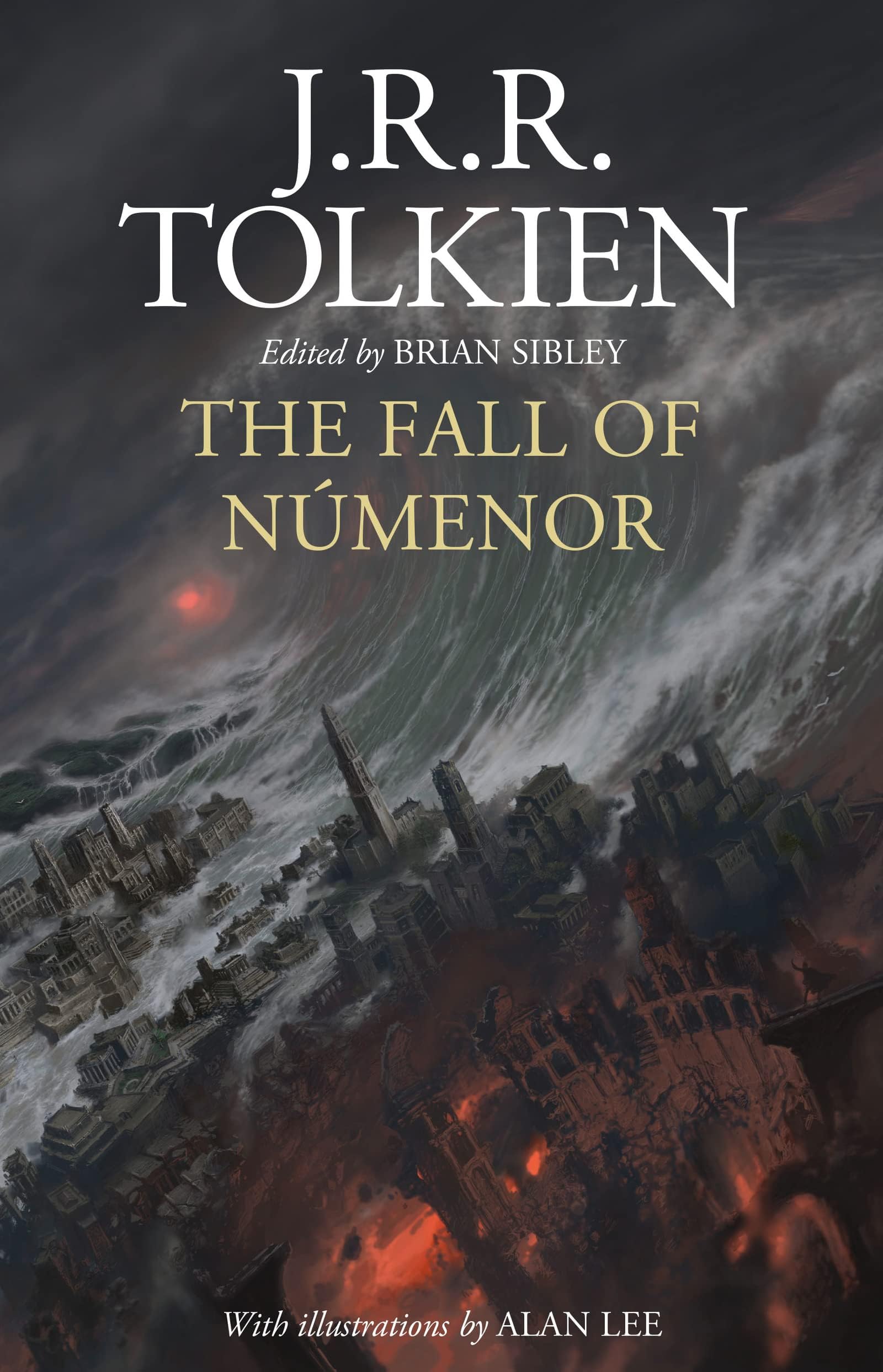
J. R. R. Tolkien’s writings on the Second Age of Middle-earth, collected for the first time in one volume complete with new illustrations in watercolor and pencil by renowned artist Alan Lee. J.R.R. Tolkien famously described the Second Age of Middle-earth as a "dark age, and not very much of its history is (or need be) told." And for many years readers would need to be content with the tantalizing glimpses of it found within the pages of The Lord of the Rings and its appendices, including the forging of the Rings of Power, the building of the Barad-dûr and the rise of Sauron. It was not until Christopher Tolkien published The Silmarillion after his father’s death that a fuller story could be told. Although much of the book’s content concerned the First Age of Middle-earth, there were at its close two key works that revealed the tumultuous events concerning the rise and fall of the island of Númenor. Raised out of the Great Sea and gifted to the Men of Middle-earth as a reward for aiding the angelic Valar and the Elves in the defeat and capture of the Dark Lord Morgoth, the kingdom became a seat of influence and wealth; but as the Númenóreans’ power increased, the seed of their downfall would inevitably be sown, culminating in the Last Alliance of Elves and Men. Even greater insight into the Second Age would be revealed in subsequent publications, first in Unfinished Tales of Númenor and Middle-earth , then expanded upon in Christopher Tolkien’s magisterial twelve-volume The History of Middle-earth , in which he presented and discussed a wealth of further tales written by his father, many in draft form. Now, adhering to the timeline of "The Tale of Years" in the appendices to The Lord of the Rings , editor Brian Sibley has assembled into one comprehensive volume a new chronicle of the Second Age of Middle-earth, told substantially in the words of Tolkien from the various published texts, with new illustrations in watercolor and pencil by the doyen of Tolkien art, Alan Lee. Review: A Work Of High Scholarship And High Beauty - J.R.R. Tolkien was a prolific writer and scholar who worked on his legendarium throughout his life. Most of his readers will be best familiar with The Hobbit and The Lord of the Rings which were published in his lifetime. After his death in 1973 his son Christopher was responsible for the editing and publishing of many other works, especially The Silmarillion, Unfinished Tales, and the 12 volume History of Middle-earth. Since Christopher's own passing other scholars have taken on the task of editing and publishing more of Tolkien's work. The Fall of Numenor, edited by well known Tolkien scholar Brian Sibley, is the latest and one of the most interesting of these. The Fall of Numenor is primarily a history of the Second Age, referred to by Tolkien himself as "a dark age." Primarily it deals with the rise and fall of the great kingdom of Men called Numenor or Westernesse, located on a large island raised for that purpose by the Valar and situated between Middle-earth itself in the East and the Blessed Realms in the Distant West. The Men who had fought alongside the Elves in the great wars against Morgoth in the First Age were granted Numenor in thanks and as a refuge from the troubles of Middle-earth. The Men, now known as the Dunedain, were given great gifts and blessings, but forbidden to sail westward out of sight of their own land. At first the Dunedain obeyed this limitation, but as the centuries wore on and their wealth and power increased many began to long for the immortality of the Elves. Eventually this led to a shadow falling over Numenor, abetted by the growing power of Morgoth's chief servant Sauron in Middle-earth, and finally to its complete destruction. Tolkien was haunted throughout his life by dreams of a great wave falling upon the lands and drowning them. These Atlantaean visions found outlets in many of his stories which have been collected here for the first time. The Fall of Numenor contains material from The Lord of the Rings and its Appendices, The Silmarillion, Unfinished Tales, the abandoned time travel tale The Lost Road, and The Nature of Middle-earth. In this collected form the tales of the Second Age gain new power and interest, enhanced by the many beautiful illustrations from one of the greatest Tolkien illustrators at work today, Alan Lee. The Fall of Numenor is not only a work of great scholarship but of beauty as well. Alan Lee's color plates and smaller black and white illustrations help Tolkien's words gain greater life, and Sibley's impeccable editing and thorough annotations add inestimable value as well. The book is a delight to hold and look through, with every page demonstrating the care taken to make it a work of quality. This is a book worthy of the libraries of Rivendell, Lothlorien, Minas Tirith, or even Bag End. All Tolkien scholars and other lovers of Middle-earth will find it indispensable and an utter delight. Review: A Definitive Second Age Reference in a Beautiful Volume - Absolutely brilliant. The Fall of Númenor brings together all of Tolkien’s writings related to the Second Age in one place, arranging material drawn from The Silmarillion, Unfinished Tales, and The History of Middle-earth into a single, coherent narrative. It’s an invaluable reference for anyone interested in Númenor, the Rings of Power, and the broader Second Age timeline, or for the Tolkien collector or enthusiast who wants this material presented in a single, well-organized volume. As for the physical book itself, I had seen some reviews mentioning copies arriving damaged. I was fortunate that mine arrived shrink-wrapped and shipped in a book-specific box, in perfect condition (your mileage may vary). The book is genuinely beautiful: thick cream-colored pages, sewn binding, a ribbon marker, and excellent artwork on the dust jacket and throughout. It feels well-made and substantial in hand, which has been my experience with many William Morrow editions (an imprint of HarperCollins), whose book quality has consistently been excellent. Overall, I could not be happier with the quality or with the value at the price I paid.


| Best Sellers Rank | #35,917 in Books ( See Top 100 in Books ) #780 in Epic Fantasy (Books) #841 in Classic Literature & Fiction #2,800 in Literary Fiction (Books) |
| Customer Reviews | 4.8 out of 5 stars 3,180 Reviews |
J**D
A Work Of High Scholarship And High Beauty
J.R.R. Tolkien was a prolific writer and scholar who worked on his legendarium throughout his life. Most of his readers will be best familiar with The Hobbit and The Lord of the Rings which were published in his lifetime. After his death in 1973 his son Christopher was responsible for the editing and publishing of many other works, especially The Silmarillion, Unfinished Tales, and the 12 volume History of Middle-earth. Since Christopher's own passing other scholars have taken on the task of editing and publishing more of Tolkien's work. The Fall of Numenor, edited by well known Tolkien scholar Brian Sibley, is the latest and one of the most interesting of these. The Fall of Numenor is primarily a history of the Second Age, referred to by Tolkien himself as "a dark age." Primarily it deals with the rise and fall of the great kingdom of Men called Numenor or Westernesse, located on a large island raised for that purpose by the Valar and situated between Middle-earth itself in the East and the Blessed Realms in the Distant West. The Men who had fought alongside the Elves in the great wars against Morgoth in the First Age were granted Numenor in thanks and as a refuge from the troubles of Middle-earth. The Men, now known as the Dunedain, were given great gifts and blessings, but forbidden to sail westward out of sight of their own land. At first the Dunedain obeyed this limitation, but as the centuries wore on and their wealth and power increased many began to long for the immortality of the Elves. Eventually this led to a shadow falling over Numenor, abetted by the growing power of Morgoth's chief servant Sauron in Middle-earth, and finally to its complete destruction. Tolkien was haunted throughout his life by dreams of a great wave falling upon the lands and drowning them. These Atlantaean visions found outlets in many of his stories which have been collected here for the first time. The Fall of Numenor contains material from The Lord of the Rings and its Appendices, The Silmarillion, Unfinished Tales, the abandoned time travel tale The Lost Road, and The Nature of Middle-earth. In this collected form the tales of the Second Age gain new power and interest, enhanced by the many beautiful illustrations from one of the greatest Tolkien illustrators at work today, Alan Lee. The Fall of Numenor is not only a work of great scholarship but of beauty as well. Alan Lee's color plates and smaller black and white illustrations help Tolkien's words gain greater life, and Sibley's impeccable editing and thorough annotations add inestimable value as well. The book is a delight to hold and look through, with every page demonstrating the care taken to make it a work of quality. This is a book worthy of the libraries of Rivendell, Lothlorien, Minas Tirith, or even Bag End. All Tolkien scholars and other lovers of Middle-earth will find it indispensable and an utter delight.
J**3
A Definitive Second Age Reference in a Beautiful Volume
Absolutely brilliant. The Fall of Númenor brings together all of Tolkien’s writings related to the Second Age in one place, arranging material drawn from The Silmarillion, Unfinished Tales, and The History of Middle-earth into a single, coherent narrative. It’s an invaluable reference for anyone interested in Númenor, the Rings of Power, and the broader Second Age timeline, or for the Tolkien collector or enthusiast who wants this material presented in a single, well-organized volume. As for the physical book itself, I had seen some reviews mentioning copies arriving damaged. I was fortunate that mine arrived shrink-wrapped and shipped in a book-specific box, in perfect condition (your mileage may vary). The book is genuinely beautiful: thick cream-colored pages, sewn binding, a ribbon marker, and excellent artwork on the dust jacket and throughout. It feels well-made and substantial in hand, which has been my experience with many William Morrow editions (an imprint of HarperCollins), whose book quality has consistently been excellent. Overall, I could not be happier with the quality or with the value at the price I paid.
C**D
A great edition and effort
I believe this is one of the first books released in the same style as the Christopher Tolkien ones post his death. Which of course, still features massive contributions from his life’s work. In the same vein as Christopher’s work, this sets out to give a straight-forward linear storyline for the falling of Númenor. It also does a really good job taking the reader through the early history of Sauron. It does not seek to overwrite, or undo previous works. As with the other works taken from The Silmarillion and Appendices, it does read similarly to a textbook in places, but doing audio from Brian Sibley and Samuel West made it very digestible. Personally for me, hearing pieces from each that are featured elsewhere just really helps my understanding, as it can be really dense. This has a beautiful wrapped artwork for the dust jacket (Alan Lee of course), a ribbon bookmark, beautiful interior artwork as well as some nice smaller chapter headers and footers. It has a great quality naked hardcover wrap too, a fantastic edition for a Tolkien collector. One thing I’d love to highlight is how perfectly this cover matches the depiction shown in The Rings of Power show…I mean spot on. Obviously it comes from the text itself anyway, but when so much else gets changed…it’s just cool. The storyline really goes to show just how much they could do with the show itself. There’s so much going on in the appendices and this edition is the proof.
S**R
Great but fyi, e-book has no color illustrations
Tolkien wrote of some scary stuff. Not much joy herein. This book provides an interesting backstory to The Second Age, long before the events described in the trilogy, The Lord of the Rings. I was especially interested in how Númenor rose and fell, but there is more. A section describes how Sauron built his fortress Barad-dûr, the Dark Tower, and another section describes the forging of the rings of power in the fires of Mount Doom. We also get a little more backstory for the wizards, including Gandalf. “Even as the first shadows were felt in Mirkwood there appeared in the west of Middle-earth the Istari, whom Men called the Wizards…. Chief among them were those whom the Elves called Mithrandir and Curunír, but Men in the North named Gandalf and Saruman.” No Frodo or Pippin to lighten the load, but there are some sweet scenes describing early Númenorians. Another upbeat section describes the natural world of Númenor, the bears, the horses, etc. “This was the beginning of that people that in the Grey-elven speech are called the Dúnedain: the Númenóreans, Kings among Men.” The Valar bestowed upon them gifts of wisdom, strength, height, and longevity, for this clan of Men had sacrificed much to help defeat dread Morgath. These men are also called the Edains, and the Valar also bestowed upon them an additional gift — the star-shaped island of Númenor, a type of Atlantis. Many references to those amazing Eagles. ‘Behold the Eagles of the Lords of the West!’ they cried. ‘The Eagles of Manwë are come upon Númenor!’ However, this work is not truly a story; it is a recitation of facts and events, with only limited narrative embellishment. Example: I read with interest how Sauron laughed when King Ar-Pharazôn sailed west to conquer Valinor, The Undying Lands, in order to wrest eternal life from the Valar. On the other hand, we get no glimpse of how Pharazôn himself reacted to the sinking of his fleet and his own doom. Did he feel an instant of sanity, an awakening from all his delusions? Did he realize he’d been a fool, easily and utterly deceived? And what of the queen? How did she feel? On an upbeat, we did get some lovely insights into how Elendil felt, and his two sons, especially Isildur. excerpt: “Nine ships there were: four for Elendil, and for Isildur three, and for Anárion two; and they fled before the black gale out of the twilight of doom into the darkness of the world. And the deeps rose beneath them in towering anger, and waves like unto mountains moving with great caps of writhen snow bore them up amid the wreckage of the clouds, and after many days cast them away upon the shores of Middle-earth.” I probably would have waited for a library loan, but I wanted the pretty pictures. Sadly, the images are black white sketches, and small. Nice enough, but a far cry from those beautiful full-size full-color illustrations shown in some reviews of this book. Are the color illustrations only included in the hardcover edition?
R**N
Essential addition to any Tolkien collection
If you’re a Tolkien fan/reader, this is nothing new, it’s a compilation of the history of Nùmenor from all across the Legendarium, even the notes from the LOTR apéndices. It’s a great reading companion/ reference, even a good place to start if you’re new to the Second Age of Middle Earth. It puts various snippets and stories found elsewhere into chronological order, with editorial comments to help fill out your understanding of the overall epic. I’m not new to Tolkien at all but I still found it a really fun read! It’s a beautiful book with fantastic b&w and color illustrations. It’s heavy, almost gloss paper, definitely not newsprint or onion-skin “Bible-type” pages and even has a ribbon bookmark. My only complaint is that the spine of the dust jacket is printed off-center, but I usually throw away dust jackets anyway. I’m really happy to add this to my Tolkien collection!
S**S
Worth the time and difficulty of perusal
To someone who has emphatically refused to read any novel of fantasy, this book will not make even a modicum of sense. However, to a person who has read Tolkien and found his writings like layers of rich tapestry, to be peeled back one after the other, each richer than the one before it, this book is best taken as an aperitif or possibly a dessert to reading the LOTR adventure that began with The Hobbit. It will offer a lot of insights and back story into the greatest series of high fantasy ever written. A Game of Thrones is exquisite and The Witcher is sublime and both, on the telly, are visually appealing but neither of them would have ever been conceived had it not been for the colour of myth and magic that Professor Tolkien gifted to the world.
C**N
Buy it
Great book and great read
N**R
A Refocusing That Accentuates the Drama and Tragedy of Numenor
As the list of Tolkien's still unpublished works relating to Middle-earth has been steadily reduced to the scantiest of scraps, it increasingly requires creativity and boldness to release a "new" book with J.R.R. Tolkien listed as its author. One option is to take a few lines of jotted down poetry and center an entire book around it, supplemented by other published-but-lesser-known material. The other option is to take already released material and present it in a more readable form, perhaps for the first time for those Tolkien fans only interested in his most completed narratives. The Fall of Númenor belongs to the second category. All the above is to say that I was initially skeptical of the value of this release, outside the always welcome illustrations by Alan Lee. If the First Age has three "great tales," tales that Christopher Tolkien himself edited for standalone release, the tragedy of Númenor would surely qualify as the great tale of the Second Age. It is also a story quite central to Tolkien's mythopoeic thought, and one of personal significance to him that he returned to very often in varying modes. Unlike The Children of Hurin, for example, which needed editing and synthesizing in order to be fully appreciated as a narrative in its own right, it seemed to me that the story of Númenor as it existed could already be read in its most complete form in a small handful of works that Tolkien fans already owned. And unfortunately, it does not exist in a more extensive narrative form as the great tales of the First Age do. I am very happy to have been mistaken. Editor Brian Sibley does indeed draw from readily available sources, but he takes bits and pieces from about the Second Age from so many places (from the text of The Lord of the Rings itself to Tolkien's Letters), it would be completely impractical for a reader to do the same. All these small snippets of information, arranged chronologically, have a curious cumulative effect as if you were reading a single narrative. Information about how the Númenoreans lived and acted drives home their similarities to elves, the heights to which they reached and the foibles that ultimately led to their downfall. Their fall reads as the climax of a great story, and the alliance between men and elves to overthrow Sauron a redemption rather than merely a prelude to The Lord of the Rings. Even Aldarion and Erendis, the longest single narrative of the Second Age and a unique and moving domestic drama within Tolkien's legendarium, feels as if it "fits" the overarching thrust of Númenor and the Second Age as a whole. In total, this arrangement of texts will be an aid in recontextualizing the Second Age, and will be of great value to Tolkien fans.
B**R
Stop putting price tag on the book
This beautiful book was ruined because they put the price tag on the dusk jacket and it rips the printing after removing the tag
G**O
Calidad muy alta
He comprado muchísimos libros de Tolkien por Amazon, y siempre he sido satisfecho. Pero esta vez lo he sido aún más! La calidad del papel es increíble, los dibujos de Alan Lee una alegría para los ojos y la tapa es de excelente factura, que ni tampoco parece papel! Hay muchísimas informaciones sobre la segunda edad de Arda, y si quieres saber todo (o casi) lo que pasó en Númenor tienes que comprarlo. Lástima que hasta ahora solo haya salido en inglés.
D**L
Dit soort boeken niet bij Amazon kopen!
Sterke afrader om dit soort boeken bij Amazon te bestellen. Ze sturen het op in kartonnen envelop waardoor de dustcover behoorlijk beschadigd raakt. Boek zelf zal ongetwijfeld fantastisch zijn voor Tolkien liefhebbers.
T**I
Todo bien
Buena compra, en libro llegó en buen estado
A**S
For Tolkein nerds
Sibley collects all the Second Age material from JRR Tolkein's published sources in one volume, arranged chronologically. The Fall of Numenor is structured according to the Tale of Years from LOtR Appendices. Tolkein readers will know that this is the story of the rise of the greatest kingdom of Men and its fall into evil and destruction, resulting, finally, in the establishment of Gondor and Anor in Middle Earth, and the Last Alliance which (temporarily) defeats Sauron, after the forging of the Rings of Power. Thus, there is nothing "brand new" here for most serious Tolkein readers (save, perhaps, some illustrative exerpts from letters and extensions of some stories), but everything being in one volume, gives a coherence to the Second Age that is lacking otherwise. Sibley supplements this history with JRR's letters and Christopher's lifelong work amongst the writings that did not appear in JRR's lifetime or from earlier drafts of his works. Lee's illustrations are very impressive, paying homage to JRR Tolkein's illustration style, but conceived much more ambitiously. Overall, I enjoyed this book thoroughly. It serves as a "might have been" if the Rings of Power had had the rights to the all the sources in the Second Age.
Trustpilot
4 days ago
3 weeks ago