Desertcart purchases this item on your behalf and handles shipping, customs, and support to SINGAPORE.
🛠️ Power up your water heater’s lifespan and smell with Corro-Protec!
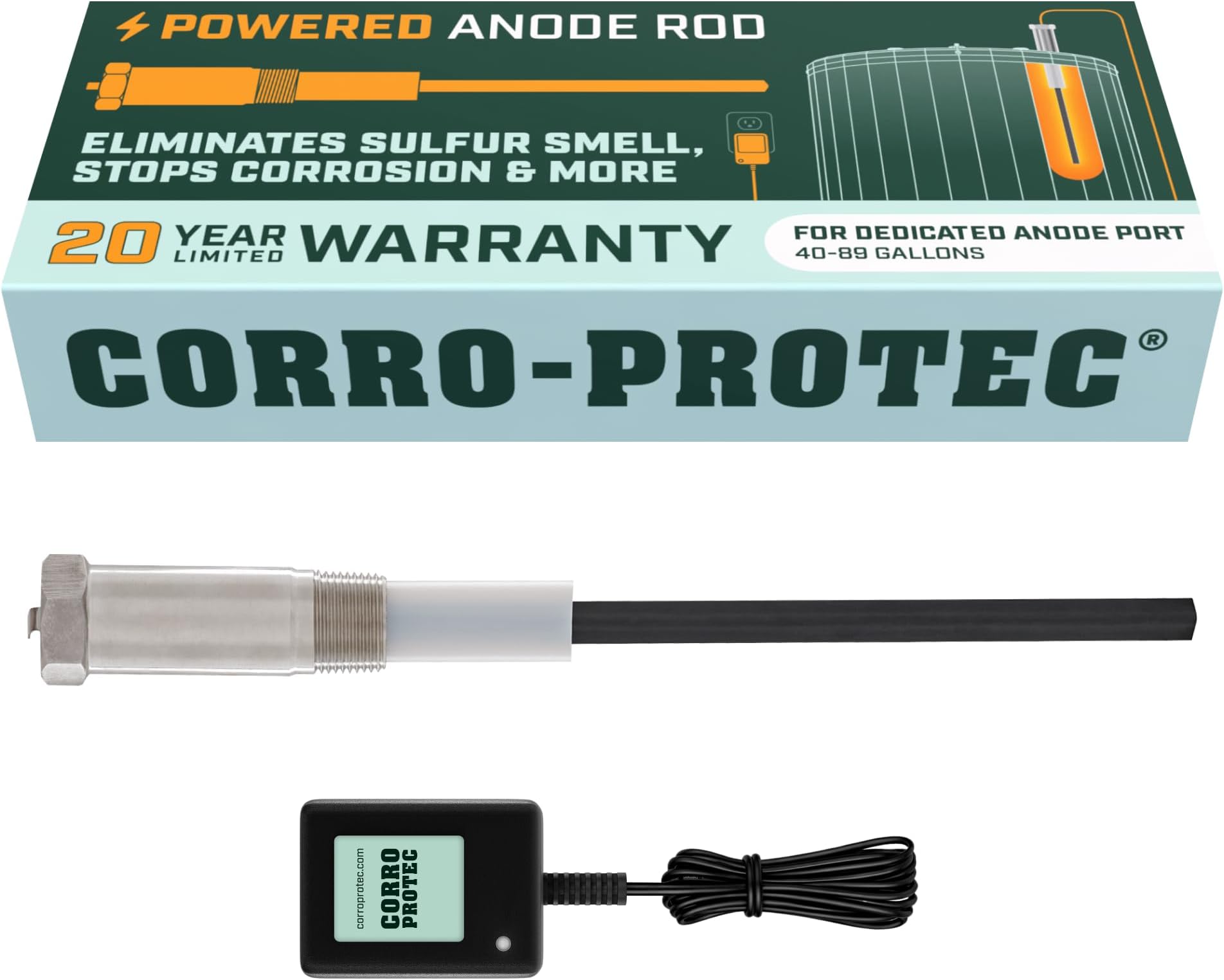
The Corro-Protec Powered Anode Rod is a titanium-based, electrically powered device designed to prevent corrosion and eliminate sulfur odors in 40-89 gallon water heaters. Certified lead-free and backed by a 20-year warranty, it fits standard dedicated anode ports and is compatible with all water sources and heater types. Its energy-efficient design reduces sediment buildup, extending tank life and saving on energy costs.


| ASIN | B01H459TAK |
| Best Sellers Rank | #3,270 in Tools & Home Improvement ( See Top 100 in Tools & Home Improvement ) #1 in Water Heater Replacement Parts |
| Brand | Corro-Protec |
| Brand Name | Corro-Protec |
| Capacity | 89 gallons |
| Color | Black |
| Customer Reviews | 4.7 out of 5 stars 7,826 Reviews |
| Efficiency | [INFERRED: Energy Efficient] |
| Is Electric | Yes |
| Item Dimensions W x H | 1"W x 12"H |
| Item Weight | 15.04 ounces |
| Manufacturer | Corro-Protec |
| Manufacturer Part Number | 96387 |
| Manufacturer Warranty Description | Manufacturer 20-year limited warranty. |
| Material Type | Stainless Steel, Titanium |
| Maximum Temperature | 71 Degrees Celsius |
| Model Number | CP-R |
| Mount Type | dedicated anode port |
| Power Source | Corded Electric |
| Product Dimensions | 1"W x 12"H |
| Smart Home Compatibility | Not Smart Home Compatible |
| Special Features | Certified by the Water Quality Association, Dedicated Anode Port Installation, Made of Titanium |
| Style Name | Indoor Installation |
| UPC | 094922963871 |
| Unit Count | 1.0 Count |
| Voltage | 110 Volts |
C**N
works fast and well!!!
installed this at 6pm on a Wednesday night, by 5:30am the next morning the sulfur smell was completely cone. Very easy to install although I do have a complaint that you have to buy a 1-3/16 deepwell socket which is NOT a standard size in any of my sets of impact sockets and I found it kind of ridiculous since all the other annode rods were 1-1/16 including the one on my tank. Why make everyone buy a special size???? Other than that this works extremely well so far, let's hope it is quality and lasts.
G**.
What you need to know before you start installing a Corro-Protec powered anode.
The Corro-Protec powered anode rod works exactly as it claims. It will immediately remove the "rotten_egg" smell coming from your hot water tank. Mine was pretty terrible after installing a brand new water heater 6 mos. earlier. My well water was reacting with the factory installed magnesium anode. This was causing bacteria to proliferate in the water heater and creating an obnoxious sulfur smell. Within 12 hours of swapping out the anodes the smell was completely gone. This product really works well and is worth everything I spent on it! It also has a 20yr. Warranty!! Very nice. There are some really big cons if you want to do it yourself, as I did. First problem was getting the existing anode out. It can be very challenging. It takes a special 1-1/16" 6-point socket to extract the factory installed anode. I couldn't budge it beating on my 1/2" breaker bar to loosen it. I had to finally put my 1/2" impact driver to use to get it to free up. Note: impact sockets wont fit in the anode recess. It has to be a thin wall socket. 2nd issue is extracting the anode from the tank. I did not have enough ceiling room to fully remove the factory anode. I literally had to cut it and remove as 2 pieces. I used a powered hacksaw and it took 10 minutes to do so. The last issue could be that you may need to get 110v power closer to where your tank is located. This unit has to remain plugged in to function. If you have the proper equipment needed that I mentioned above you can save a considerable amount of money in this doing yourself. My cost $185.00 Quoted price by plumber $500.00
H**.
Buyer beware , additional parts needed.
It clearly states in the ad that you will need a 1-3/16 socket to install this, no it does not come with it. I did not have any luck with local hardware stores so had to buy it online. This rod works wonders. In 24 hours my hot water went from from scrambled egg wet fart to fresh and clean smelling water. Install was super easy. Make sure you also have a 1-1/16 socket to remove old rod and maybe a torque gun to remove. Do not use torque gun to install new anode.
W**G
Powered anode rod? Yes please!
After a random video on yt about water heaters, I decide to check my own. Yeah, I needed a new one. After searching for a regular anode rod, I came upon a video with the corro-protec. I researched more and more about it and I was sold. I didn’t see any real negatives about it and purchased it the same day. Installation was easy, just follow directions and it should be no problem. I think many people don’t know what an anode rod is and located inside the water heater. I didn’t. I know it needs to be flushed once in a while. I did have to change the thermocouple which died in in the middle of winter. The price is high compared to a normal anode rod but in my opinion worth it. The 20 year warranty is awesome. The thought of possibly of not changing it in 20 years is a bonus. I’ve heard customer service is good also. And to keep my water for a bit longer is good too. All in all this device uses simple science to combat corrosion and smell in a water heaters. It is very useful to a home product which is taken for granted and hardly even thought of. This is an excellent product and should be a good replacement for older water heaters and even newer ones without the worry of changing the original one every 5 to 6 years. I’ve heard people needed to change the replacement earlier. Depends on water conditions and where the water comes from I guess. Okay, that’s it. Highly recommended!
R**K
If you have well water and have sulfur smell in hot water, read this.
Ok so we moved to a new house with septic and well water, which I have never had before. The previous owner got septic cleaned one day before handing us the house. First day, we noticed a fowl smell in the sink, a friend who has well and septic said it might be coming from septic since they just cleaned it, give it a few days. I did, nothing changed. Then I decided to call a well company to come check the water, now sadly we didn't have a water filter in our basement, just a water softner system. So the well company said smell might be from bacteria in the system, you need filters, reverse osmosis preferably, but if not, at least a nano filter 0.01 microns to filter out the bacteria. Sounded convincing, but from the 2 quotes we got, one was 16,000 for a rolls Royce of water filters, and one was 9000 for the nano, we settled for that and got it done and also got a bigger water softner. They bleached the system before installing so they could kill all bacteria in pipe lines. Took 8 hours, installed everything and went, smell immediately went away, only to return after 2 to 3 days. Can't explain the feeling. I have to admit that when I smelled the water on first day, I googled it and found that hot water heater has sacrificial anode rods and they go bad and I could either replace it with another 30 buck rod, or get titanium which last long and costs 80 bucks OR get corro-protec and I also watched the installation video, so I kind of knew I need to do this but was waiting for a professional to tell me that, which didn't happen. The well company sold me filter and all, and then when smell came back, they said I need a chlorone injector for my filter (another 2500 bucks). I said NO. Because i don't want chlorine in my drinking water if possible. Then I looked for a plumber who could replace my anode rod in water heater with corro-protec. Found one and they said they can come next morning OR a week later, so I quickly searched and found same day delivery on Amazon. So I i gave them a go ahead for next morning. Next morning plumber comes and inspected the smell and said that's not coming from water heater, if you have a well, it's coming from there. (Another expert not telling me to install this). I said to him, I spoke to your company and they sent you here to replace the anode rod and flush my system ($700 BTW), so do it. He said I am trying to save you money, this will not solve your problem. I said I don't want to save money and am not asking your opinion, please replace this if you can, otherwise I'll look for someone else. Can you imagine the dilemma? This is me, with my google research, after spending 9000 dollars on a well water filteration system telling another expert that I want you to charge me the 700 bucks even if it doesn't help. Well he flushed the water heater, took out the anode rod (check the picture of how yuck it looks), and installed corro-protec. It took about an hour for the water to heat up but when I opened the faucets the smell was gone. Zero sulphur smell. I wanted to make sure I wait a few days before I do my happy dance and post this review. It's been over a week and it is working like a charm. It still sucks that no experts recommend this product, but end of the day, here's a reason for us to take so much time to post reviews. I am pretty handy but I didn't want to mess with my 17 year old hot water heater and mess up something big time so decided to use a professional company. Best money spent. Highly recommend this product for those with similar use cases. Good luck
M**.
Robust Solution for Water Heater Maintenance
Like the idea of this product. I was about 3.5 years in on my current 50 gallon water heater and figured I was approaching the time for a replacement given the mineral content of our town's water. Decided to try Corro-Protec versus another standard anode rod as I did not want to have to revisit this again (and again and maybe even again); this system allegedly will last for 20 years (or more). I don't have the "rotten egg smell" to contend with, so cannot speak to it's effectiveness on that front, but there are other advertised benefits, like reduced sediment accumulation and a reduction in lime scale, which I found appealing despite the lofty price tag. Regarding installation, the process was pretty straightforward. Checkout YouTube for some good step by step guides. One piece of advice would be to use/borrow an impact wrench versus using a socket wrench (and cheater/breaker bar); this made taking the old anode rod out pretty simple. [Do recommend finding a deep socket as there is a metal tab that juts out of the top of the Corro-Protec, which is where the AC adapter hooks on. I had a shallow socket and did end up bending the tab, but was able to reposition it (thankfully) without issue.] My only criticisms at this stage would be the exclusion of teflon tape in the kit (like c'mon... it's $150+ and can't spare a few feet of tape?) and, out of the box, the rod was a bit bent to one side. It was easily repositioned by hand, but the box was in perfect condition, so not sure how this happened to the product. Also, despite the company's highly (self)touted warranty, I'm not overly impressed with the terms. The consumer is still inheriting a lot of risk and needs to have blind faith in the product doing what it's billed to do. If your water heater corrodes and gives out with this anode installed, they will not cover anything. Corro-Protec only covers the anode/power supply. Certainly, if other components of the water heater fail, I wouldn't expect that to be covered, but even if the anode fails in it's primary purpose and the tank does corrode, the company still claims no responsibility. Additionally, full reimbursement is only offered for the first 5 years, not 20. After the 5th year, coverage decreases 5% each year. (e.g. at year 20, you'd only have 25% coverage) Lastly, on a related note, there are anecdotal accounts of water heater manufacturers not honoring their warranties when this unit is installed. This might vary from company to company, but better to assume your tank warranty is void if you use this product. (It better work!) All that aside, I'm still focusing on the positive. I'll be interested to see if I notice any changes to the water heater performance or water quality, but suspect that they will be subtle. Will update this review accordingly. 3/27/24 UPDATE: I definitely noticed a lot less lime scale in the dishwasher almost immediately. This effect has persisted in the 5 weeks since installation. So far, everything still seems to be working well and the bright green light on the power supply is on. Nice product! 8/30/24 UPDATE: All is still well. Scale levels still seem to be reduced. Looks like a good product!
W**.
Simple to install, 100% Effective in Sulfur Smell Removal
Not one to write reviews but felt compelled to do so for this item. We recently had to have a new well dug on our property and since doing so have had that awful suffer smell in our water but only on the hot "side" of the plumbing. Our water heater was less than a year old so I figured couldn't be the issue. Once I read about this product I thought it certainly was worth a try. It most definitely required an impact driver to remove the existing anode even as "young" as it was. Installation was simple but not real simple, but to no fault of the Corro-Protec. I actually had to use tin snips to cut away a small portion of the metal around the access hole to the anode as I could not get the socket on the head of the anode due to the thickness of the socket, and the positioning of the access hole. But that only added a couple of minutes to the process. Total installation, including removal of the existing anode took less than 15 minutes. Once installed and running, the sulfur smell was 80-90% removed from the hot water within about 5 hours. Within 24 hours NO SMELL AT ALL. This device is practically a miracle product. I woe recommend it 100% if you are experiencing sulfur smelling hot water!
M**V
If you are looking at this product, then you have smelly hot water.
If you are looking at this product, then you have smelly hot water. Period. You've searched the internet and found lots of information, but you are unsure how much of it applies to your own situation due to the large numbers of variables involved. Plus, for whatever reason, you are reluctant to call in a professional. Yep, been there, done that, got the t-shirt. My scenario: my sister-in-law called last summer, asking for help with the water heater at her cottage. The cottage is actually a very small, two-bedroom year-round home, probably a bit over a hundred years old. And I should add that her cottage is about 75 miles away from where I live which means the entire process took awhile. The existing water heater had a slight leak. This sucker is certainly old enough to vote, might even be older. No problem. I headed to my local wholesaler and picked up a shiny new Rheem for her. Spent the better part of a day pulling out the old heater, re-working the wiring and the piping a bit and putting in the new one. Filled the heater, turned the power on, cleaned the pipe scuz out of the faucet strainers and called it good. And in retrospect here is where I made a mistake. Took the old heater to a scrapyard and got around $4.00 for it. What I should have done was removed the anode rod from the old unit. I suspect there wasn't one in there at all, but I'll never know. A few weeks later she mentioned her water smelled. Nuts. More background: I have a pole barn with one of those little point-of-service water heaters for the sink. Almost right from the start, I had smelly water out there, but since I was only using the hot water for cleaning, I ignored it. Not that it matters, but the heater is on a timer and it is only on a very few hours a week. But eventually I had enough and pulled it out. The anode rod was almost completely consumed. Ordered another from good ol' Amazon. When it arrived, I thoroughly cleaned out the inside of it with alcohol, put the new rod in and re-connected it. Within days the hot water stunk again. Since this is a family oriented site, let's just say I said "oh drat." Back to the internet. There is mention of aluminum used as an anode, but lots of cautions due to ingestion of the material. I wasn't worried about that since I only use that hot water for cleaning and not cooking. But there are no aluminum rods available for my little heater due to it being a somewhat specialized product. Being the somewhat creative guy I am, I picked up a 1/2" diameter length of aluminum rod from the hardware store, drilled and tapped it for 8-32, stuck it in the heater and ALL water problems have disappeared. Yay me. Back to the sister-in-law's cottage. I read a whole bunch of stuff regarding aluminum vs. magnesium vs. powered-anodes vs. no anode at all. I just did not feel qualified enough to make a decision for her. She wanted to stay away from the aluminum ones as she would be using the hot water for cooking. I started pricing the powered rods and we were looking at $250 to $350. I really hate spending other people's money for them if not absolutely necessary. So I suggested she call a local plumber who may have more experience with the water in her area. Did I mention this is well water? I should have. Anyway, he gave her the usual song-and-dance about how busy he was, but offered to remove the existing rod altogether. He couldn't do it, but he would send his son out. Well, this was almost a disaster. The son apparently spent 3 hours and was unable to remove the rod. No idea why. Remember I'm 75 miles away. OK, so much for that idea. She tried calling a professional and it didn't work. So now it is back to me. By this time, winter has arrived in the mitten-shaped peninsula of Michigan and the cottage was shut down for the duration. Earlier this year I did another search for the problem and this time found the Corro-Protec rod for a much more reasonable price. Asked the sister-in-law if she was willing to try it and she agreed. Ordered the kit and about a month ago went out to install it. I came loaded for bear remembering the son of the trained professional couldn't budge the existing rod. I drained the heater completely, which wasn't necessary for this job, but seems the recommendation now is to put water heaters in shallow pans. So drained and disconnected the heater and moved it out of the way. Set the pan in place, wrestled the heater into it and reconnected. Then tried extracting the existing rod. I have to explain I do have a 3/4" drive socket wrench set with a breaker bar that is a full 39" long, but no way did I need that much reefing force to bust it loose. It came right out, no problem whatsoever. I poured in 4 quarts of peroxide to disinfect the heater, then screwed the new rod in. Refilled the heater, turned it on, purged the lines and called it good. Sister-in-law called last weekend to report she was opening up the cottage and had virtually no water pressure, either hot or cold. Argh! I should have cleaned the faucet strainers. Yesterday I went over there and sure enough the strainers were clogged with pipe scuz. Cleaned them out and all is well. And finally, here is the point: after about a month of sitting there, I am relieved to tell you there are NO odors in the water. I love the product. Of course, we have no way of telling how long the product will last at this point, so stay tuned should something come up in the future. Will this product solve your particular problem? No idea. But it is a more reasonably priced alternative that might be worth exploring.
L**Y
We tried everything!!
We spent a lot of time and money to get rid of the rotten egg smell at our new cottage. I was so mad and felt so sick everytime the water was used, I had to leave! We had replaced the anode in the new hot water tank, we attached an inline filter, we tried a filter at the kitchen tap, dropped a chlorine tablet into the tank and when that didn't work we tried pouring a bottle of hydrogen peroxide but the smell was still bad! We never thought we'd fix this until we decided on the corro anode! It just worked! No smell!!! NONE! It was easy to put in, it took away the extreme odour that came from the hot water almost immediately. We are ecstatic, over the moon! I almost never went back to the cottage until the Corro-Protec. AMAZING PRODUCT!
G**B
Pricey but it works instantly
I tried everything under the sun to get rid of the foul rotten eggs smell in my hot water: filters with UV lamps, flushing the tank, sterilized it, increase temperature, aluminum anode, nothing worked more than a few days. Installed this product, was very easy ( you will need an impact gun with the proper socket of 1 1/16 for the original anode and 1 3/16 to install this product), but it worked, the very first day. Been enjoying smell free water for a week now and feel totally satisfied with this anode. Stop wasting your time with useless tricks from the web, if your well water has sulfur smell, install one of these on any brand new water heater and call it a day.
L**.
Fenomenal
Muy especial y deseo que cumpla lo que tiene de garantía. Ya que es difícil que te contesten para registrar tu producto
D**Y
Facile d'installation et bonne qualitée.
L' an passé, à l'achat d'un chauffe-eau neuf d'une marque renommé et bien installé, les couchemares sont apparus. Senteurs d'oeufs pourris, l'anode corrodé au max, ce qui a fait dégradé les éléments chauffant à un tel point qu'ils ont cessé de fonctionner complètement, et beaucoups de rouille qui sortaient des robinets. Alors, pour remédier à tout ces problèmes, j'ai tout remplacé. J'ai fais l'achat de cette merveilleuse anode électrique, et deux bons éléments chauffant. Depuis ce temps, il n'y a plus de mauvaise senteur, n'y de rouille qui sort des robinets. Je suis vraiment satisfait de l'efficacité des ces bons produits. Je les recommande à tous.
C**F
This product is far superior to regular anode rods for your hot water tank
This product is an incredible piece of engineering!! My well water is quite nasty with iron being high along with some iron bacteria also some calcium. When I used the standard sacrificial aluminum anode rod that is standard in each hot water tank to protect your heating elements, they get eaten away badly, and had to be replaced every year!! ! Every year I drained my hot water tank to flush and clean, it has been a nightmare !! The anode rode had so much buildup on it, I could barely pull it out of the tank . The worst part is the hours of time it took to remove all the accumulation of chunks of calcium and other alien looking crud in the bottom of the tank. A very tricky job with a shop vacuum and pressure washer !!! Too much to explain, but a very effective method . Albeit, a very labour intensive and time consuming job. I hated the thought of doing it each year because I knew what I was in for. NOT ANYMORE!!! Today was the “acid test” to see if this Corro-Protec electric anode rod stood up to the claims. Well did it stand up !! Nothing in that tank other than a bit of rust residue on the bottom of the tank which was easily washed away. My hot water tank job took me less than an hour after the water had drained out compared to the regular 5-6 hours before!!! This corro-Protec is nothing short of amazing from my experience. If you go through the same BS I do with tough well water, you definitely will not regret buying this product. I’d give the product 10 stars if I could.
Trustpilot
4 days ago
1 month ago