
Desertcart purchases this item on your behalf and handles shipping, customs, and support to SINGAPORE.
๐๏ธ Unlock the secrets of Romeโs empireโbecause historyโs best stories belong to those who know them first.
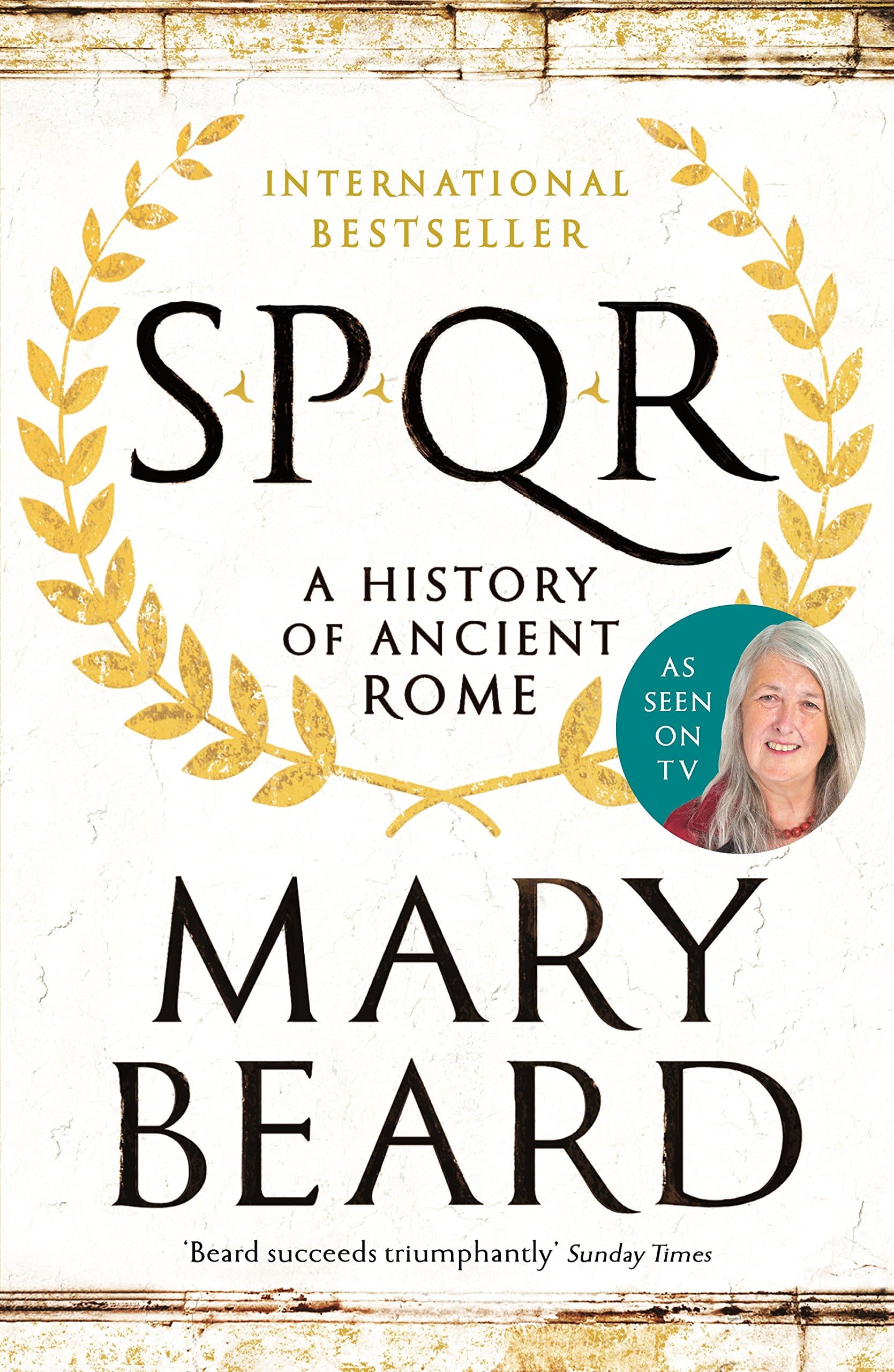
Spqr: A History of Ancient Rome by Mary Beard is a critically acclaimed paperback that offers a scholarly yet accessible exploration of the Roman Empire. With a 4.6-star rating from over 3,700 readers and top rankings in Ancient Rome and European history categories, this book is a definitive resource for professionals and history enthusiasts eager to deepen their understanding of one of the worldโs most influential civilizations.

| Best Sellers Rank | #3,663 in Books ( See Top 100 in Books ) #5 in History of Ancient Rome #19 in History of Europe #32 in World History |
| Customer Reviews | 4.6 out of 5 stars 3,712 Reviews |
R**A
Enjoyable to Read
All Gud
F**R
Fascinating research, very poor story
I started to read this book with a question in mind: "what distinguished the Roman empire from the rest, how did they rise while many others didn't?". On the positive side, the author is clearly super well versed on the topic, and shares an astonishing amount of findings and facts. However, these findings / facts were not presented in an easy to read way. I found the book to be very hard to read as I personally felt there was no coherent story or a natural flow. I also wasn't able to find the answer to my original question. If you read a few hundred books per year and/or are a massive Roman history fan this could make a nice addition, otherwise I'd pass.
T**I
Mary Beard's take on Roman history
A ubiquitous commentator on affairs both ancient and domestic in her native Great Britain, Mary Beard is something of an institution. Her latest written work, SPQR, is an interpretive history of ancient Rome aimed at a lay audience. Beard eschews a strictly chronological narrative in favor of a more thematic approach, peppering her history with insights and personal perspectives. It seems to me that any prospective reader should already have a firm grasp on the basics of Roman history, although the litany of awards SPQR has garnered, including New York Times Bestseller status, suggests that many disagree. Beard begins her history at the dawn of Roman civilization and ends with Emperor Caracallaโs grant of citizenship to everyone living in the empire in 212 AD. She starts by writing that Romeโs seven kings were likely more myth than reality. It is highly unlikely, she says, that just seven men served over the course of 250 years. It is noteworthy, she says, that many of the enduring features of Roman life were introduced by the kings. โAbominated as they were, kings were credited with creating Rome,โ Beard writes. For instance, Numa created much of Romeโs religion and Servius Tullius developed the census and the associated centuriate assembly system that gave weight to the wealthier classes. Moreover, some of the kings were clearly Etruscan in background, which underscored from the earliest days that Roman leaders could come from outside of the city, a key theme of Roman self-identify. Much like the United States, Rome was a city of asylum where anyone could rise to the top. Next Beard turns to the Republic, which she is quick to note did not spring full grown in the wake of the rape of Lucretia in 509 BC. Rather, she argues, it took centuries for the Republic of Ciceroโs day to develop. Major turning points occurred in the early fourth century BC. First came the Roman destruction of Veii, Romeโs Trojan War, in 396, and then the sack of Rome by the Gauls in 390 BC. The pattern of conquest and fear of conquest was thus established, she writes. โRoman military expansion drove Roman sophistication.โ The sophistication in building the massive defensive walls around the city and the logistics of incorporating large contingents of allied forces required โinfrastructure unthinkable in the fifth century.โ Next, in 367 BC, the plebs were allowed to stand for the consulship. Henceforth, Beard writes, being a patrician โcarried a whiff of snobbery attached to it and not much more.โ Beard agrees with the historian Polybius who saw the Roman political system as responsible for the success of the city during the Republic. The mixed constitution provided the state with strength and stability. She writes that the tradition of ancestor worship and the competition for political office and military spoils is what drove the expansion of empire, not any formal plan of imperial conquest. It was a coercive empire, she says, not one of annexation. The Latin word imperium meant โthe power to issue orders that are obeyed,โ and that is what the Romanโs did. However, the influx of conquered people and wealth would challenge what it meant to be traditionally Roman. Next, she points to the year 146 BC as a turning point, the year both Carthage and Corinth were razed. Roman violence was suddenly turned inward, beginning with the controversial tribunates of the Gracchi brothers. The road to Augustus, she claims, runs directly from the brothers to Marius versus Sulla and then Pompey versus Caesar. Each did their part to undermine key elements of the Republican system that led inexorably to dictatorship. The feud of the Gracchi brothers introduced violence to the domestic political process. The reforms of Marius allowed men without property to serve, thus turning the army into โa new style of personal militiaโ directly controllable by only the commanding general. Sulla added the military march on Rome and Roman soldiers spilling Roman blood, not to mention proscriptions and reviving the dictatorship. Pompey, for his part, climbed to the top of the political system outside of the natural order of the Republic, gaining commands without officially holding office. Caesar was just a culmination of his predecessorsโ careers. Beard affirms the remarkable legacy of Augustus in the transition from Republic to Empire, โa puzzling and contradictory revolutionary.โ Perhaps his greatest reform โ and certainly his most expensive โ was the introduction of pensions for soldiers. No longer were the Roman legions dependent on their commander for taking care of them. Now after 20 years of service soldiers received 12 years salary or the equivalent in land. The reform cost an estimated 450 sesterces or half of the annual imperial income. But it effectively removed the army from politics, at least for the time being. Augustus also made the Senate hereditary for three generations and allowed the Senateโs bills to have the weight of law. Now that Augustus was solely responsible for receiving positions in the imperial infrastructure, elections slowly died off and the old patron/client system, once the bedrock of Roman society and politics, was rendered nugatory. Although Augustus held the consulship 13 times, the position had largely become symbolic. The Roman Republic was dead but kept alive as fiction by filling old positions and offices. Or as Beard explains it, โAugustus was cleverly adapting the traditional idioms to serve a new politics justifying and making comprehensible a new axis of power by systematically reconfiguring the old language.โ Concerning the first two centuries of emperors, Beard writes that for all of their idiosyncrasies and outlandish behavior they were far more similar than they were different. โThere is no sign at all,โ she writes, โthat the character of the ruler affected the basic template of government at home or abroad in any significant way.โ Moreover, โthere was hardly any such thing as a general policy for running the empire or an overarching strategy of military deployment.โ The emperor did represent a new tier in the structure of command, but โhis role was largely a reactive one; he was not a strategist or forward planner.โ The truth was that the emperorship provided โa remarkably stable structure of rule,โ at least for the first two centuries of the empire. Between ascension of Augustus in 31 BC and the assassination of Commodus in 192 AD there were just 14 emperors (not counting the three short-term emperors of 69 AD). In a period half as long, between 193 and 293, there were no fewer than 70. For all of its stability, however, succession was an enduring challenge, as naming a new emperor always came down to โsome combination of luck, improvisation, plotting, violence and secret deals.โ In closing, SPQR is a marvelous synthesis of one renowned scholarโs take on one thousand years of Roman history. Iโve read much Roman history, particularly the Republican period, but I learned a lot from SPQR. I suspect Beard has delivered something very few authors can, a learned piece of scholarship that advances our understanding of Roman times that is as much admired by her academic peers at is enjoyed by the general educated public.
B**Y
great
great
P**L
Ripped
Arrived ripped
C**E
Affascinante
Affascinante storia dell'antica Roma. Ho acquistato anche altri due libri di questa autrice. Consigliato
M**A
The Best One-Volume History
Easily the most accessible and thorough book on Ancient Rome I have read. The writing is witty and the research is top notch. I highly recommend this edition for any history lover's shelf.
Trustpilot
1 week ago
3 days ago