Desertcart purchases this item on your behalf and handles shipping, customs, and support to SINGAPORE.
📡 Unlock the invisible spectrum — analyze, generate, and dominate every frequency!
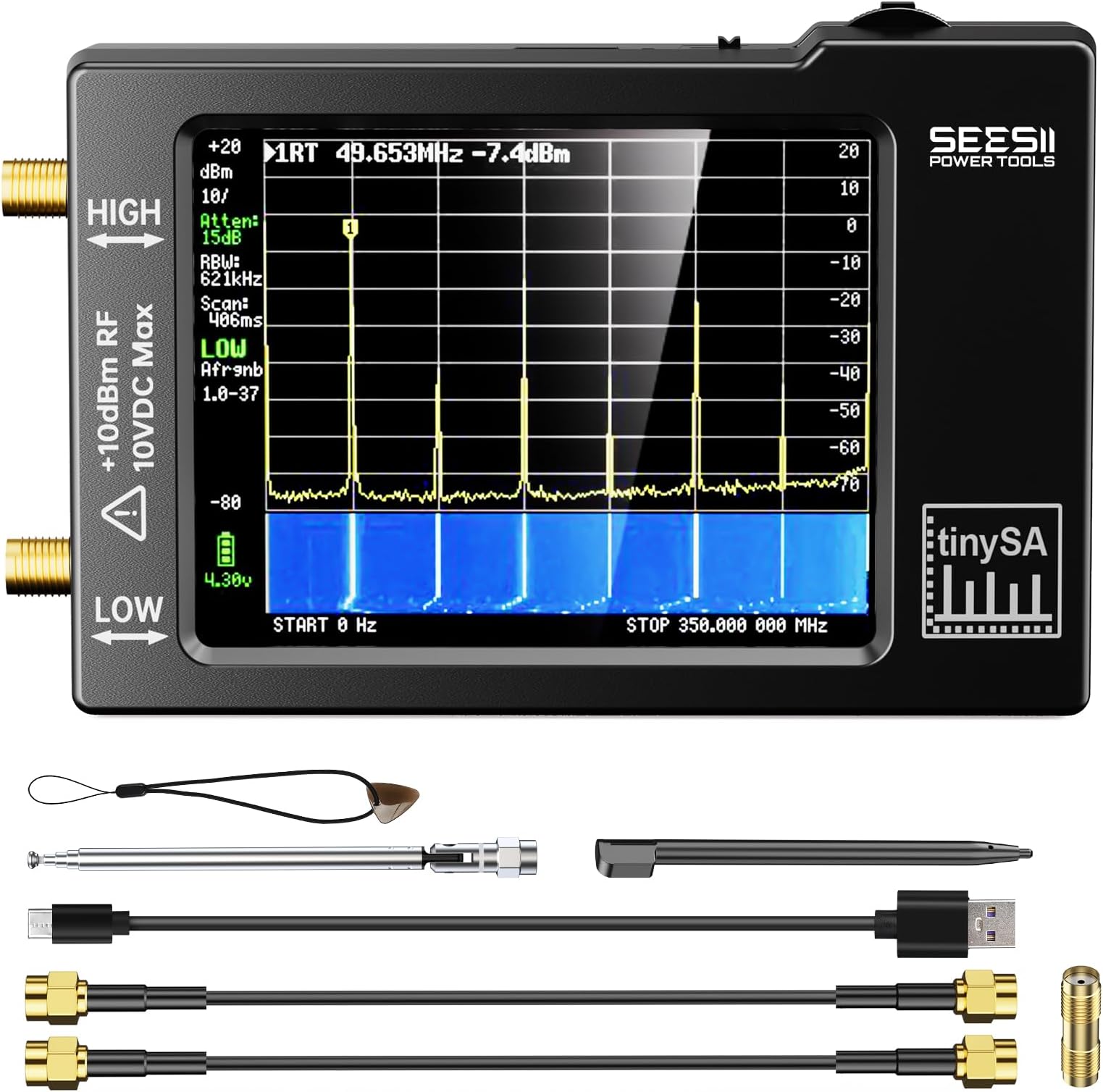
The Portable TinySA Spectrum Analyzer V0.3.1 by SEESII is a compact, handheld device covering 100kHz to 960MHz frequency ranges with dual inputs and switchable bandpass filters. Featuring a 2.8-inch color touchscreen, built-in signal generator, rechargeable battery for over 2 hours of portable use, and advanced ESD protection, it offers professional-grade spectrum analysis and signal generation. USB connectivity allows seamless PC control with automatic driver support, making it an essential tool for engineers, ham radio enthusiasts, and tech professionals seeking precision and portability.


| Customer Reviews | 4.6 out of 5 stars 520 Reviews |
M**S
Great for hunting for stray interference for wireless mic channels
Radio frequency spectrum analyzers can be very expensive, heavy and complex. Only in the last couple of years has the technology been available, at a reasonable performance level and portability. TinySA (and it's big brother, TinySA Ultra) and RF Explorer are the leading breakthrough products in Spectrum Analyzers. They each excel at different aspects of measuring RF and , all in a similar price ballpark. The original TinySA is by far the cheapest, at around $60-70. It is also the most feature-limited (though it is very full-featured by historical measure). It is marketed largely to ham radio operators, but I bought it to sniff out RF interference that might affect my wireless microphone systems that I use for my documentary work. Documentation is a bit sparse, as this is designed and supported essentially by a single person. There is no documentation in the box. However, there is a Wiki and series of short tutorial videos created by the developer to cover setup and menu controls. Most third-party reviews and video tutorials focus on ham radio and other use-cases that are unrelated to my needs. The TinySA's 0-950mhz band width is perfect for me to sniff out the UHF band from 470-608mhz (the remaining legal bands in the US) for interference sources. This device is described as "less accurate" in the 350mhz and up band, but it's plenty accurate enough for me. If I was coordinating large numbers of wireless mics for a venue or a large production, this would not be the best tool for me. I would be much better served by the 3x more expensive RF Explorer, which has a decent desktop computer application and can export frequency scans to a file that can be read by Shure's industry standard free frequency coordination app ( must, if you are looking to coordinate large numbers of RF sources. RF Explorer is a professional standard in portable RF test gear that can interface with the apps for advanced analysis and frequency coordination. TinySA Ultra has a bigger screen and extra bells and whistles and boasts a much broader range of frequencies it can scan (including way up into the wifi range) but if you just need a very portable, reliable, inexpensive standalone RF "sniffer" to help you avoid and solve RF interference problems in frequency ranges up into the UHF range, TinySA does the job beautifully.
J**.
Groat Addition to any Ham Shack
Works great
A**R
Small, cheap, very useful tool
Fun little analyzer. Does all of the basics including measurement functions. Waterfall display has two different size modes which isn’t really indicated on the menu. Signal generator has a wide output level range. AM and FM modulation works well but I haven’t tried external yet. Measurement sensitivity is a little quirky. Amazing capabilities for something so inexpensive. Complements the NanoVNA well.
L**A
Its a toy, not a metrology grade SA - but fits the bill for my application
For my intended purpose (Locating of RFI) it does its job. But I reckon it does not really matter whether I connect a magnetic loop of a telescopic antenna to it, it would not make any difference with regards to the readings. To locate if RFI is present, esp. on the shortwave frequencies its okay and it helps me to track down sources such as swtiching power supplies of Christmas lights which pollute the RF spectrum. I also bought it for spurious emissions testing to see if any homebrew transmitters (which I am legally allowed to use) have harmonics levels that don’t comply with FCC rules but now it already gets sketchy because I really can’t determine absolute values. I can estimate whether the harmonics are bad, but not more than that. For that purpose I would prefer a Rigol SA or a metrology grade R&S but for hobby purposes I don’t have that money - plus the tiny SA easily fits in your pocket. All in all, be aware of the limitations and then you have a nice unit, but be realistic what the unit is capable of and what not!
M**O
Great little SA!
Needed a small SA to keep track of some simple RF scanning for wireless in ear monitor packs and this did the trick. It was very easy to program and setup a preset so I can quickly go to the freq's I need to see. It's been very reliable from town to town that I've used it while on tour. The screen size is small but for my use I can see what I need to quickly. The battery life is great, feels fairly durable and it packs into a micro Pelican case for extra protected storage.
D**Z
Outstanding RF picture
This little guy made a big impression when trouble shooting random RF. I was able to quickly tune into the area of concern and fix the problem. My only con is that I was not able to hear sounds due to the lack of a headphone jack and BT capes. But overall would highly recommend this tool for those POTA HAM operators.
D**T
Amazing value for the money.
Truly tiny with all the features our field service team needs for LoRa radio field applications. The ability to set preset frequencies and to scan and record these is exactly what we needed.
V**V
Not great, not terrible
You get what you pay for – enough to compare devices, but way too unreliable to get precise measurements.
J**E
Es portátil pero requiere una cantidad de señal bastante elevada de cuando menos -40dBm
El rango dinámico es bastante escaso por lo que algunas pruebas no las puede hacer.
Trustpilot
3 weeks ago
1 month ago