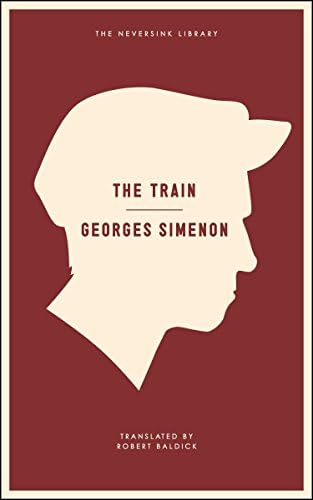
The Train (Neversink) Paperback – July 19, 2011
Product ID: 1783535
Desertcart purchases this item on your behalf and handles shipping, customs, and support to SINGAPORE.
Full description not available
E**R
Strange Interlude
Marcel Feron, the narrator of THE TRAIN, had a difficult early life. The boy Marcel, who was born in 1908, sees his mother, head shaven, driven in disgrace from their village in the Ardennes, probably for consorting with Germans during World War I. Meanwhile, his father, a reliable man before the war, returns from the front lines as an emotionally erratic alcoholic. Finally, Marcel acquires tuberculosis and lives his teenage years in a sanatorium, where he receives institutional care.In THE TRAIN, Simenon follows Marcel in 1940, after he, his wife, and daughter are evacuated from their village following the Nazi invasion in France. Almost immediately, the family divides and Marcel, shuttling toward the south of France in a crowded boxcar, gradually assembles a new and genuine emotional life that centers on Anna, another refugee. In THE TRAIN, Simenon shows Marcel's new emotional life gradually emerge, as well as the choices Marcel makes as developments challenge his marriage and impassive personality.What I liked the most and the least about THE TRAIN are the same thing--Simenon's terse style. On one hand, this style--many paragraphs are single sentences--produces a disciplined narrative, with the stages of Marcel's new emotional life emerging with both clarity and credibility. On the other, Marcel's laconic voice offers little reading pleasure. That voice suits Marcel, who is conventional and emotionally guarded. But it has no flash or flourish. (Still, this efficient style is the one to employ if a writer's nature pushes him/her to produce 200 books.)THE TRAIN is the sort of novel that converts into an involving movie, since its story is linear and touching while its prose does not burden a director with impossible-to-capture literary nuance. Rounded up to four stars.
J**Y
Dissonant Symphony
This is another of Simenon’s ROMANS DURS, a term that translates roughly to “psychological novels” or “harrowing novels” in English. I found it to be harrowing because of the juxtaposition of deaths by Nazi fighter jets, people acting like animals on the train heading out of the war zone, the unfaithful husband and father and the missing pregnant wife with the little daughter with her dolly--heartbreaking. The fears of the protagonist may have given way to the thrill of liberation as war allowed him to break out of his rut, but the rest of us couldn’t stop thinking about what was going on in the background with the pregnant wife and her cute little daughter who might be anywhere, at the mercy of anyone and might even be dead. There was a constant tension. It was like a symphony with a lot of dissonance.It was interesting and a little odd that the train ride became like a surreal experience. After all, there must have been people on the train from his hometown who could have informed on the protagonist about his lack of fidelity. Simenon dismisses that. Being on that train is like being set down in the middle of a distant foreign country. Apparently, things that happened on the train stayed on the train.It’s also interesting and a little odd that of the two ROMANS DURS of Simenon that I’ve read, wives and children occupy about the same status in the lives of these protagonists as furniture.Despite these misgivings, it was interesting and enjoyable reading.Again, I wouldn’t recommend this as a gift for the kids.3 stars
J**K
Simenon in Top Form
I never cease to be amazed by Simenon. I've lost track of the number of novels I've read by him.What shocks me is they have all been pretty good and I've barely scratched the surface of his body of work.This novel reiterates a common theme of Simenon's .You take an ordinary , even plodding man, and you unmoor him.You watch him become someone else.The plasticity or unfixed nature of the human personality clearly interested Simenon quite a bit.Here WW2 winds up being an opportunity for the narrator, Marcel ,to be another man.Yet, he is is this other man for only a few weeks and much as he enjoys it, he always intends to go back to his old life.Which he does quite effortlessly.The novel is his reflection on this brief moment in his life which he readily concedes was the most interesting part of his life.The novel works , in large part , because this is shown rather matter of factly.There is no high drama and very little romance.The author captures the strangeness of everyday people with remarkable fluency.We are all Martians at times.
M**Y
A war story you've never seen before
Most stories about war — about World War II especially — treat it as a rather simplistic matter: victims and aggressors, young and fearful or brave adversaries, an experience that happens *to* you rather than one you co-create with your own longings, hesitations, ambitions, aimlessness. THE TRAIN up-ends all that. It tells, persuasively, of the invasion of France and the westward flight of refugees as they must have been experienced by ordinary people at the time — by its narrator in particular, for whom the displacement is an escape that becomes a passion and leads to a stark discovery about his own moral nature.The narrative is swift and wonderfully told. Because of our acquaintance with war chronicles, we think we know where the story is going — but no, it is doing something quite different. And if I can be forgiven for stating the obvious, Simenon can really write (and the translation reflects his great virtues). The prose is lean and full of movement. Every observation, every detail selected for attention counts. And not to give away too much, but this is about as unsentimental a love story as you will ever encounter.
N**S
A great novel about the ephemeral gift of love
Love showed him for a brief interlude the amazing glory of life. In most hands other than Simenon's the experience of love and the intense natural wonder would have been transformative. But not here. This is a very powerful work of art, reminding us that the portion of joy which illuminates moments of our lives is by far the minor portion. And, secondarily, for students of France during the German Occupation, this book is a sobering reminder that the ordinary muffles even the most horrific deeds of history.
N**N
A brilliant war story
This is a devastating story of love and war which leaves the reader rather shocked and broken. Simenon explores gigantic issues of love, loyalty, human purpose and marriage in this tale about a man who becomes separated from his pregnant wife and daughter as they seek to escape the German invasion of northern France in World War II. But Marcel Feron's marriage had always been somewhat incomplete. "The fact of the matter was that she had never ceased to belong to her family," he writes of his wife as he later narrates this episode in his life when they board a refugee train to escape the invaders. "She had married me, lived with me, given me one child, was going to give me another. She bore my name but remained a Van Straiten for all that..." Then he is put in a separate train compartment to his wife and daughter and, without their realising it, the train is split into two and they go off in different directions. Meanwhile, he sees a dark-haired woman in his compartment. They develop an understanding. Time loses its effect. "A break had occurred. That didn't mean that the past had ceased to exist, still less that I repudiated my family and had stopped loving them." The tightly written novella describes the relationship between Marcel and the stranger as well as the way society re-evolves as most of the French are in flight from the invading forces. This small section of Marcel Feron's life becoming the truest part of it, the one time in his life when he finds his real nature. 'The Train' is gripping from start to finish. It applies just as much to peace time as to war, and makes the reader wonder, like Marcel, if he or she is fully alive.
B**H
A clever pyschological study
This is a really interesting psychological study that largely takes place within the confines of a railway carriage. The behaviour of some (particularly sexual) is, it seems to me, acceptable in a way it would not in most other circumstances. This is where the book carries its punch; it questions your notions of (absolute) morality and I think it's fair to say you may learn something along the way.A clever small book.
F**A
A moving, beautiful take on the horrors of WWII
This is a beautifully written book. The small details written in a way that made me feel as though I was there on that train. It encapsulated so much about the horrors of the second world war through this one relationship. Quite an amazing feat of writing.
A**R
Feels like a pointless book
Feels like a pointless book, while keeping you from putting the book down. The main character feels like someone we all know
B**E
Five Stars
A short story with love and affection
Trustpilot
3 days ago
2 months ago