


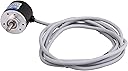
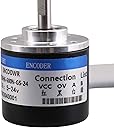
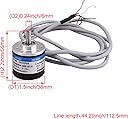

600P/R Incremental Rotary Encoder DC5-24V Wide Voltage Power Supply 6mm Shaft
Product ID: 17026898
⚡Wide 5-24V DC power range
🔄600 PPR (2400 quadrature resolution)
🛠️Smooth 6mm stainless steel shaft
Desertcart purchases this item on your behalf and handles shipping, customs, and support to SINGAPORE.
🔧 Elevate your projects with precision that professionals trust!
The 600P/R Incremental Rotary Encoder offers high-resolution 600 pulses per revolution (2400 quadrature), wide 5-24V DC power compatibility, and a smooth 6mm stainless steel shaft. Designed for precise measurement of rotation speed, angle, and acceleration, it features NPN open collector output and easy installation with color-coded wiring. Ideal for Arduino and Atmel projects, this durable encoder delivers reliable, high-performance feedback for advanced engineering and DIY applications.

| Manufacturer | BQLZR |
| Part Number | N04452 |
| Item Weight | 4.8 ounces |
| Package Dimensions | 4.1 x 3.3 x 2.7 inches |
| Item model number | N04452 |
| Is Discontinued By Manufacturer | No |
| Material | stainless steel |
| Power Source | DC power supply |
| Item Package Quantity | 1 |
| Batteries Included? | No |
| Batteries Required? | No |
| Description Pile | No batteries required |
N**Y
Turned out pretty good!
Nice solidly-built encoder. It works exactly like it should, and is very responsive. It requires at least 5V to operate, so you'll need to consider that if your controller runs 3.3V logic. However, it is open collector, meaning you just need to add pull-ups to the A and B lines to match your preferred logic level. The mounting plate is nicely machined and takes M3 screws in a triangular arrangement, in two different positions. Overall a great encoder and a must-have for anyone learning control system design.
D**E
Nice unit -- see picture for color translation
Seems to work well. The shaft is very smooth and low-friction. There are several questions about the correct wiring diagram, and the answers seem inconsistent, so I created and have attached a color key obtained using Google Translate -- match these to your unit for correct wiring. I've removed one star for poor documentation. I found that by using the INPUT_PULLUP mode on a standard Arduino UNO board, I did not need any external pullup resistors. And the unit ran happily using just the USB-provided 5V supply. Another reviewer (Kevin Blasko) of a similar item posted some sample code. I modified it slightly for my unit and repost it here: // Wiring connections for my encoder: // Red : VCC = 5V // Black: 0V = GND // White: OUTA = Digital pin 2 // Green: OUTB = Digital pin 3 // With these OUTA/OUTB connections and the interrupt code below, // clockwise rotation gives positive encoder counts. const int outA = 2; const int outB = 3; volatile long encoder = 0; // declare volatile since modified by interrupt routines long encoder_save = 0; void setup() { // set encoder pins pinMode(outA, INPUT_PULLUP); pinMode(outB, INPUT_PULLUP); // attach interrupts to pins // call digitalPinToInterrupt(pin) to be compatible with different Arduino boards attachInterrupt(digitalPinToInterrupt(outA), outAChange, CHANGE); attachInterrupt(digitalPinToInterrupt(outB), outBChange, CHANGE); // initialize serial Serial.begin(9600); Serial.println(""); Serial.println("Rotary encoder test."); } void loop() { if (encoder_save != encoder) { // only print if new value encoder_save = encoder; Serial.println(encoder); } delay(100); } // interrupt routines void outAChange() { // when outA changes, outA==outB means negative direction encoder += digitalRead(outA) == digitalRead(outB) ? -1 : 1; } void outBChange() { // when outB changes, outA==outB means positive direction encoder += digitalRead(outA) == digitalRead(outB) ? 1 : -1; }
K**S
This sensor worked Great with RoboRio
FRC team 1080, Resurgence robotics here. This sensor worked Great with RoboRio, Arduino, and (modern robotics FTC controllers). This sensor pulls the two signal wires down to ground to "pulse" or create a signal, when each line is triggered a pulse is read ona digital input pin, these ppulses are then counted, and whichever is pulsing first will generally determine direction. Micro controllers such as the arduino have a weak pull up resistor inside of them pulling the signal pin high for a logical 0, and when the transistor completes a connection to ground it pulls down on the signal voltage and a trigger voltage is reached. in the case of this sensor, it has a very low leakage current, meaning if using a "weak pullup" (5v at 15k-ohms) some arduino (3.3v at 40k-ohms) RoboRio, you wont notice much change or voltage drop when both lines are logical 0 as there is almost no leakage current from either transistor in off state, when pulled down, as much current as the roborio pin can supply is used resulting in a very near 0.0v. Be aware That, this encoder, when set to count rising and falling edges of all pulses, can output 2400 cpr. enc = new Encoder(4,5, true, Encoder::EncodingType::k4X); k1x= 600cpr, k2x= 1200cpr, k4x=2400cpr. if run at high speed this encoder when quadrature decoding (k4x) will tax any CPU.
O**T
Excellent Quality and Performance!
Excellent Quality and Performance! I bought one, tested it then ordered more. On various projects, I've worked with more than 20 different encoder brands/models and these are as good as the top-of-the-line when compared to others with similar PPR (Pulse Per Rev). Very responsive and smooth. No missed pulses and works well with Atmel chips (stand-alone on breadboard) and with Arduino. Note: They work without physical resistor pull-ups if using INPUT_PULLUP in code for Atmel chips/Arduino. Using 'C' code and/or PIC chips require physical pull-up's. The 600 PPR at Quadrature yields 2400 PPR. Using these on my Telescopes with Gear Ratio of 4:1 yield 0.0375 deg resolution. I recommend them. Here's a link to my Design and 3D parts for Telescope Tracking: https://www.thingiverse.com/thing:2242951
L**N
Works great and no debounce to mess with.
Not much to say that the other 5 star reviews haven't said. It works very well -- no contact bounce to deal with, no extra/missed pulses, 2400 pulses per revolution using the excellent code in Mr Blasko's review. Works fine with 5 volt Arduinos and with a 3.3 volt M4 using an Adafruit BSS138 3/5 volt level shifter. For Arduino's other than Uno suggest use of "attachInterrupt( digitalPinToInterrupt(encoder_a ), encoderPinChangeA, CHANGE ) ;attachInterrupt( digitalPinToInterrupt(encoder_b), encoderPinChangeB, CHANGE );"" to make sure you get the right interrupts. Worth the extra $16 just to get bounce-free pulse counts.
B**R
I can't give a review at this time, as ...
I can't give a review at this time, as I am still in process of collecting parts for my project, it may be several months before they actually get put to use.
J**S
IMPORTANT: Seller's connection information is wrong!!! Vcc is the red wire not the white wire!!!
Good product, just be careful about the connections. See other buyer's connection information first and don't trust the information listed on the Amazon site for this product. If you connect the white wire directly to Vcc (white is actually A or B, not Vcc), as instructed in the product description, you may break the open-collector output. It did not come with any other instructions and the connection information on the device is only in Chinese.
N**K
Nice and accurate
I bought one of these for an Arduino project, but I could not get the Arduino to keep up with the amount of pulses coming from the encoder. I had to go with a PIC. The quality of this encoder is great for the price. I have since bought 3 more. I would highly recommend it.
F**N
Unclear labelling on wires but works like it should otherwise.
I first relied on the indications on the amazon page, which said that: White wire = VCC Black wire = Negative Red wire = Phase A Green wire = Phase B Only problem though is that I first wired up and uploaded the code, when I started turning the knob, nothing happened. I first thought the encoder was busted or anything, but then I went on Google to look up what were the colors symbols in mandarin, and in the end, I inverted Red and White. However, after testing it, properly wired, it worked like it should (Serial monitor displaying consistent incrementing/decrementing based on turning direction and stable readings). However, I suppose that, if you were using something like 24 V, you could have easily fried some components inside. So, make sure you look up the color symbols and figure them out as a double check. Other than the labelling, as I said earlier, it works like it should (no erratic behavior like some other encoders seem to have in reviews) and the materials seem to be of more than very acceptable quality. No bouncing like mechanical encoders (because it's optical). It doesn't have a "Z" phase (1 pulse per turn), but for most applications, 2 phases might be all that you need. Honestly, this encoder is a good enough deal.
Trustpilot
2 weeks ago
3 days ago