Desertcart purchases this item on your behalf and handles shipping, customs, and support to SINGAPORE.
🌲 Print with nature’s touch — where precision meets eco-style!
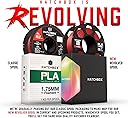
HATCHBOX Wood PLA 3D Printer Filament offers a 1 kg spool of 1.75mm diameter filament with tight dimensional accuracy (±0.03mm). Infused with 11% recycled wood fibers, it produces authentic wood-like prints that are sandable and stainable. Designed for easy printing with minimal warping and no heated bed needed, it runs optimally between 175°C and 220°C. Trusted by the 3D printing community for quality and consistency, this filament is ideal for creating unique, natural-finish models and decor.


| ASIN | B01092XXD4 |
| Additional Features | Less warping, No heated bed required, 11% recycled wood fibers, Sandable and stainable finish |
| Best Sellers Rank | #79,744 in Industrial & Scientific ( See Top 100 in Industrial & Scientific ) #1,052 in 3D Printing Filament |
| Brand | HATCHBOX |
| Brand Name | HATCHBOX |
| Color | Wood |
| Customer Reviews | 4.6 out of 5 stars 2,366 Reviews |
| Global Trade Identification Number | 00849344040439 |
| Item Diameter | 1.75 millimeters |
| Item Weight | 1000 g |
| Manufacturer | HATCHBOX |
| Manufacturer Part Number | 3D WOOD-1KG1.75 |
| Material | Polylactic Acid, Wood |
| Material Type | Polylactic Acid, Wood |
| Model Number | 3D WOOD-1KG1.75 |
| Number of Items | 1 |
| Special Feature | Less warping, No heated bed required, 11% recycled wood fibers, Sandable and stainable finish |
| UPC | 849344040439 |
| Unit Count | 35.27 Ounce |
J**2
Way Better Than Expected!
First off I will say I went into this filament with extreme caution initially. This was my first attempt at printing with wood filament but of course I naturally did a lot of researching and scouring the internet about users experiences with wood filament and which brands would be most recommended. Pretty much everything I read talked about constant nozzle clogs while using 0.4 nozzles, jammed hot ends and even hot end replacements because of the wood filament jams being so bad, and people saying wood filament strings terribly. Every source I read said you have to use 0.5 or even 0.6 mm nozzles because 0.4 will not work. Well, being the adventurous person I am I decided to go against what everyone says and use my 0.4 mm ruby tip brass nozzle because I knew the wood filament could potentially be abrasive so I wanted to at least eliminate that out of the equation with nozzle wear. I will say I was kind of scared because this is a nice printer (Qidi X-Smart 3) and I hate ruining things due to stupidity lol. Well, I will say, this blew me away when I knocked out my first print (the heart shaped box) which ran 13h 36m 13s, and not a single under extrusion and absolutely no stringing. Now I have the lid printing for it, using the exact same settings and at the time of writing this review it's at about 2 hours into the next piece with about 6 1/2 hours to go, and not a single hiccup. Soooo, I don't know why people are having problems with this stuff clogging their hot ends and nozzles, but truth be told, this stuff prints just as easily as normal PLA. I do run this slightly cooler than my normal PLA, but these first prints I'm doing are running at 190c on the hot end and 63c on the bed temps. Retractions are set to 1mm distance and 40mm/s speed. Since I'm a patient person, I run things slow, like 35-40mm/s print speed slow. Why go that slow if this printer can hit over 100mm/s? Well, like I said, this is a hobby for me, not a business, so I don't need fast prints and I'm not pressed for time, even though it's nice I can do that with this printer, but maybe that's why people complain about clogging, if they're trying to run faster than the filament can handle. I have included two pictures to try and show off how nice this stuff prints, at least the best I can. On my X-Smart 3, bed adhesion is perfect. I do a dawn soap and hot water wash on the build plate before each print though, no rubbing alcohol is ever used for cleaning, and a good z-offset calibration. In the two prints I've done so far, adhesion was never a problem and it stuck to the plate solidly and popped right off once cooled, like normal PLA would, and the first layer went down butter smooth with no gaps. As a bonus, this stuff smells great while coming off the hot end. Almost like a campfire smell, just not as overbearing and eye watering like a real fire. So I can say I know there's definitely wood embedded in the filament. I do intend on sanding and staining this so I may update this review at a later time when my first project with this stuff is done printing, but to sum it up, I highly recommend this particular wood filament from Hatchbox and don't be scared to run it with a 0.4 nozzle even if other people are having problems, but again, I'm using a ruby tipped brass nozzle, so I'm not sure how a normal brass nozzle will hold up to this and I'm not sure how hardened steel quality will be since you're going into new territory as far as slicer settings with hardened steel (temperatures, retraction, etc.). Just keep your temps lower than normal as this stuff will ooze a bit at the higher end, but at 190, I have no stringing or oozing, keep your speed respectable and watch your retractions. I definitey plan on buying more at a later point and I can safely recommend this brand as Hatchbox is know for quality filaments, and this is no exception.
V**L
Very smooth prints! Perfect for aesthetic pieces.
Now this is some good filament. I don't know what about this stuff makes it print so smoothly, but this wood PLA has aced every other filament I've tried when it comes to aesthetic print quality. It has its pros and cons. This filament looks so nice. If you compare this to other standard PLAs, this stuff (for me at least) has turned out much nicer looking prints using the same settings. Tops/bottoms come out very smooth, and even the striations on the sides of prints are less noticeable, in my experience. I've seen other people say that this filament sands like wood, but it really doesn't. It DOES sand down, however, but it's not as smooth of a process as normal wood. Which is totally fine because I haven't been able to sand down any other PLAs without it looking like trash. You can get a nice finish with the right sandpaper, but this stuff sands down like you're removing material, but also pushing it around, so sometimes edges will smooth over or become harder to sand. You just have to let it cool down and clean off your sandpaper before giving it another go. Fine grits will give you a harder time. This filament is more brittle. I didn't think it was a whole lot weaker at first, but comparing it to other PLA prints, it's obvious that it doesn't hold up to the strength of standard plastics. But, that being said, it is still a strong material, and it will hold up to some pretty impressive forces when parts are thick, but you have to be careful about impacts or thin pieces. It's not necessarily a whole lot weaker than normal PLA, but definitely more brittle. This PLA has jammed on me in the extruder twice, but after turning the temp up, I haven't had a problem since. In my experience, this PLA doesn't really take a stain that well. I've tried some darker stain pens, but it doesn't soak in like it would with normal wood. HOWEVER, using the darker stain pens, I find that when it leeches its way into cracks and crevices, you get a really nice weathered look that brings a lot more depth to your parts. I haven't tried many stains, but an ebony stain pen has given me great visual results. I recommend sanding your part after print, then running a very rough, low grit sandpaper over the surface a few times to give the stain something to sink into. The results are a very nice, textured look. The stain will darken then entire print a tiny bit, but the scratches put into the piece will stick out the most. You can put something like oil or sealant over the print if you like. Again, it won't soak in that much, but it will soak in enough. All that being said, this, so far, has been my favorite filament for printing pretty things. I can not recommend it enough. I've gone through 3 rolls already, and I plan on buying more.
P**.
Finicky filament with AMAZING results
So, first I want to say that this filament gives AMAZING prints. I am beyond happy with the results and quite shocked, honestly, with the quality. I included pics of a shelf that I printed and the layers blended so well you can’t see most of them with the naked eye in almost all of my prints except for in a few of the less visible areas in crevices or on finer details, but the layering that is visible looks more like a natural wood grain which was perfect for the look I was going for on these prints. Most people can’t even tell that they are 3D prints when looking at them or touching them and are shocked to learn that they aren’t real wood shelves. The look, feel and weight of the prints really gives off a carved wood appearance and feel. I didn’t do any sanding or painting to the shelves. I left them as is right off the print bed minus the supports. But here’s the thing with this filament. It is FINICKY!! You have to have a lot of patience and be able to pay close attention to your printer especially with longer/larger prints because it is prone to clogging and scorching. These shelves are large and took 32hours each. my first shelf failed 5 times about halfway through before I got the hang of printing with this filament and after several days of failures and fine tuning I was just about ready to call it quits. No matter which settings I changed or adjustments I made it just kept failing after several hours of printing until I started preemptively clearing the nozzle regularly to prevent clogs or random scorched filaments clumps from occurring. I know this filament does tend to wear down nozzles quicker because of its slightly gritty wood texture so make sure you have extra nozzles on hand if you’re printing large/long prints with this filament. Keep the temperature low to avoid scorching the filament. I printed at 175-185 max on the successful prints. Using Higher temps tended to produce frequent clumps of scorched filament and clogging especially with longer print times. (Full disclosure: I’m a printing novice.. I’ve only had a 3D printer for a few months so it is possible that my difficulty printing with this filament lies with my inexperience and not with the filament itself) Over all I HIGHLY recommend this filament. It turns out some of the best prints I’ve seen or printed to date. It’s absolutely worth the lengthy frustrating process i went through trying to figure out how to get a successful print with this filament.
J**N
Beautiful, brittle, and tricky
This filament has great potential for beautiful, non-functional prints. I've found it to be significantly more brittle and fragile than normal pla. On the flip side, it looks much better than most pla materials. I've had issues with first-layer adhesion, which were solved with higher first layer temperatures (210C works great for me). It was a nightmare of blobs and strings until I figured out good settings. I'll post the important ones here for prusa slicer / mk3 in case anyone else is struggling: - DISABLE THE FAN. This eliminated 99% of my stringing. Seriously. Turn it all off. - Retraction 1mm length @ 80mm/s helped with most of the blobbing and remaining strings - Disable wipe while retracting. You may want to also disable Lift Z. - Normal print temperature at 190. You can go as low as 185. Do not go lower than 185, adhesion will fail. - Bed temperature at 55. You can print higher temps for first layer for better adhesion. 210 / 60 worked well for me. - YMMV, but I wasn't able to print on the textured sheet. The first layer would always fail. I had to use the smooth sheet for this material. I'm sure I could have used a glue stick or something else, but I don't have access to rubbing alcohol right now due to covid, so I couldn't clean the sheet after printing if I did that. Speaking of, that may also have affected my first layer adhesion, since I can't clean my sheet right now!
M**N
Hatchbox Wood 1.75mm - Excellent prints once you figure out how to get build plate adhesion!
Updated 3/26/2021: It turns out our extruder was not extruding properly - gears were worn, so under-extruding, prevented sticking to bed, even though prints looked good when it did stick. After fixing that, sticks to bed nicely. The ideal temperature for this material for our Ender 3 v2 appears to be about 190 degrees to minimize stringing (see temperature tower pic - tower courtesy of gaaZolee on thingiverse). 185 is too close to the failed 180 deg temp, and as you go higher than 190 degrees stringing steadily gets worse. Original review: My wife and I are brand new to 3D printing, having just purchased a Creality Ender 3 v2 printer (love it BTW). We had excellent results right out of the box with the way-too-little Creality-provided filament, and then with the eSun Cool White we ordered. We thought "This is easy peasy! What are all these poor schmucks complaining about with stringing, bed adhesion problems, layer shifting, etc." THEN... we bought Hatchbox Wood. Wouldn't stick to the build plate for anything! A number of failed prints at slightly different temperature and speed settings, bed leveling again and again - NADA. We finally got it to work with blue painter's tape and glue. But that was such a pain! UGHH!! Then, as Bob Ross used to say, 'We don't make mistakes, we just have happy little accidents". Well, I 'happy accident' printed with my eSun filament at 180C nozzle instead of 205C. It didn't stick to the bed. LIGHTBULB WENT ON - filament not hot enough, doesn't bind well to textured glass Ender 3 v2 build plate. SO... bumped the nozzle temp up to 220C (high end of filament range - no 5 degree baby steps for me! ;-), and upped the bed temp from 65 to 70C. Voilà!! Perfect prints ever since, both large and small items (see pic - railroad trestle and pencil holder). Nice slightly woody texture versus the ultra-smooth texture we get with regular filaments. Prints pop right off the plate after cool-down. A bit stringy for odd shapes, but still highly recommend this filament - just be prepared to experiment a bit to get it to adhere well. Or just be smarter than newbies like us...
P**L
Easy to Print and Easy to Sand
I haven't used wood-based filaments from any other brands, so I wasn't sure what to expect from the Hatchbox filament. However, I haven't had any trouble with it so far and it really does look like wood after sanding the printed part. When I used the filament for the first time, I noticed that it was extremely brittle. While some PLA filaments will snap if you bend them too far, this filament snapped even easier than that. I was initially worried that it might snap as I was feeding it into my extruder, but that didn't turn out to be a problem, and I haven't had any problems with the brittleness of the filament since then. I should note that all of the parts I've printed have been rather solid and have not had thin walls. The thick parts that I've printed have all been very rigid and sturdy. Another notable difference between this filament and regular PLA is that the Hatchbox wood filament is not perfectly smooth. When looking at it closely, it looks like individual pieces of sawdust are visible. It's almost like the texture of composite wood decking. I was worried that the sawdust in the filament may not be ground fine enough and that it might clog within my printer's nozzle (0.4mm), but I haven't had any clogging issues yet. The photos that I've uploaded show what it looks right straight off the printer as well as what it looks like after a light sanding with 220 grit sandpaper. I printed the part on a Printrbot Play using the stock 0.4mm nozzle at a temperature of 220c (probably hotter than needed). The layer height was 0.3mm. I hope this helps anyone who's wondering how parts printed with this filament look after being sanded.
J**M
Worth the price, STRONGLY Reccomended For CR-10 Printers
This filament may be more on the expensive side, but it is certainly worth it, especially if you have a Crealty CR-10/ CR-10S. This is the only wood filament I recommend for the CR-10/CR-10s. I tried Haccka & Amolen wood filaments for the CR-10S and both filaments constantly jammed, and one ruined my hot end to where I had to have it replaced. But Hatchbox Wood Filament is the only filament that flows smoothly through the hotend pipe and the nozzle and I've rarely ever had to clear a jam with it. This is the only filament that allows me to get the most successful prints throughout the whole spool. The roll may be in the $30s, but its definitely worth your money. Advantages: 1. Flows Smoothly through small extruder sizes 2. Rarely jams the hotend 3. Emits a pleasant, subtle smoky wood smell while printing 4. You can sand it, blends nicely with wood filler 5. You can varnish and stain the filament, since there are real chunks of wood mixed with PLA plastic, so you do not have to worry about dissolving Disadvantages 1. Like all wood filaments, they tend to string a lot more than pla plastic filaments. I would recommend to double your default retractions to allow less stringing. If you are afraid of jamming, you can disable your retraction completely, but it will produce more stringing. With my months of experience using this filament, that's the only disadvantage while using my CR-10S. It may be on the pricey side, but its definitely worth your money for any printer, especially the CR-10/CR-10S
M**N
Amazing!
This stuff is absolutely amazing! You can sand it and use wood-stains and it looks so much like wood, you won't be able to tell unless you pick it up. (even then, if you got the texture, color and infill amount right (for weight)), many people might not be able to tell that it's not actually something carved from a solid piece. It prints well, (I have an Ender 3. I use lower than normal temps.. 194-196c for nozzle, 58-60c for bed). Supports remove well (when completely cooled), and I had no bed-adhesion issues (I print on heat-treated/textured glass with no glue, tape or hairspray.) The rolls I have gotten so far have been wound on the spool very well, but have heard from others that there might be tangles. (there are ways to fix that before printing, but it's better if they are just well-wound to begin with) I have printed with 0.4mm and 0.2mm nozzles, and it comes out amazing. It can look a little 'plasticy' if you don't have a good texture on your model, or you make it 'too smooth', but some sanding and/or stain can fix that if you want.. (some of the prints I have done with this look so good, I didn't do anything with them.). There is also a darker shade of this filament available if you don't want to mess with wood-stain. Really a good product. I wish the price was a few dollars lower, but after using many different brands and a LOT of Hatchbox, I am happy to pay a little extra for the quality. (If they go down any at all in quality though, the higher price is easily beat for even a small dip in quality as there are other filaments out there that are almost as good and consistent in quality.
R**S
Well wound, good product
I was really impressed with how well the filament was loaded on the spool, it gives me peace of mind if I want to print overnight. I have a monoprice select mini and this filament had no troubles running through the nozzle with temps. I had to amp up the nozzle temp to 230 initially to clear out the previous filament and get things going. After that, it printed beautifully without any issues and as a bonus, the room I printing in has a woodshop smell! The finished product has an interesting texture to it that's not fully wood but definitely not fully plastic. It has a different weight to it than a fully plastic PLA would have as well. I'm very impressed with this filament and company and will definitely be purchasing more!
J**L
Buen producto
Excelentes resultados en impresora Ender 3 Pro
L**.
¡Excelente filamento!
Imprimí una torre de temperatura y observé que la mejor es 185 ºC, Uso la impresora CR-10 y no utilizo nada diferente salvo la cinta azul para mejorar la adherencia, y pegamento en barra para papel, a 55 ºC y adhiere perfecto, incluso se dificulta la remoción del objeto. No cambié la boquilla de extrusión, que es de 0.4 mm, y no tuve problemas de obstrucción en una impresión grande de 32 hrs, de la cual adjunto la imagen. Luce muy bien como madera, pues tiene un acabado mate, es muy diferente a un PLA color café, pues la sensación del objeto con este filamento no es de plástico, sin embargo, es menos resistente que el PLA común, hay que tener cuidado con las piezas impresas, lo recomiendo solo para lo ornamental.
M**N
Real WOOD in 3D printing filament -- YES!
This Hatchbox product has upwards of 40% wood fibers within the filament. It prints so nicely as is, but once sanded, it can be stained and the look is fantastic! Like my other Hatchbox filament, it meets the specs for quality as Prusament PLA. Use this WOOD filament to make those baskets, bowls, vases, picture frames, and many other things with a "real" wood look and feel!
T**R
By far the worst I’ve tried so far
On recommendation I thought I’d try the Hatchbox filament. Sadly I have nothing good to report about it. Apart from taking a long time to deliver the filament is terrible. I have not yet managed to get a successful print job off it. I have used the same print parameters as other wood effect filaments but no. I have tried different settings all to no avail. I’ve even tried printing it on other PLA bases. Nope. It doesn’t stick well (either to the plate or PLA), it is stringy, brittle, clogs easily. I don’t like leaving one star reviews and I only VERY rarely do so, however, there is simply nothing good I can say about this filament.
Trustpilot
1 week ago
4 days ago