
Desertcart purchases this item on your behalf and handles shipping, customs, and support to SINGAPORE.
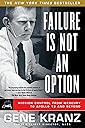
🌕 Failure Is Not an Option: Command Your Next Big Leap!
This 416-page paperback memoir by Gene Kranz, a veteran NASA flight director, offers an unparalleled insider’s view of America’s manned space program from Mercury through Apollo 13. With a 4.7-star rating and bestseller status in Aeronautics & Astronautics, it combines riveting historical accounts with leadership lessons that resonate beyond space exploration.
| Best Sellers Rank | #31,930 in Books ( See Top 100 in Books ) #15 in Aeronautics & Astronautics (Books) #16 in Astronautics & Space Flight #18 in History of Engineering & Technology |
| Customer Reviews | 4.7 out of 5 stars 3,017 Reviews |
D**D
Excellent Account of America's Early Manned Space Program
This is an excellent book but not exactly what I had hoped for. This book is a tribute to the dedication of the famous Gene Krantz. His dedication and service over the years from Mercury thru Apollo is not in doubt. But the book spends a lot of time talking about those he worked with in mission control and that is not why I bought the book. I thought that it might be more about the space flight mission details and stories of his encounters with the astronauts. But it appears that he had very limited contact with them.
B**L
Revitalized my interest in NASA and Space Exploration
Very enjoyable read! I saw this recommended and I'm always a sucker for a book, so I bought it on a whim, listened to it, and got sucked into NASA history. I loved all of the history and details and leadership lessons it contained. Now I'm looking for more on the subject.
L**R
A Simple Man for A Complex Mission
Growing up as a kid watching the Gemini and Apollo missions is what first sparked my interest in science and engineering. The other kids wanted to be astronauts; I wanted to be one one the engineers in Mission Control, ideally the flight director. Astronauts went into space once, twice if they were lucky. The engineers in Mission Control got to go on each one (or so it seemed). I wanted to know what it was like to ride into space with a headset, an oscilloscope and a chart recorder. Having to make life and death decisions in seconds or fractions thereof. Gene Kranz's book has finally given me that ride. Kranz tells of space exploration from the controllers viewpoint. And what a view it is, from the 4" flight of Mercury-Redstone 1, to the first Moon landing with Apollo 11 and the death defying flight of Apollo 13 Kranz allows us to live the adventure that he and his fellow controllers lived. The computers of the day were too big to place in the spacecraft. The computers controlling the craft were in Houston and a successful mission meant relaying results and limited code from Houston to the craft and vice versa. Poor decisions could mean a failed mission or worse, dead astronauts. The pressure these men lived under was tremendous but they took it on willingly as they believed in the cause set for them by President Kennedy - To place a man on the moon before the end of the decade. They worked 12 & 16 hour shifts, lived at the Johnson Space Center during missions, skipped vacations for years leading up to that first moon landing. Kranz tells of how the pressure could take a toll on the controllers and their families but the mission always came first. Mission training for both controllers and astronauts began months before the actual mission. Simulations were run to anticipate common and not so common emergencies. And they were run again and again until the right solutions came almost automatically. Much of the pressure would be blown off at informal beer laden mission debriefs at a local biergarten in Webster or by various physical activities. In Kranz's case he took up judo with a couple of other controllers to help blow off steam. Kranz is quite humble about his own role as flight director for Gemini and Apollo. While a believer in strong leadership, his concept of that is someone who provides his team with clear goals and objectives, the tools needed and then gets out of their way. Kranz truly believes in teamwork freely acknowledging that any and all success he had with NASA was due to excellent collaboration of a complex team of astronauts, controllers, contractors and administrators and the support provided by his wife Marta and his Catholic Faith. So why only 4 stars? Let's face it, Kranz writes like he talks - in the short clipped speech of an engineer or better yet a flight director. To be honest, its more like hearing him telling stories while sharing a beer. Still let's face it, he lacks the eloquence of Tom Wolfe in The Right Stuff. There are times I was aching for him to broaden the tale and give us more of the back story. However, except in rare occasions, if Kranz didn't experience it, he doesn't write about it. I was almost shocked that he doesn't tell the story of Alan Shepard needing to urinate after being locked up in Mercury-Freedom 7 for over 4 hours prior to launch. I would have loved to known how the controllers reacted to that request. There had to be a lot of scrambling, and contradicting opinions floating about on that one (they finally told Shepard to go ahead and go in his suit). Still there are times when Kranz rises to the occasion. His description of Armstrong and Aldrin's descent to the lunar surface was riveting. I was right there in Mission Control, holding my breath with the other controllers only letting go when Neil had placed the LEM down with only 17s of fuel remaining. In the end, it's a great read by a great and humble man.
T**N
Great flight controller coming up through the ranks. Working with people.Not an egotist like Chris Kraft
I read almost all the astronaut books. This book was great explaining some of the ground control of Mercury through the Apollo program. We see Gene Krantz becoming a fighter pilot with the Saber's. Unfortunately the Air Force wanted Krantz to fly tankers. No way. He joins NASA and is mentored by Chris Kraft. He goes up the ranks working with various people and becomes a flight controller and then becomes "Flight" the head of the "white" crew. We see him working with telemetry members in the "trench". His wife makes him a white vest to wear on the missions with Gene at flight control. We see the first 4 inch launch, Al Shepard's first American in space launch and the rest of the Mercury shots. Then the Gemini and later the Apollo shots. Krantz and his white crew were in charge of the LM touching down and off the moon on Apollo 11. Krantz helps get Apollo 13 home after an oxygen tank explodes and takes out the entire side of the service module.The astronauts are so proud of ground control helping them. Ground control receives the Medal of Freedom award. After Apollo 17 Gene is promoted to a higher management level under Kraft so his days as being in direct control as "Flight" are over. Its incredible the pressure the controllers and Flight worked under. There was life and death decisions, and abort, go or no go decisions that had to be done sometimes in seconds. Only a select few had the mentality to function at this pressure level. Many washed out and those that were good many times got promoted to higher positions. What a great book. Much less ego busting and egotistical put downs like Chris Kraft did in his book Flight ( see my review 3 stars). Gene Krantz is a man that knew he needed help from other people who were smarter than he and was able to work in teams with hundreds of men.He learned much from many and gave credit to those who helped and were the best of the best in their job specialties. Gene was not afraid to tell people including Chris Kraft that he believed they were wrong in some aspects of a mission.Sometimes he was right sometimes wrong. We see the new breed of flight controllers trained that were faster and brighter with faster technology than the Kraft and Krantz generation.Krantz helped develop a degree of excellence and mission rules for the controllers and Flight that they must work through their problems, be prepared and have a deep mind set that "Failure is not an option". The torch is passed. A great ending of the book. Krantz tells us that NASA has deteriorated and does not have a clear direct to go deep into manned space. We need a leader like John Kennedy to set up a bold mission to go to Mars and beyond. Congress must get involved and support NASA. An excellent book that helps describe ground control in the Mercury, Gemini and Apollo eras. Thanks Gene Krantz for your contributions to manned space. 5 stars
2**Z
The incredible inside story of mankind's greatest achievement
As an airline pilot I have always had more than a casual interest in the US space program. Gene Kranz tells an amazing story of what is probably mankind's greatest accomplishment. A true leader, visionary and team player, Kranz takes you inside mission control and provides a front row seat to the 1960's space race. The "crew concept" so widely trained in commercial aviation today has its roots in our early space program. These incredible people didn't have a book to go by, so instead they wrote the book on space flight. Kranz does a good job of highlighting the risk/reward relationship of every decision. Despite already knowing the outcome of every mission, the story of each flight is gripping. I was surprised at just how many very close calls there were. These were truly brave people (and not just the astronauts) who came to work every day pushing the limits of man and our technology. More than just a historical chronology of each mission, Kranz does a respectable job of bringing out the human element and the many personalities involved, each of whom played a critical role in making key decisions. You really get an appreciation of the high stakes involved. Risk management is the name of the game and the stress never abates. Every aspect of every mission was clearly a team effort and compromises were necessary at every level. It was a special time and these were special people. Sadly, the book highlights just how far we have fallen as a nation of pioneers. Kranz observes that the 1960's opened with JFK's bold and visionary assertion that America was going to the moon and only a decade later Richard Nixon effectively gives the Apollo program it's obituary with a "thanks" to the astronauts who would likely be the last to walk on the moon that century. By 1973 the public was already becoming disinterested with space so the money, and the will, dried up. Gene Kranz does a convincing job of explaining the intangible benefits of leading the world in exploration and pushing into the universe beyond. I believe if more people read Failure is Not an Option, there would be a renewed interest in returning to space. As a side note, there are a lot of acronyms in the book, which is normal everyday fare in aviation, but for the uninitiated it can be a bit daunting. There is a handy appendix provided that will help you keep it all straight. You may not realize that it is there until you've finished the book, especially if you have the Kindle version.
H**U
Essential Reading
When it comes to the space program, most books focus on the astronauts, but the readers do themselves an incredible injustice by skipping the other 95% of the action. This book covers those heroes. I had always thought of Mission Control as similar to Air Traffic Controllers. If the tower isn't open, planes can still land on their own with a specific set of procedures. But Mission Control is just that - they are as integral to the mission as the astronauts and the rockets - every one of them. For every action of the astronauts - from docking, to EVAs, to even taking a poop, there was someone on the ground whose job it was to worry about that specific aspect of it and how it impacted every other part of the mission. These amazing specialist controllers worked and trained with the primary and the backup astronaut crews to develop the specific procedures for performing every action (potential and planned) the whole team might foreseeably encounter. When it came time to perform those actions, the makeup of the shift of controllers would be the specialists in those areas. So when the action changed from launch to docking rendezvous, the controller shift changed, too. The Apollo 14 mission is one great example. Paraphrasing a chapter, one of the controllers had detected a problem with the ABORT switch. After a quick conference with other specialists, they called a backroom of other experts who was there to specifically back him up. Behind that back room of specialists was a software team from MIT on the line waiting just in case. While the astronauts were preparing and proceeding with their lunar descent, the MIT team had written a software patch, the back room team had tested it with the backup astronaut crew in the SIM and then transmitted to the crew. Without their efforts, the landing would have been scrubbed. As another example, every time the launch was put on hold, there was a trajectory controller who performed the calculations for the new trajectory and upload it to the computers. You have to think, every minute or so means a new trajectory! The Apollo 13 movie only hints at the immense pressure these guys were under. No rocket was perfect and every mission required troubleshooting (and fixing) one set of problems after another. Live. Thanks to Gene for giving these guys their due. Another book that I think of as essential is Deke Slayton's book, "Deke!" This bridges the gap between astronauts and admin and how many of the decisions were made (such as who was first in space or on the moon).
M**R
Excellent book
An Amazon book! Highly recommend it to anybody who wants to learn about the early days of the space race!
A**R
Well done
If you’re interested in the Mercury, Gemini, and Apollo projects this is the book to read. It is full of information but it does not get overly detailed as some of the books on the space program do. He keeps it manageable. A very good read written by a man who was ringside for all of it.
り**う
読み応え有り
ジーン・クランツ氏は映画アポロ13でエド・ハリス氏が好演し、偉大なリーダーとして存在を知りました。本書は、ヒロイズムに彩られた単なる成功体験では無く、クランツ氏本人による、アメリカ宇宙開発の黎明期から黄金期に至るまでの、数々の試行錯誤や苦い失敗、職場の人間関係も垣間見え、苦悩や喜びの記録が本人の言葉で淡々と回顧された良書である。
M**A
Toll
Das Buch wurde in einem Film erwähnt. Das Buch hat meine Erwartungen übertroffen. Abgesehen davon, das es ein Stück Raumfahrtgeschicht erzählt und eine Fülle von Hintergrundinformationen und Einblicke in die Geschichte des Raumflug liefert, gibt es einen Einblick in die Führungsstruktur, das Leadership und das Teamwork das dahinter steckt. Die damaligen Stars (wir wollten damals alle Astronauten werden) treten in den Hintergrund. Man bekommt deutlich gezeigt wieviel Manpower nötig war (- und ist- ), um die paar Leute in den Weltraum zu befördern. Wie viele faszinierenden Persönlichkeiten mit genialen Ideen, Wissen, Können und Risikobereitschaft unter einen Hut gebracht werden mussten. Wie man mit (auch katastrophalen) Fehlern umgeht und daraus lernt. Was in Mission Control abgelaufen ist, wie optimiert und knapp im entscheidenden Moment die Kommunikation abläuft - Dinge die man damals im Fernsehen nicht vermittelt bekommen hat. (Astronaut? Mission Control! Das wäre mein Platz gewesen) Das Buch vermittelt nicht trockene technische Fakten. Wer sich dafür interessiert ist hier nicht richtig. Wer sich für die Geschichte hinter der Geschichte interessiert, findet hier ein spannendes Buch und wer sich für die Führung eines Unternehmens oder Kommunikation interessiert, für den gibt es Einblicke in den Führungsstil von Gene Kranz. Wie man Wissen und Können mit der geeigneten Führung zum Ziel führt - einfach faszinierend und bei bei meiner Arbeit sehr hilfreich. Mir persönlich hat der Schreibstil von Gene Kranz zugesagt. Die Art, wie er die Dinge auf den Punkt bringt, gefällt mir. Die Erzählungen privater Ereignisse lockern das ganze nett auf. Trotz 400 Seiten war ich mit dem Buch superschnell durch. Damit ich immer wieder darauf Zugreifen kann, habe ich mir auch die Kindle Version gegönnt. Die Bestellung und Lieferung bei Amazon perfekt wie immer. Fazit: Einer meiner besten Käufe bisher - eigentlich würde ich gerne 10 Sterne vergeben.
A**O
Great reading!!!
Epic story, couldn't stop reading until the end.!!
E**A
Content is so great, book quality is so bad
The book quality is not good, not worth the money, but the content is so great.for the content 5 star,for the quality 1 star.
J**A
Nie polecam
Książka przyjechała zniszczona
Trustpilot
2 weeks ago
2 months ago