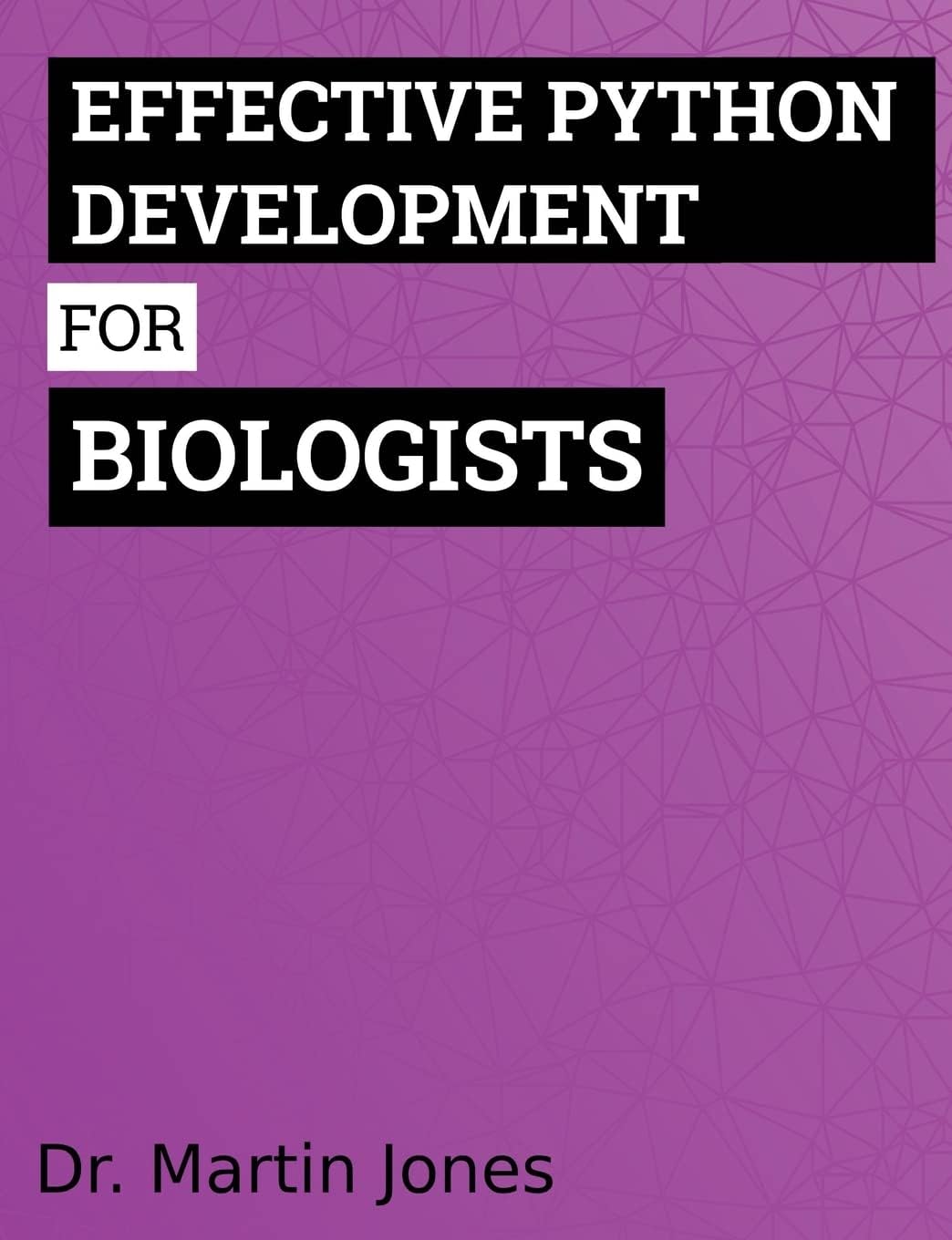
Effective Python Development for Biologists: Tools and techniques for building biological programs
Product ID: 139557513
Desertcart purchases this item on your behalf and handles shipping, customs, and support to SINGAPORE.
Python is rapidly becoming the standard language for many talks in scientific research, and is particularly popular in biology and bioinformatics. One of the great strengths of Python is the ecosystem of tools and libraries that have grown up around it. This book introduces the novice biologist programmer to tools and techniques that make developing Python code easier and faster and will help you to write more reliable, performant programs. Written by a biologist, it focusses on solving the problems that students and researchers encounter every day: How do I make my program run faster? How can I be sure that my results are correct? How do I share this program with my colleagues? How can I speed up the process of writing my code? Chapters include: Environments for development - learn how you can take advantage of different tools for actually writing code, including those designed specifically for scientific work. Organising and sharing code - learn how Python's module and packaging system works, how to effectively reuse code across multiple projects, and how to share your programs with colleagues and the wider world. Testing - learn how automated testing can make your code more reliable, how to catch bugs before they impact your work, and how to edit code with confidence. Performance - learn how to make your code run quickly even on large datasets, how to understand the scaling behaviour of your code, and explore the trade offs involved in designing code. User interfaces - learn how to make your code more user friendly, how to design effective interfaces, and how to automate record-keeping with Python's logging system. About the author Martin started his programming career by learning Perl during the course of his PhD in evolutionary biology, and started teaching other people to program soon after. Since then he has taught introductory programming to hundreds of biologists, from undergraduates to PIs, and has maintained a philosophy that programming courses must be friendly, approachable, and practical. In his academic career, Martin mixed research and teaching at the University of Edinburgh, culminating in a two year stint as Lecturer in Bioinformatics. He now runs programming courses for biological researchers as a full time freelancer. Praise for Martin's previous books "Great, great book. I think this is the perfect book for any biologist to who wants to start learning to code with Python... I didn't know a command-line from a hole in the ground when I first opened up this book, and mere days later I was impressing my colleagues with my own DNA analysis programs." "Zero to writing useful programs in a weekend... Python for Biologists arrived last Thursday, 6/16/16, I spent the whole weekend glued to my laptop in a 2 1/2 day frenzy of coding, and I just finished it -- and came on desertcart to order the next one!" "One of the BEST coding books I've used in a long time. Direct applications in bioinformatics. I bought the advanced python book too." "The most useful guide to Python I've found...I've tried a few Python books, and this is by far the best for me." Review: First-Rate Practical Tutorial On Bioinformatics Workflow - I came to this book interested in how Python was being used in biology. It turns out this book is highly practical detailing the steps for using Python in bioinformatics. The book starts assumed you are familiar with DNA related biology. I had to look up a few terms on Wikipedia, but I am glad the author assumed this knowledge still because it was not that hard to get up to speed. Examples always focus on the biological and the practical. Jones explains very clearly how to use Python, which libraries, and which tools to get most of Python in the biological workflow. Right away you will see the practicality of the examples such as reading and manipulating DNA sequences. Even though I am not a biologist myself it was still understandable and I wanted to research more. The beginning of the book shows you how to debug Python programs well. The topics were surprisingly wide ranging going from sharing code, to testing, and then some graphical tools explained towards the end. I liked that the author said which tools are good and which ones you may want to avoid. He was critical of the tools he did not like and praised the ones he did, helping to make it obvious what the best choice is in the biological workflow. At the end of the book he explained well why the command line is a preferred choice: "For most bioinformatics work, a command line interface is the best choice: it's most likely to fit in with other tools, it's amenable to automation, and you can document all the arguments used to run a program by simply copying and pasting the command line into a text file or an email." Overall this book in an excellent choice for learning about Python or biology related engineering. One small suggestion for future editions of this book is to include the code on GitHub. I would have liked to see the code online as well because typing the gene sequences manually was prone to error for me, although I liked that the examples were easy enough to type from the book too. Review: Fantastic resource - This book gathers extremely useful information that is otherwise sparsely distributed. Everything is explained clearly and accompanied by example files and code through the website. Highly recommend for novice bioinformaticians.
| Best Sellers Rank | #3,016,956 in Books ( See Top 100 in Books ) #2,869 in Python Programming #5,901 in Computer Programming Languages |
| Customer Reviews | 4.6 out of 5 stars 12 Reviews |
W**S
First-Rate Practical Tutorial On Bioinformatics Workflow
I came to this book interested in how Python was being used in biology. It turns out this book is highly practical detailing the steps for using Python in bioinformatics. The book starts assumed you are familiar with DNA related biology. I had to look up a few terms on Wikipedia, but I am glad the author assumed this knowledge still because it was not that hard to get up to speed. Examples always focus on the biological and the practical. Jones explains very clearly how to use Python, which libraries, and which tools to get most of Python in the biological workflow. Right away you will see the practicality of the examples such as reading and manipulating DNA sequences. Even though I am not a biologist myself it was still understandable and I wanted to research more. The beginning of the book shows you how to debug Python programs well. The topics were surprisingly wide ranging going from sharing code, to testing, and then some graphical tools explained towards the end. I liked that the author said which tools are good and which ones you may want to avoid. He was critical of the tools he did not like and praised the ones he did, helping to make it obvious what the best choice is in the biological workflow. At the end of the book he explained well why the command line is a preferred choice: "For most bioinformatics work, a command line interface is the best choice: it's most likely to fit in with other tools, it's amenable to automation, and you can document all the arguments used to run a program by simply copying and pasting the command line into a text file or an email." Overall this book in an excellent choice for learning about Python or biology related engineering. One small suggestion for future editions of this book is to include the code on GitHub. I would have liked to see the code online as well because typing the gene sequences manually was prone to error for me, although I liked that the examples were easy enough to type from the book too.
A**R
Fantastic resource
This book gathers extremely useful information that is otherwise sparsely distributed. Everything is explained clearly and accompanied by example files and code through the website. Highly recommend for novice bioinformaticians.
Trustpilot
4 days ago
3 days ago