


🎧 MiniDSP 2x4 HD — Small box, massive sound mastery.
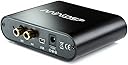
The miniDSP 2x4 HD is a compact, USB-powered digital audio processor featuring a 400MHz Analog Devices SHARC floating-point DSP engine. It supports 24-bit ADC/DAC resolution, USB audio streaming up to 192kHz, and Toslink digital input, enabling high-resolution, customizable audio processing with flexible EQ, crossovers, and delay. Ideal for audiophiles and professionals seeking powerful sound control in a sleek, versatile package.
| ASIN | B014SJ420M |
| Customer Reviews | 4.4 4.4 out of 5 stars (146) |
| Date First Available | 12 Nov. 2015 |
| Guaranteed software updates until | unknown |
| Hardware Interface | USB 1.0, USB 1.1, USB 2.0, USB 3.0 |
| Item Weight | 200 g |
| Item model number | revA |
| Product Dimensions | 10.16 x 10.8 x 2.54 cm; 200 g |
J**Z
Dual subwoofers
Anyone with 1 to 4 subwoofers get this. You need it.
J**.
This seller is mis-selling these units
When you are looking for a Mini DSP be careful which one you go for . This item is not the Mini DSP 2x4 as advertised. IT is the basic 2x4. A which is not as good for EQ or bass management. This is why these are a £100 cheaper than other sites.
A**R
The results are significantly better than passive crossovers even on "
The miniDSP 2x4 HD does exactly what I wanted: it takes stereo input (analogue or digital) splits the signals into 4 channels and allows each channel to be filtered, equalized or compressed. I use it as an active digital crossover, the 4 output channels being two stereo pairs filtered into "woofer" and "tweeter" frequency bands. The results are significantly better than passive crossovers even on "high end" speakers. The accompanying control software was installed on Windows 7 running as a virtual machine in VirtualBox on a Linux host. My wish is that that I could run the software natively on Linux. However, I only need Windows for the control and set up part. Normal Linux is fine for playing and recording so overall at least 4 stars. Delivery in the UK by Kalibrate Ltd. was quick and efficient as well.
D**E
BE WARNED - NOT THE HD VERSION!!!!
NOT THE HD VERSION!!!!
X**M
Excellent Performance
First, there seems to be some confusion regarding Rev A (0.9vrms in/0.9vrms out) vs. Rev B (2vrms in/0.9vrms out). This is understandable as revisions generally mean design changes. In the case of the miniDSP it would have been better to refer to them as Mode A and Mode B, for they can be easily changed via internal jumper. Our application is intended for an in-house design of a high-end 3-way speaker system. We started with a profession two channel 3-way crossover, adjusting the crossover to obtain an initial optimum performance limited by the capabilities of the crossover. We then carefully measured the parameters of the crossover to transfer to the miniDSP; this would provide a starting point, and an immediate performance comparison between the crossover and the miniDSP. While we have not yet performed a formal A/B comparison; the initial reaction was the minDSP duplicated the performance of the crossover to an amazingly high degree. This now gives us a starting point from which we can refine the speaker-system to include component time-alignment, which the crossover was not able to accomplish. The accompanying support/programming software is relatively straight forward, although we did note one occasion where a parameter was set only to find it had reverted back to its default value. The issue may be do to the fact that there are two ways to navigate through the sub-blocks of the miniDSP; direct selection of a block and a sequencing arrow-icon that serially steps through each block. We are still investigating this issue. Also, there may be a slight insertion loss even if both the input and output of a given channel are set to 0dB. We are very pleased with the performance of the miniDSP 2x4 and would not hesitate to recommend it. UPDATE: We discovered a minor issue with the miniDSP 2x4 Output-Delay [version 1.06 (1.6 as displayed within plugin)]. The initial delay increment 0.02083 ms (1/48 Sec), is not sent to the DSP, even though it displays in the plugin. This was detected in two ways; comparing the input to the output; and routing the input to two outputs, delaying only one output and then comparing the delay between the two outputs. There is a simple work around simply increment the delay one more than required will provide the correct delay (as mentioned only the initial delay increment is not sent to the DSP, all subsequent increments are sent. Actual Delay = Displayed Delay - 0.02083 ms). The company has a pre-release update that corrects the problem. We still highly recommend this product.
M**R
Ich bin BEGEISTERT! Aber Achtung: nichts für Plug-and-Play-Menschen
Vorweg für alle aus der "ich finde an allem was zu nörgeln"-Fraktion und Technik-Dummies: das miniDSP ist kein Plug-and-Play Gerät, welches man eben mal kurz anschließt und sofort Ergebnisse liefert. Es bedarf schon etwas Hintergrundwissen zum Thema Akustik und Raummoden, sowie entsprechendes Messequipment und natürlich Zeit um das Potential des miniDSP auszuschöpfen. Selbsredend, dass das miniDSP die Gesetze der Physik (schlechte LS-Aufstellung, Raumakkustik wie Nachhall, etc.) nicht umgehen kann. Aber all dies vorausgesetzt, ist das Gerät in der Lage, die Basswiedergabe in heimischen Räumen immens zu verbessern. Das Einsatzspektrum reicht vom Single-Sub bis hin zu einem einfachen (2+2) DBA. Ein weiterer hervorzuhebender Nebeneffekt ist, dass das miniDSP die Subwoofersignale perfekt vom Stromnetz trennt. Ich war mit meinem Klipsch-SW schon am verzweifeln ob des deutlich hörbaren 50Hz-Brummen. An das miniDSP angeschlossen, und seither herrscht Ruhe im Karton (allein deswegen hat sich die Anschaffung für mich schon gelohnt). Noch etwas zu dem "fehlenden" Netzteil: Na und? In einem normalen Haushalt liegen i.d.R. eh reichlich USB-Netzteile ungenutzt rum. Ich versorge das miniDSP übrigens per USB-Kabel direkt vom Verstärker mit Saft, somit ist dies automatisch Strom-los, wenn ich den Verstärker ausschalte.
I**.
splendido oggetto
facile da usare (ricordarsi di scaricare il software subito, se no poi costa 10 dollari). Molto utile anche sul piano didattico, per imparare a programmare un DSP audio.
A**S
Bra service
Bra service
G**N
Hard to believe a little box could be so powerful
Obviously this is not a beginner toy, and if you don't understand system tuning or have a step-by-step guide, the product is not for you. I also have the 2x4 balanced for my mixing setup and as they have the same set of features, my opinion is the same for both. Yes, this unit can be USB powered. So I didn't bother buying the extra DC adapter, I just use a USB wall plug and the provided mini-USB cable. The only downside is that when I need to look at the settings or re-tune, I unplug the USB from the wall and put it in my computer, so the unit is powered off and back on. Luckily, losing power does not cause the unit to output any voltage spike that could damage equipment! So three cheers for that. It's hard to believe that this can do so much low latency processing, and just WORK. I'm using the 2x4 Advanced plugin. The EQ sounds good, even the output compressor sounds good though I am not using it. Long story short, what this unit does, it does well. Compared to other solutions, this is pennies on the dollar.
Trustpilot
3 weeks ago
2 days ago