We remain fully operational. Our teams are working around the clock to ensure your deliveries continue safely.

下载应用程序


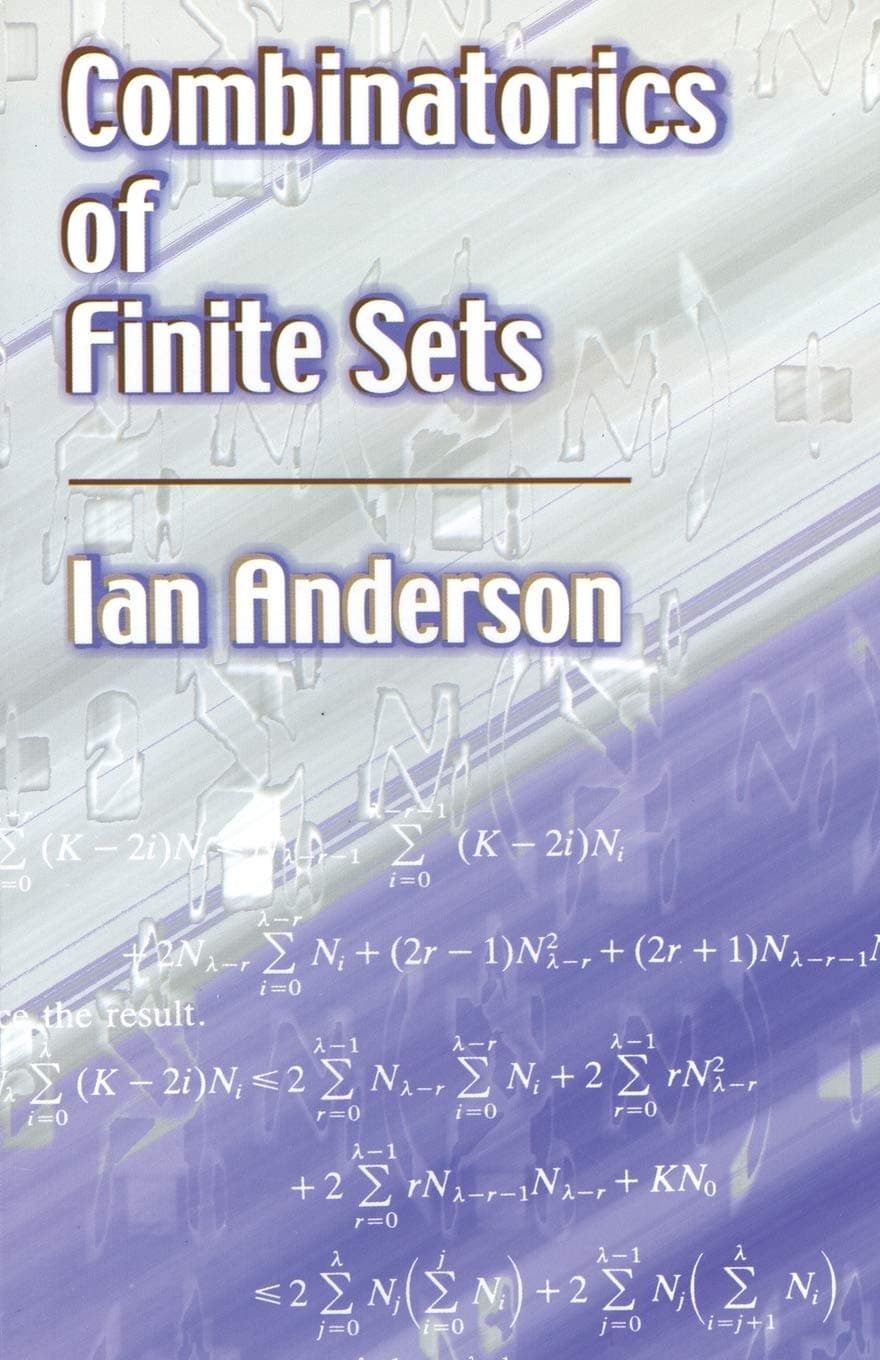

Buy Combinatorics of Finite Sets (Dover Books on Mathematics) on desertcart.com ✓ FREE SHIPPING on qualified orders Review: very interesting - Have just started, but I can already imagine that this will open doors that many readers will never have known existed. Book does assume a significant mathematical maturity however. The reader has to be willing to pause and say to themselves initially, "ok, that is what he must mean". I am guessing the frequency of which will diminish exponentially as the reader progresses. For example |X| means the element count of set X. I can't imagine anyone not knowing that would ever be interested in this book in the first place. The author jumps right in with anti-chains, and despite the lack of belabored introduction to notation I found the first proof surprisingly clear. Interestingly enough he does have a short list of symbols and I can't imagine anyone except an expert not saying "wow I want to know what that means" / or better yet "my gut straight away tells me that this is going to fit nicely with my research". Review: An excellent and unique perspective on combinatorics - When one thinks of combinatorics of finite sets, he or she might first think of codes and designs. But this book introduced me to an area of combinatorics which I knew very little about, namely extremal set problems and their solutions which fall under famous Theorems by famous mathematicians: Erdos-Ko-Rado, Sperner, and Kruskal-Katona to name a few. I found these topics fascinating and fun to think about, which is in large part due to the author's coherent style, organization, explanation, and expertise of the subject-matter. Moreover, the author provided solutions to *every* one of the 150+ problems!!! How many math books can boast such a claim? Aside from may be a rough presentation of Lemma 4.3.2 the rest of the book is a masterpiece which I hope will gain more recognition within the next twenty years. I highly recommend this book to both mathematicians and computer scientists. Although the book has very few "algorithms" in it, the thinking and reasoning about discrete structures (e.g. families of finite sets and multisets) will do wonders in developing the mind of a computer scientist, whether advanced or undergraduate. Yet it is quite sad that many cs departments (and math for that matter) invest little if any curriculum in discrete mathematics. Hopefully this will change at least to the point where the cs major will take two or three semesters of discrete math instead of two or three of calculus. For, as this book demonstrates, calculus is not a prerequisite for engaging one's mind in some quite fascinating mathematical problems related to finite sets. Finally, it should be noted that Bela Bollobas also has an interesting book titled "Combinatorics: Set Systems, etc...." which significantly intersects with this book, but not to the degree where the reader should think they are interchangeable. I recommend both, and to read Anderson's book first; as I believe this book lays a better foundation than the latter.
| Best Sellers Rank | #2,244,121 in Books ( See Top 100 in Books ) #113 in Mathematical Set Theory #256 in Combinatorics (Books) #357 in Discrete Mathematics (Books) |
| Customer Reviews | 4.5 4.5 out of 5 stars (7) |
| Dimensions | 5.38 x 0.57 x 8.46 inches |
| ISBN-10 | 0486422577 |
| ISBN-13 | 978-0486422572 |
| Item Weight | 10.4 ounces |
| Language | English |
| Print length | 272 pages |
| Publication date | November 2, 2011 |
| Publisher | Dover Publications |
P**E
very interesting
Have just started, but I can already imagine that this will open doors that many readers will never have known existed. Book does assume a significant mathematical maturity however. The reader has to be willing to pause and say to themselves initially, "ok, that is what he must mean". I am guessing the frequency of which will diminish exponentially as the reader progresses. For example |X| means the element count of set X. I can't imagine anyone not knowing that would ever be interested in this book in the first place. The author jumps right in with anti-chains, and despite the lack of belabored introduction to notation I found the first proof surprisingly clear. Interestingly enough he does have a short list of symbols and I can't imagine anyone except an expert not saying "wow I want to know what that means" / or better yet "my gut straight away tells me that this is going to fit nicely with my research".
T**T
An excellent and unique perspective on combinatorics
When one thinks of combinatorics of finite sets, he or she might first think of codes and designs. But this book introduced me to an area of combinatorics which I knew very little about, namely extremal set problems and their solutions which fall under famous Theorems by famous mathematicians: Erdos-Ko-Rado, Sperner, and Kruskal-Katona to name a few. I found these topics fascinating and fun to think about, which is in large part due to the author's coherent style, organization, explanation, and expertise of the subject-matter. Moreover, the author provided solutions to *every* one of the 150+ problems!!! How many math books can boast such a claim? Aside from may be a rough presentation of Lemma 4.3.2 the rest of the book is a masterpiece which I hope will gain more recognition within the next twenty years. I highly recommend this book to both mathematicians and computer scientists. Although the book has very few "algorithms" in it, the thinking and reasoning about discrete structures (e.g. families of finite sets and multisets) will do wonders in developing the mind of a computer scientist, whether advanced or undergraduate. Yet it is quite sad that many cs departments (and math for that matter) invest little if any curriculum in discrete mathematics. Hopefully this will change at least to the point where the cs major will take two or three semesters of discrete math instead of two or three of calculus. For, as this book demonstrates, calculus is not a prerequisite for engaging one's mind in some quite fascinating mathematical problems related to finite sets. Finally, it should be noted that Bela Bollobas also has an interesting book titled "Combinatorics: Set Systems, etc...." which significantly intersects with this book, but not to the degree where the reader should think they are interchangeable. I recommend both, and to read Anderson's book first; as I believe this book lays a better foundation than the latter.
?**Y
certainly better than decent
This book provides excellent coverage of sperners theorem including multiple proofs ,like the original one by sperner and more concise proofs using closely related concepts. The various proofs of sperners theorem provides a firm understanding of its connections with many other fundamental topics in finite combinatorial mathematics.Great book for those that have a good grasp on algebraic concepts.
C**N
Ci sono libri che costruiscono teorie e libri che costruiscono chiarezza. Quello di Ian Anderson appartiene alla seconda categoria — e, paradossalmente, proprio per questo si colloca tra i grandi testi formativi della combinatoria moderna. In un’epoca in cui la disciplina tendeva a frammentarsi in sottosettori sempre più specialistici (design theory, enumerazione, grafi, algebre d’incidenza), Combinatorics of Finite Sets si presenta come un ritorno all’essenza: la costruzione rigorosa e completa del pensiero combinatorio su basi puramente insiemistiche e strutturali. Il merito maggiore di Anderson è l’equilibrio: la trattazione è lineare ma mai banale, rigorosa ma mai pedante. L’autore parte dall’idea che la combinatoria non sia l’arte di contare cose, ma di riconoscere e classificare configurazioni discrete in base alle loro simmetrie e ai vincoli di costruzione. Tutto è costruito ex nihilo, con logica impeccabile e progressione euclidea, a partire dal teorema di Sperner, del quale vengono proposte ben tre distinte dimostrazioni, in una progressione logica e didattica straordinariamente efficace. Rispetto ai testi successivi e più monumentali di Stanley o Cameron, Anderson scrive con una sobrietà britannica che richiama i classici di Hardy e Hall: nessuna verbosità, nessuna retorica, nessuna concessione alla divulgazione di maniera. Ogni pagina è una lezione di metodo. Ogni capitolo termina quando il concetto è chiuso nella sua necessità, non un rigo prima né uno dopo. Persino gli esercizi — selezionati con intelligenza e gusto matematico — rivelano l’intento formativo dell’autore: indurre il lettore a pensare combinatoriamente, non solo a calcolare. Questa ristampa economica Dover ripropone il testo originale Cambridge in un formato sobrio e maneggevole, con la consueta carta opaca e impaginazione chiara: ideale per lo studio e per la consultazione. Nessuna perdita qualitativa, anzi: l’opera guadagna in accessibilità e disponibilità, e rimane uno dei riferimenti insostituibili per chi voglia costruire solide basi concettuali prima di affrontare opere più specialistiche. In definitiva, Combinatorics of Finite Sets è un manuale che non invecchia: asciutto, elegante, rigoroso. Un testo che restituisce alla combinatoria la sua dimensione naturale di logica delle configurazioni finite, e che continua, a decenni di distanza, a insegnare la vera forma mentis del combinatorialista e del discretista, tanto cara a Gian-Carlo Rota: il valore del pensiero ordinato e della chiarezza formale.