We remain fully operational. Our teams are working around the clock to ensure your deliveries continue safely.

下载应用程序


Buy anything from 5,000+ international stores. One checkout price. No surprise fees. Join 2M+ shoppers on Desertcart.
Desertcart purchases this item on your behalf and handles shipping, customs, and support to SINGAPORE.
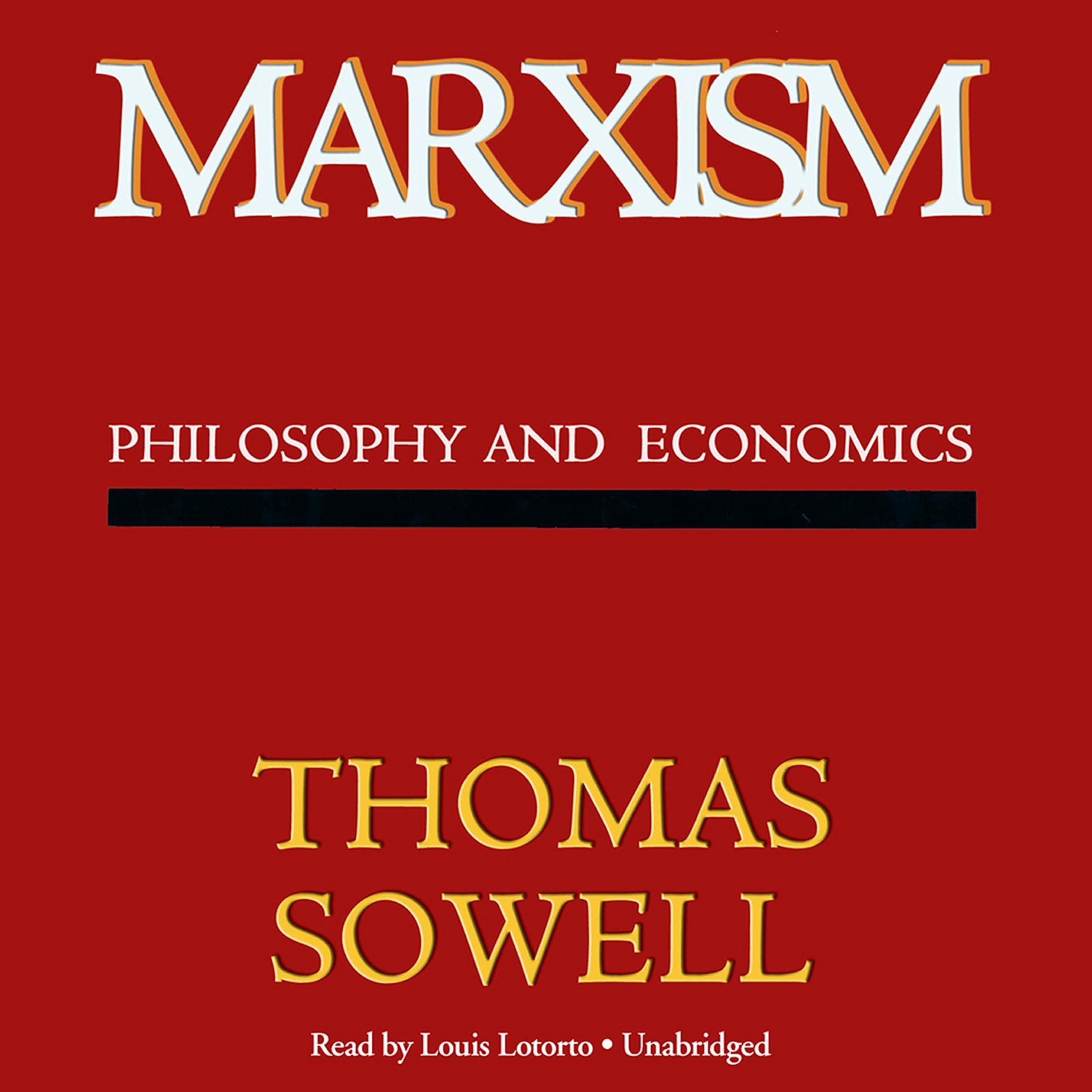
desertcart.com: Marxism: Philosophy and Economics (Audible Audio Edition): Thomas Sowell, Christopher Louis, Blackstone Audio, Inc.: Books Review: Marxism: The Final Critique - Economist and philosopher Thomas Sowell has closed the book on Marxist debate with this tightly reasoned exposition and analysis. However, as Sowell notes in his final chapter (see below), the intellectual aura and moral vision of Karl Marx will not soon fade from the human imagination. That is why this plain spoken book is so important for the future of mankind. It took Marx thirty years to complete the three volumes of Capital. It took Sowell 25 years and one slender book to refute not only the three volumes, but the entire corpus of Marx and his associate, Frederick Engels. It might come as a surprise to some that Thomas Sowell has a more capacious mind and is a more rigorous analyst than either Marx or Engels. The greatness of Sowell's mind has not been given proper acclaim by modern and postmodern cognoscenti, no doubt because it is essentially conservative in outlook. The text of this book is only 221 pages: it is built to last; with stitched binding, quality paper, and reader friendly font. This solid, handy book will survive serious study. Sowell's reasoning power ranks as genius, and he has composed a critique that is taut as a drum and worthy of repeated and thoughtful readings. It is not possible in this review to expound on all the concepts that are covered by the author as this would require a lengthy and complex discourse: what is attempted is a distillation of the substance of the book. The first nine (of ten) chapters explains what Marx "really said" and what he "really meant" as opposed to the accumulated misinterpretations that have passed as faux Marxism since the time of Marx himself. Thus, the concepts of the actual, historical Marx are described, while at the same time the incorrect concepts of the later interpreters are disclosed. This dual system of analysis must be understood by the reader, or confusion can arise as to what Marx did or did not say. Sowell writes that nowadays it is almost impossible to find any writing about Marx that refers to his actual work. Instead, our learned academics use as references secondary sources that can be traced to tertiary sources, and so on ad infinitum. A good example is the article on Marxism provided online at Wikipedia. Out of thirty references at the end of the article, only four are attributable to Marx or Engels. The other twenty-six refer to secondary sources. Secondary sources are matters of opinion, often questionable, especially as regards such a hotly debated subject as Marxism. If the first nine chapters of "Marxism" are difficult, they are worth working through to get to the tenth and final chapter; "The Legacy of Marx". At this juncture the "real" Marx has been defined, and Sowell quickly and clearly refutes his core concepts. Having critiqued the "theory", Sowell spends considerable time refuting the "praxis," using Lenin's Russia as an example. This first example of Marxism is described in some detail as an example of what happens when egalitarianism is forced upon people by a Police State. Sowell concludes by stating, on p. 221: "The supreme irony of Marxism was that a fundamentally humane and egalitarian creed was so dominated by a bookish perspective that it became blind to facts and deaf to humanity and freedom. Yet the moral vision and the intellectual aura of Marxism continue to disarm critics, quiet doubters, and put opponents on the defensive." "In this context, there are grim implications to Engel's claim that Marx's name and work `will endure through the ages.'" Sowell's book will also endure through the ages, to counteract the "grim implications" of Marxism. P.S. After writing this review I discovered that Sowell's book has gone out of print. Why am I not surprised? Sowell did not offer us any Utopian redemption; just a clear look at reality. Sowell's work will fade only from the minds of faddists, faux-Marxists and coffee-house revolutionaries, who have temporarily consigned his critique to the remainder bin. But among serious thinkers the book will live on. There are enough copies in college and public libraries and elsewhere to keep this spark of reason alive and it will surely see the light of print again. Review: Exactly What I Was Looking For - Sowell is my favorite contemporary economist, and a great writer. Not all economists are great writers, look at Hayek, although to be fair Hayek's first language was German ANYWAY I wanted a book that simply told me what Marx and his economics and philosophy were all about, without adding modern interpretations into it. And this book does exactly that. It is a bit difficult to follow at times, obviously the more you know about classical economics (the economics Marx used as a springboard for his own analysis) and philosophy the better. The book fills in some detail on the philosophical background that Marx and Engels grew up in, but leaves out some of the important economic details. This is a book for those with a grounding in economics, especially those who know how classical economics differs from modern economics (Sowell's "On Classical Economics" or "Classical Economics Reconsidered" would make a great companion book to this). If there is a weak spot to the book, it is the chapter on the Marxian concept of value, possibly the longest in the book, and on the most complex and difficult to understand topic. I still don't have a perfect grasp of it, but this is because Sowell is attempting to distill a massive three-volume epic into one 300-page book. Until the final chapter, you'd have no idea where to place the author on the political or economic spectrum. It is simply an objective interpretation of Marx up until that point, and the only "sermonizing" is when Sowell goes out of his way to explain more modern (and corrupt) interpretations of Marxism which are not supported by the writings of Marx/Engels. The last chapter, on the legacy of Marx, adds some critiques from an economic, historical, and even moral standpoint, although Sowell makes it clear that what happened in the USSR, China, Cuba, etc., is not what Marx planned (Marx did not support revolutionary groups overthrowing governments, rather he believed that communism would *emerge* after certain conditions had been met). I'd like to see a larger critique of Marxian economics, philosophy, and history, but that's not what I wanted from this book. I'd like to see Sowell write a book where he puts his usual Hayekian analysis on things, explaining why Marxism, Leninism, etc., don't work in practice and how they clash with contemporary economics. You could say that to some extent, he did that in Basic Economics, but it was far from being the main thrust of that book.
F**D
Marxism: The Final Critique
Economist and philosopher Thomas Sowell has closed the book on Marxist debate with this tightly reasoned exposition and analysis. However, as Sowell notes in his final chapter (see below), the intellectual aura and moral vision of Karl Marx will not soon fade from the human imagination. That is why this plain spoken book is so important for the future of mankind. It took Marx thirty years to complete the three volumes of Capital. It took Sowell 25 years and one slender book to refute not only the three volumes, but the entire corpus of Marx and his associate, Frederick Engels. It might come as a surprise to some that Thomas Sowell has a more capacious mind and is a more rigorous analyst than either Marx or Engels. The greatness of Sowell's mind has not been given proper acclaim by modern and postmodern cognoscenti, no doubt because it is essentially conservative in outlook. The text of this book is only 221 pages: it is built to last; with stitched binding, quality paper, and reader friendly font. This solid, handy book will survive serious study. Sowell's reasoning power ranks as genius, and he has composed a critique that is taut as a drum and worthy of repeated and thoughtful readings. It is not possible in this review to expound on all the concepts that are covered by the author as this would require a lengthy and complex discourse: what is attempted is a distillation of the substance of the book. The first nine (of ten) chapters explains what Marx "really said" and what he "really meant" as opposed to the accumulated misinterpretations that have passed as faux Marxism since the time of Marx himself. Thus, the concepts of the actual, historical Marx are described, while at the same time the incorrect concepts of the later interpreters are disclosed. This dual system of analysis must be understood by the reader, or confusion can arise as to what Marx did or did not say. Sowell writes that nowadays it is almost impossible to find any writing about Marx that refers to his actual work. Instead, our learned academics use as references secondary sources that can be traced to tertiary sources, and so on ad infinitum. A good example is the article on Marxism provided online at Wikipedia. Out of thirty references at the end of the article, only four are attributable to Marx or Engels. The other twenty-six refer to secondary sources. Secondary sources are matters of opinion, often questionable, especially as regards such a hotly debated subject as Marxism. If the first nine chapters of "Marxism" are difficult, they are worth working through to get to the tenth and final chapter; "The Legacy of Marx". At this juncture the "real" Marx has been defined, and Sowell quickly and clearly refutes his core concepts. Having critiqued the "theory", Sowell spends considerable time refuting the "praxis," using Lenin's Russia as an example. This first example of Marxism is described in some detail as an example of what happens when egalitarianism is forced upon people by a Police State. Sowell concludes by stating, on p. 221: "The supreme irony of Marxism was that a fundamentally humane and egalitarian creed was so dominated by a bookish perspective that it became blind to facts and deaf to humanity and freedom. Yet the moral vision and the intellectual aura of Marxism continue to disarm critics, quiet doubters, and put opponents on the defensive." "In this context, there are grim implications to Engel's claim that Marx's name and work `will endure through the ages.'" Sowell's book will also endure through the ages, to counteract the "grim implications" of Marxism. P.S. After writing this review I discovered that Sowell's book has gone out of print. Why am I not surprised? Sowell did not offer us any Utopian redemption; just a clear look at reality. Sowell's work will fade only from the minds of faddists, faux-Marxists and coffee-house revolutionaries, who have temporarily consigned his critique to the remainder bin. But among serious thinkers the book will live on. There are enough copies in college and public libraries and elsewhere to keep this spark of reason alive and it will surely see the light of print again.
F**S
Exactly What I Was Looking For
Sowell is my favorite contemporary economist, and a great writer. Not all economists are great writers, look at Hayek, although to be fair Hayek's first language was German ANYWAY I wanted a book that simply told me what Marx and his economics and philosophy were all about, without adding modern interpretations into it. And this book does exactly that. It is a bit difficult to follow at times, obviously the more you know about classical economics (the economics Marx used as a springboard for his own analysis) and philosophy the better. The book fills in some detail on the philosophical background that Marx and Engels grew up in, but leaves out some of the important economic details. This is a book for those with a grounding in economics, especially those who know how classical economics differs from modern economics (Sowell's "On Classical Economics" or "Classical Economics Reconsidered" would make a great companion book to this). If there is a weak spot to the book, it is the chapter on the Marxian concept of value, possibly the longest in the book, and on the most complex and difficult to understand topic. I still don't have a perfect grasp of it, but this is because Sowell is attempting to distill a massive three-volume epic into one 300-page book. Until the final chapter, you'd have no idea where to place the author on the political or economic spectrum. It is simply an objective interpretation of Marx up until that point, and the only "sermonizing" is when Sowell goes out of his way to explain more modern (and corrupt) interpretations of Marxism which are not supported by the writings of Marx/Engels. The last chapter, on the legacy of Marx, adds some critiques from an economic, historical, and even moral standpoint, although Sowell makes it clear that what happened in the USSR, China, Cuba, etc., is not what Marx planned (Marx did not support revolutionary groups overthrowing governments, rather he believed that communism would *emerge* after certain conditions had been met). I'd like to see a larger critique of Marxian economics, philosophy, and history, but that's not what I wanted from this book. I'd like to see Sowell write a book where he puts his usual Hayekian analysis on things, explaining why Marxism, Leninism, etc., don't work in practice and how they clash with contemporary economics. You could say that to some extent, he did that in Basic Economics, but it was far from being the main thrust of that book.
P**O
Sowell's masterpiece lays out what is Marxism, clear and analytical, then critically slams it all
Thomas Sowell began his adult life at 19, believing Marxism was the path to follow. Throughout much of later college education, his studies toward his Master's and Ph.D., he firmly held onto this way of thought. Thus, this book, although written well past his conversion to capitalism and conservative thought, provides the reader with the proper insight into Marxism. Sowell wrote almost the entire book from a purely analytical perspective leaving out his critiques, but fair analysis backed by numerous quotes from Marx. Sowell saves his savage critique to the end in the final chapter. The reader gets a great perspective of Marxism, with modifications and some surprises where what is taught about it is errant.
D**L
Will the Real Karl Marx Please Stand Up?
If you want to know Marxism as understood by Karl Marx and Fridrich Engels this is your book. Sowell gives a detailed understanding of the philosophical underpinnings that animate their work such as Marx's using Hegals system and how that affects how he uses certain words (i.e. contradiction, alienation, etc.) in their Hegalian sense. He doesn't criticize the work of Marx or Engels until the last chapter making the book a descriptive work on just understanding Marxism/Communism. If your a Marxist, read this important work to ensure you even understand Marx. If your capitalist, this read this book so you can clearly dialogue with socialist/communist and not tare down a strawman but the real thing. Sowell is excellent. In all his writings but this one is one of my all time favorites. Get it. Read it.
T**N
Essential to understand Marx and Marxism, Socialism/Communism at large.
B**S
Para quem quer entender o básico do real Marxismo de Karl Marx. Thomas Sowell, que estudou Marx por mais de 25 anos de sua vida, consegue abordar o cerne da filosofia "materialista-dialética" de Marx desde duas origens Hegelianas até a teoria econômica que dela deriva. São 8 capítulos de exposição honesta e de análises muito bem referenciadas das ideias Marxistas, com muitas citações diretas de diversas obras de Marx e Engels para embasá-las. O nono capítulo é uma breve biografia de "Marx, o homem", e o décimo e último capítulo é a crítica nada imparcial mas suficientemente embasada aos problemas da verdadeira teoria marxista. Não é o livro mais fácil de ser lido por conter bastante das abstratas ideias dialéticas, e por exigir um mínimo de noção de economia no geral, como oferta e demanda, etc. É o melhor livro para quem quer conhecer o Marxismo sem começar pela obra per se de Marx e Engels, ou mesmo para quem só quer garantir que não precisa de tal obra para viver, sem ignorar por conpleto essa filosofia que tanto impactou o século 20 e, por consequência, os nossos tempos. É um livro caro, mas recompensador. A edição física é bem simples, mas pelo menos o papel (branco) não é ruim como um paperback literário tradicional em língua inglesa.
D**F
Comprehensive and succinct overview of Marxian thought.
T**D
Understanding communism in the US today
TrustPilot
3 周前
1天前