
🎧 Elevate your audio game with power and precision — don’t just listen, experience!
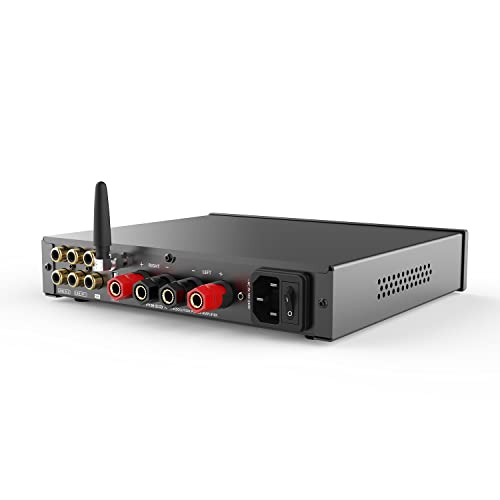
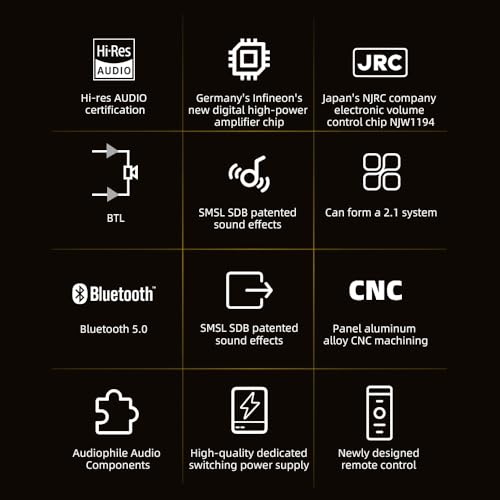
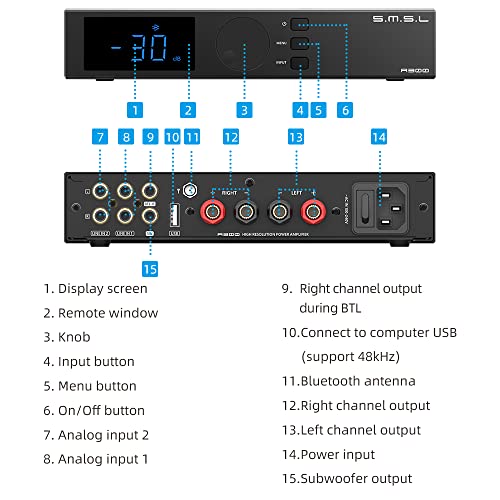
The S.M.S.L A300 is a sleek Class D integrated amplifier boasting 165W RMS per channel with ultra-low distortion (0.004% THD+N). Featuring Germany’s Infineon amplifier chip and Japan’s NJRC volume control, it supports 2.1 audio setups via subwoofer pre-out and high-pass filtering. Connectivity includes Bluetooth 5.0, USB, and RCA inputs, complemented by 8 EQ modes and remote control, making it a versatile powerhouse for audiophiles and professionals alike.


| ASIN | B0B2ZD2CLC |
| Are batteries included? | No |
| Brand | S.M.S.L |
| Customer Reviews | 4.4 4.4 out of 5 stars (108) |
| Date First Available | 15 December 2023 |
| Global Trade Identification Number | 06970141857846 |
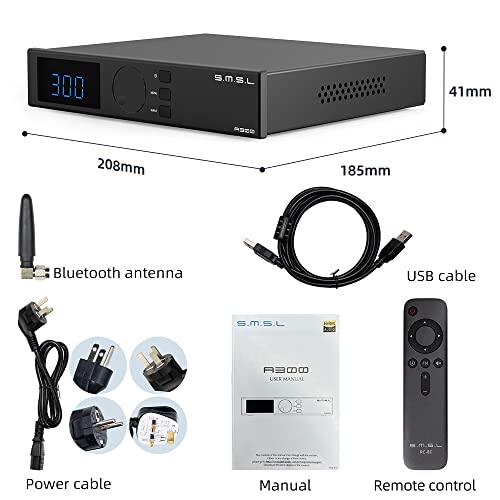
| Item Dimensions LxWxH | 21 x 19 x 4 Centimeters |
| Item Height | 4 Centimeters |
| Item Weight | 1 kg 600 g |
| Item Width | 19 Centimeters |
| Item dimensions L x W x H | 21 x 19 x 4 Centimeters |
| Item model number | A300-BK-US |
| Manufacturer | S.M.S.L-A300 |
| Model number | A300-BK-US |
| Mounting Type | Freestanding |
| Number of Channels | 2 |
| Output Power | 165 Watts |
| Package Type Name | cardboard box" or "shipping box |
| Product Dimensions | 21 x 19 x 4 cm; 1.6 kg |
| Specification Met | FCC |
| Voltage | 220 Volts (AC) |
R**L
Puissance et clarté imbattable à ce prix. Fonctionnalités basiques mais finalement suffisantes.
T**R
Having owned ancient pioneer amps and even later onkyo higher end class ab amps this is by far the cleanest sound and also most expensive due to being new. The remote is under powered (no batteries included) but does the job Menu is super simple. Really only need to setup how you use it and leave it alone. After that I only need power and volume control to use. Eq is set to 4 (super bass) and I have a 10" sub. Also big box 6.5 double woof / metal dome tweeter. I'm no audiophile but I can notice more instruments in my music. Anyways recommend this amp has heaps of power more than 3x than I've ever needed
E**I
Muito bom
T**N
Really good
K**N
Just like with the A20a I had recently, I purchased the A300 with the intent to use them as monoblocks. I thought it would be cool to have amps underneath my Lintons on the stands, and admittedly, have gotten caught up in the swirling opinions regarding the benefits of “MORE POWER”. After some disappointments with the A20a, I turned to the A300 which I had just recently discovered. At the $150 sale price, I knew resistance was futile. Are these the cheapest entry into monoblocks? Naturally, I’ll be making comparisons to the A20a throughout this review. Starting with the build and functionality. Now, this is usually something I don’t care to spend too much time on, but this is where the main deciding differences lie between this and the A20a. For one, I think these just look better. Black just blends in effortlessly and they disappear visually much easier than the A20a. The volume knob is awesome! More like an infinitely spinning disc with gentle clicks for feedback. I love that it sits flush with the face of the unit, helping it look more streamlined. The power button is much preferred over the lever of the A20a. Bonus points for not having to hold it either! One click on, one click off. The blue display numbers aren’t too jarring, especially when turned down to 1 brightness, but are more difficult to read than the orange display on the DX3 Pro+. Binding posts look/feel cheap compared to the nicer ones on the A20a, but they function so I don’t really care. Same with the housing, A300 is thin and hollow whereas the A20a feels more substantial and hefty. But again, here we have a mediocre implementation of bluetooth. A feature most of us won’t use but have to pay for. Pass. On the brightside, the included remote is a glorious addition! Being able to power the units on/off remotely is invaluable, as is being able to control the volume if not using a preamp (more on that later). The included digital filters (tone controls) are also a nice bonus, being able to mess around with the sound if one wishes. And I’ll take the digital volume of the A300 over the analog volume of the A20a any day! All said, here we already have a better featured, more versatile package than what was offered with the A20a. On to power. I tested a single A300 in stereo, dual A300s in mono, and my PA3s in stereo. I set my UMIK-1 up at my listening position 6ft away from my Lintons and used REW to produce a 75db test tone in these different configurations. The amps were maxed out on the dials and my DX3 Pro+ was used as volume. The results: (2) A300 in mono: -43 volume (1) A300 in stereo: -37 volume (1) A20a in stereo: -34 volume (1) PA3s in stereo: -22 volume Much greater volume and power than the PA3s! But a less significant change going from stereo to mono. Using these as monoblocks, I detected a level of hiss that was consistent from 0 to about 50 on the volume. Onwards past 50 and especially at 55-60 (max volume), the hiss got louder and more distracting. Thus, I settled on using these at 50 when using the DX3 Pro+ as the preamp. However, I soon ended up stacking both A300s front and center, switching the DX3 Pro+ into DAC mode and using the volume normally on the A300s. Close proximity offered the advantage of using the remote to control both at once, although I didn’t always find this consistent and it would change the volume of one and not the other. Sometimes they both magically “rematched” themselves when adjusting volume, but other times, I had to get up and manually adjust one dial to rematch them. I liked this configuration better, knowing all the power was available and I wasn’t cutting a significant portion off at 50/60. The digital volume kept things perfectly consistent, being able to listen at 1/60 and the channels were perfectly matched. So what now? Well for one, these are definitely usable as monoblocks with their unbalanced RCA inputs, the A20a were not (much too noisy in unbalanced mode). Both are still perfectly viable to be used in stereo with a single unit, so don’t sleep on that. As mentioned earlier, the biggest differences between units come cosmetically and in functionality. It really depends on what you value most, but I just don’t see much advantage of the A20a unless you love the look or need balanced inputs. Otherwise, the A300 is an easy pick over the A20a for me. Grab ‘em at $150 and the decision is almost too easy. Finally, the reason I’m sticking with the PA3s lies in the hiss volume that emits from the speakers, or lack thereof! Seriously, the PA3s is so dang quiet and now I have a true appreciation for it. The A300, like the A20a, is definitely audible especially if in a quiet room. Even when I thought I got used to it, I’d hit mute on the remote and was like “ahhh quiet”. Some may never care or even hear it depending on your ambient noise levels and speakers. Personally, since I’d never approach even a fraction of the available volume and my preference for as quiet as possible devices, the PA3s becomes the winner by default. Plus, we all know that splitting a matching equipment “stack” is blasphemy. Oh. I almost forgot. They all sound the same to me.