We remain fully operational. Our teams are working around the clock to ensure your deliveries continue safely.

下载应用程序


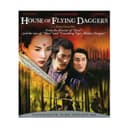
No one uses color like Chinese director Zhang Yimou--movies like Raise the Red Lantern or Hero , though different in tone and subject matter, are drenched in rich, luscious shades of red, blue, yellow, and green. House of Flying Daggers is no exception; if they weren't choreographed with such vigorous imagination, the spectacular action sequences would seem little more than an excuse for vivid hues rippling across the screen. Government officers Leo and Jin (Asian superstars Andy Lau and Takeshi Kaneshiro) set out to destroy an underground rebellion called the House of Flying Daggers (named for their weapon of choice, a curved blade that swoops through the air like a boomerang). Their only chance to find the rebels is a blind women named Mei (Ziyi Zhang, Crouching Tiger, Hidden Dragon ) who has some lethal kung fu moves of her own. In the guise of an aspiring rebel, Jin escorts Mei through gorgeous forests and fields that become bloody battlegrounds as soldiers try to kill them both. While arrows and spears of bamboo fly through the air, Mei, Jin, and Leo turn against each other in surprising ways, driven by passion and honor. Zhang's previous action/art film, Hero , sometimes sacrificed momentum for sheer visual beauty; House of Flying Daggers finds a more muscular balance of aesthetic splendor and dazzling swordplay. --Bret Fetzer An exotic, blind dancer finds herself torn between the loyalties of love and honor as she fights acrobatic warriors in the treetops in battles the likes of which have never before been seen. Review: No Escape - No Escape Zhang Yimou's House of Flying Daggers is one of the most visually exciting, beautiful, and emotionally painful films I've ever seen. From his first images, Zhang plunges viewers into this romantic tragedy - a story full of mysterious twists, life and death action, intense color and design, unique use of sound and music, beautifully choreographed action, sensuality, wrenching conflict, passion and devastating loss. The film is set in 850 AD during the Tang dynasty, when all of China was in chaos. Caught in this time of great political instability, three warriors find themselves not only fighting on opposing sides, but unexpectedly tangled in a fatal love triangle. The film begins with a single, bold, bright red brush stroke sweeping diagonally across the bare parchment background. As it disappears, an identical stroke quickly follows from the opposite side, and fades. A drop of blood falls, like a musical note on an empty score. This marks the visual key for Zhang Yimou's drama that is masterfully supported by the film's cinematography, unusual score, and superb acting. As the blood drops, Dai Ya's haunting bamboo flute melody is suddenly overcome by an ominous crescendo of yangqin dulcimers. The film's title appears, center screen, boxed like an official stamp in large, red Chinese characters - House of Flying Daggers. - Zhang turbulent, heart breaking tale. As the story opens, the emperor of China is weak and ineffectual. Corruption and disorder are rampant. The country has split into numerous warring factions. One of the rebel groups fighting the government is the House of Flying Daggers secreted in a forest of timber bamboo. Because they have the support of the people, and their members have an almost magical skill with daggers and in martial arts, The House of Flying Daggers is a major threat to the government. Two local police officers, Leo and Jin, are ordered by their general to find and kill the new leader of the House of Flying Daggers in ten days. Believing that the daughter of the recently assassinated rebel leader is the blind dancer, and rare beauty, hiding at the local brothel, Leo devises a plan for her capture. Jin is to go to the brothel, pretend to be drunk, and order the new girl, Mei, to dance for him. Leo arrives after her dance. He pretends to arrest Jin for drunkenness. To see if the girl is really blind, Leo orders Mei to dance the Echo Game for him before he arrests her. She performs amazingly. This is one of the most extraordinary scenes in the film. At police headquarters Leo threatens Mei with torture if she doesn't reveal the location of the House of Flying Daggers. Later that night as part of the ruse, Jin rescues Mei. He pretends to be tired of war and wants to escape with her. Leo calculates that she will lead Jin to the House of Flying Daggers while government soldiers secretly follow behind. Leo warns Jin not to fall for Mei. She can be deceptive, Leo says. Jin, who has a reputation for seducing women, assures Leo, "I'm a free spirit. I'm always in control." Unconvinced, Leo orders Jin not to turn a game into reality and ruin their plan. War isn't the real story in this film. It's the stage on which the personal dramas of these three characters are played. The war serves to divert, disrupt and endanger Jin and Mei's journey as they are drawn into more devastating personal struggles between loyalty and honor, and the real enemy - unnoticed and unsuspected until too late - true love, the assassin of all good intentions. Once struck, there is no escape. Nature's beauty is as much a character in this film as are the humans. The wild meadow first deep in flower, and at the end, veiled in snow, which hosts choreographed battles for life, love and death. The woods of white birch against fallen red leaves through which Jin on his magnificent horse flies like the wind itself. Forests of ringed, timber bamboo with their hollow song and whispering leaves in which the lovers discover their true identities. Zwang camera is often distracted away from human subjects to the pure graphic beauty of nature. Human characters, dressed in the intricate costumes of the period, appear like exotic blossoms, jewels, within these stunning natural patterns and colors. House of Flying Daggers is also an unusually sensual film where physical attraction turns into something much deeper and with greater consequences. When Leo shows Mei the torture she could face at the jail, his hands caress her face and arms and hands as a love's would. After Mei and Jin escape from jail, she bathes in a pool Jin makes for her. To hide her identity, he seductively dresses her in men's clothing. Later, Mei asks to know what her rescuer "looks" like. She kneels before Jin and runs her fingers delicately up over his hands, then his body to his face, to feel what kind of man he is. When they are captured by the soldiers, Mei reaches through the cage that imprisons them for Jin's hand. Again and again the camera closes in tight on their hands clasped together. Touch, the messenger of love. In the end, it isn't the war that matters most to these warriors, nor their political commitments. It's desire, jealousy and passion that are their real life and death battles. Review: What is the depth of beauty? - What a stunning film this is-- House of Flying Daggers . There is a beauty so deep, the viewer is mesmerized: characters/actors who play them, scenery/setting, astonishing martial arts movements unlike what the viewer finds in other movies, costumes, the use of colors and light. Director Zhang Yimou assembles the parts to create a whole, a film so deep in beauty that the viewer's focus is a totality in that frame. My breath was whooshed away! The two leads, Ziyi Zhang--she with the delicate face in a powerfully controlled yet delicate body, and Takeshi Kaneshiro--he with his masculine beauty and graceful arrogance, play off each other with consummate skill as actors and martial artists. The third in this inevitable fate-must-play-out film is Andy Lau, a man's man who plays his control until the last second when his passion must out. Watching the interplay of these three give-and-take, back-and-forth is so unsettling. The casting is perfect! The framework for the film is the House of Flying Daggers, a group of female martial artists, who oppose the corrupt Tang government and seek to embarrass it when necessary and opportune. Although this secretive group is the raison d'etre for the story, it is the story of the three characters who absorb our interest. And what is obvious becomes the source of secrets. With the necessity of secret organizations comes the well spring of secrets--one by one, several times, always keeping the viewer a little more off-balance. In a time of corruption, the unusual becomes the norm. Soldiers walking the trees in battle becomes common rather than a seemingly magical skill exerted by only a special few. Every person is a remarkable handler of martial arts instruments. Everyone fights equally well. Who is to win? The final conflict is played out across a meadow in a snowstorm. White has been described in literature as representative of "the inscrutable cosmic mystery." Why these people? Why this battle? Why this ending? I think perhaps I love this film as much as "Crouching Tiger, Hidden Dragon" for that mystical element that is part of Asian films (in my limited experience), the Taoist belief in accepting things for the way they are and if challenging this, falling subject to one's fate anyway. The film then reflects both the Greek dramatic belief of the inevitability of fate and the Shakespearian technique of mistaken and double identities. "House of Flying Daggers" is a beautiful cinematic experience--mesmerizing, stunning, powerful.


| Contributor | Andy Lau, Dandan Song, Takeshi Kaneshiro, William Kong, Yimou Zhang, Ziyi Zhang |
| Customer Reviews | 4.7 out of 5 stars 3,123 Reviews |
| Format | Blu-ray |
| Genre | Action, Martial Arts |
| Initial release date | 2004-12-03 |
| Language | Mandarin Chinese |
S**Y
No Escape
No Escape Zhang Yimou's House of Flying Daggers is one of the most visually exciting, beautiful, and emotionally painful films I've ever seen. From his first images, Zhang plunges viewers into this romantic tragedy - a story full of mysterious twists, life and death action, intense color and design, unique use of sound and music, beautifully choreographed action, sensuality, wrenching conflict, passion and devastating loss. The film is set in 850 AD during the Tang dynasty, when all of China was in chaos. Caught in this time of great political instability, three warriors find themselves not only fighting on opposing sides, but unexpectedly tangled in a fatal love triangle. The film begins with a single, bold, bright red brush stroke sweeping diagonally across the bare parchment background. As it disappears, an identical stroke quickly follows from the opposite side, and fades. A drop of blood falls, like a musical note on an empty score. This marks the visual key for Zhang Yimou's drama that is masterfully supported by the film's cinematography, unusual score, and superb acting. As the blood drops, Dai Ya's haunting bamboo flute melody is suddenly overcome by an ominous crescendo of yangqin dulcimers. The film's title appears, center screen, boxed like an official stamp in large, red Chinese characters - House of Flying Daggers. - Zhang turbulent, heart breaking tale. As the story opens, the emperor of China is weak and ineffectual. Corruption and disorder are rampant. The country has split into numerous warring factions. One of the rebel groups fighting the government is the House of Flying Daggers secreted in a forest of timber bamboo. Because they have the support of the people, and their members have an almost magical skill with daggers and in martial arts, The House of Flying Daggers is a major threat to the government. Two local police officers, Leo and Jin, are ordered by their general to find and kill the new leader of the House of Flying Daggers in ten days. Believing that the daughter of the recently assassinated rebel leader is the blind dancer, and rare beauty, hiding at the local brothel, Leo devises a plan for her capture. Jin is to go to the brothel, pretend to be drunk, and order the new girl, Mei, to dance for him. Leo arrives after her dance. He pretends to arrest Jin for drunkenness. To see if the girl is really blind, Leo orders Mei to dance the Echo Game for him before he arrests her. She performs amazingly. This is one of the most extraordinary scenes in the film. At police headquarters Leo threatens Mei with torture if she doesn't reveal the location of the House of Flying Daggers. Later that night as part of the ruse, Jin rescues Mei. He pretends to be tired of war and wants to escape with her. Leo calculates that she will lead Jin to the House of Flying Daggers while government soldiers secretly follow behind. Leo warns Jin not to fall for Mei. She can be deceptive, Leo says. Jin, who has a reputation for seducing women, assures Leo, "I'm a free spirit. I'm always in control." Unconvinced, Leo orders Jin not to turn a game into reality and ruin their plan. War isn't the real story in this film. It's the stage on which the personal dramas of these three characters are played. The war serves to divert, disrupt and endanger Jin and Mei's journey as they are drawn into more devastating personal struggles between loyalty and honor, and the real enemy - unnoticed and unsuspected until too late - true love, the assassin of all good intentions. Once struck, there is no escape. Nature's beauty is as much a character in this film as are the humans. The wild meadow first deep in flower, and at the end, veiled in snow, which hosts choreographed battles for life, love and death. The woods of white birch against fallen red leaves through which Jin on his magnificent horse flies like the wind itself. Forests of ringed, timber bamboo with their hollow song and whispering leaves in which the lovers discover their true identities. Zwang camera is often distracted away from human subjects to the pure graphic beauty of nature. Human characters, dressed in the intricate costumes of the period, appear like exotic blossoms, jewels, within these stunning natural patterns and colors. House of Flying Daggers is also an unusually sensual film where physical attraction turns into something much deeper and with greater consequences. When Leo shows Mei the torture she could face at the jail, his hands caress her face and arms and hands as a love's would. After Mei and Jin escape from jail, she bathes in a pool Jin makes for her. To hide her identity, he seductively dresses her in men's clothing. Later, Mei asks to know what her rescuer "looks" like. She kneels before Jin and runs her fingers delicately up over his hands, then his body to his face, to feel what kind of man he is. When they are captured by the soldiers, Mei reaches through the cage that imprisons them for Jin's hand. Again and again the camera closes in tight on their hands clasped together. Touch, the messenger of love. In the end, it isn't the war that matters most to these warriors, nor their political commitments. It's desire, jealousy and passion that are their real life and death battles.
J**S
What is the depth of beauty?
What a stunning film this is-- House of Flying Daggers . There is a beauty so deep, the viewer is mesmerized: characters/actors who play them, scenery/setting, astonishing martial arts movements unlike what the viewer finds in other movies, costumes, the use of colors and light. Director Zhang Yimou assembles the parts to create a whole, a film so deep in beauty that the viewer's focus is a totality in that frame. My breath was whooshed away! The two leads, Ziyi Zhang--she with the delicate face in a powerfully controlled yet delicate body, and Takeshi Kaneshiro--he with his masculine beauty and graceful arrogance, play off each other with consummate skill as actors and martial artists. The third in this inevitable fate-must-play-out film is Andy Lau, a man's man who plays his control until the last second when his passion must out. Watching the interplay of these three give-and-take, back-and-forth is so unsettling. The casting is perfect! The framework for the film is the House of Flying Daggers, a group of female martial artists, who oppose the corrupt Tang government and seek to embarrass it when necessary and opportune. Although this secretive group is the raison d'etre for the story, it is the story of the three characters who absorb our interest. And what is obvious becomes the source of secrets. With the necessity of secret organizations comes the well spring of secrets--one by one, several times, always keeping the viewer a little more off-balance. In a time of corruption, the unusual becomes the norm. Soldiers walking the trees in battle becomes common rather than a seemingly magical skill exerted by only a special few. Every person is a remarkable handler of martial arts instruments. Everyone fights equally well. Who is to win? The final conflict is played out across a meadow in a snowstorm. White has been described in literature as representative of "the inscrutable cosmic mystery." Why these people? Why this battle? Why this ending? I think perhaps I love this film as much as "Crouching Tiger, Hidden Dragon" for that mystical element that is part of Asian films (in my limited experience), the Taoist belief in accepting things for the way they are and if challenging this, falling subject to one's fate anyway. The film then reflects both the Greek dramatic belief of the inevitability of fate and the Shakespearian technique of mistaken and double identities. "House of Flying Daggers" is a beautiful cinematic experience--mesmerizing, stunning, powerful.
J**E
One of the very best action martial arts films that has ever been made. A pure joy to see.
I have been a lifetime student of the martial arts and Asian action movies most of my adult life. My all time favorite one is "Crouching tiger, Hidden Dragon." However, this movie (House of Flying Daggers) is a very close second on my list of great action martial art movies. You can see the professionalism in this fantastic film because it was made by the same Director of Crouching Tiger and Hidden Dragon. This gem has everything you might desire in an Asian martial arts movie. The cast is absolutely wonderful (Ziyi Zhang, Takeshi Kaneshiro and Andy Lau). The dance scene at the beginning of this film is one of the most beautiful parts of the film. The fight scenes are nothing short of fantastic. The story moves along at a fast pace and this is a movie that I have watched several times(twice at the show and twice after buying the DVD) because it is that good. In conclusion, there is nothing more that I can add that has not already been written about from other reviewers; nevertheless, this movie is so fantastic that I just had to also comment on it with this short review. This is a movie for anyone who loves martial arts films. I am glad I have it in my personal DVD library. Rating: 5 Stars Joseph J. Truncale (Author: Haiku Moments: How to read, write and enjoy haiku)
A**R
EXCELLENT!
EXCELLENT.
R**J
Good but Unsatisfying
A decent show. Leaves a lot of questions and isn’t terribly satisfying but otherwise a good movie.
E**S
Intriguing Beautiful Love Amidst Clandestine Operations/War
Better than "Crouching Tiger Hidden Dragon" this story gradually reveals an unexpected love triangle which contains amazing martial arts choreography woven into a stunning visual masterpiece of epic proportions. The unusual love-triangle is heart-stopping ... the fight scene at the conclusion of the film is a gut-wrenching and powerful. The close-up scenes of pure emotions reveal both artistic cinematography as well as superb acting: whether it is desire, bliss, lust, rage, doubt, torment, suffering or other emotions ... the visual effects are absolutely amazing. This film has it all: gorgeous period costumes designed by Emi Wada, spectacular landscapes like delicate water colors and oil paintings on canvas and visually pleasing actors and actresses ... They are fairy-tale like in their magnificence. The mountain scenery is breath-taking as the fall foliage paints a collage of orange, red, fading green and brown leaves which are exceptionally stunning from a distance. The field of wild flowers where Jin and Mei playfully discover the depth of their true feelings for each other is a natural wonder. They express their feelings gently at first and then with passionate abandon ... The martial arts fighting scenes in the bamboo forest where the government soldiers ambush Jin and Mei during their escape is exceptionally creative and well filmed ... This enhanced DVD has a great interview with the director Yimou Zhang who explains that bamboo forests have been symbolic of martial arts in films from long ago and he felt it must be included. Watching the interview, the viewer learns to appreciate the amount of planning and background work which is painstakingly done to perfection to film this artistic masterpiece ... Ziyi Zhang who plays Mei, lived with a blind girl for two months to learn the proper body and head movements in order to play a blind girl accurately. Also, she had studied traditional Chinese dance when a young girl which helped her learn the choreographed dance and martial arts movements in her outstanding performance in the scene for General Leo at the Peony Pavillion. The original music in the film is fantastic, Kathryn Battle sings the theme song which is sung by Mei during her dance performance for Captain Jin. It is a totally heart warming performance that captivates Jin and wins over the viewers ... The story begins in a brothel called "Peony Pavillion" where government officers visit for a tryst with the ladies and to be entertained ... The visual effects of the establishment are extraordinairily authentic, the set design, bright colors, flowers, and weapons on the wall are all extremely balanced and harmonious ... After Mei, the blind dancing girl does a magnificent martial arts and dance performance for General Leo, she is taken prisoner. She is believed to be the blind daughter of the dead leader of a clandestine organization, called "House of Flying Daggers" who are resisting government authority and creating unrest and rebellion against the Tang Dynasty. General Leo's plan is to flush out the covert operatives ... but unexpected emotional relationships develop to confound his plans. How the love triangle is revealed and resolved is the stuff of which great films are made. The story line itself is deceptively simple ... but its execution is thoroughly unequalled. The film expresses how in the short time of three days true feelings of love can develop with unequalled depth and passion. It can grow into becoming one of the most complex human emotions ever put on film. Erika Borsos (pepper flower)
A**D
How wonderful it is to watch an aesthetics-driven film that doesn't depend on CGI.
This is a genuinely unique experience that tones down the magical acrobatics typical of most wuxia films and grounds the action in nature. Example: at no point, except maybe one shot near the beginning, do people appear to simply fly through the air supported only by wind. Instead, there is an absolutely brilliant scene in a vivid-green bamboo forest, where enemies traverse the treetops in pursuit of our heroes. Of course, such action is probably as impossible as the typical aerial acrobatics I mentioned, but we don't care because the bamboo forest and costumes are so gorgeous to look at! Nature is everywhere here. Stunning forests, vivid five-element costuming, fields of flowers... This film looks wonderful and sounds wonderful. That alone, regardless of the story, is enough to give this a watch. Believe it or not, though, the story is great as well! It is essentially a love story about freedom versus obligation, and you truly come to care about the characters. As I said above, the movie is all about aesthetics. To some, a certain aspect of the ending (hint: the weather) might seem ridiculous, but it makes sense given the film's style and values (ex: daggers that appear to have lives of their own), even if it doesn't make the slightest bit of sense on any other level. Personally, I loved the ending, and I think you will too.
C**B
Flying Daggers Does Pierce the Heart!
This was really great! I had somehow missed it since being out since 2004, but caught up with it after hearing Jackie Evancho sing the love song version of "Lovers" on stage. I watched it twice within 24 hrs and ended up buying the HD version for my library. The beautiful cinematography, script and acting made this movie a treasure to watch. I found the direction to be poetic and paced for the right balance of drama, romance, tragedy, epic and touching personal moments to have maximum impact at emotional storytelling level. I felt like I was right there as part of this epic adventure and found myself swept up in the adventure as if I was a player. I did not see the surprises coming, nor the twists and turns in the plot. I was at the edge of my seat for the ending and felt like I had witnessed a timeless moment where love, pain, war and honor get all fused together at once in a dramatic meaning with blurry edges. Highly recommended.
TrustPilot
1天前
4天前