We remain fully operational. Our teams are working around the clock to ensure your deliveries continue safely.

下载应用程序


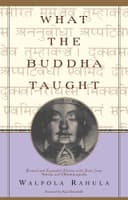
desertcart.com: What the Buddha Taught: Revised and Expanded Edition with Texts from Suttas and Dhammapada: 9780802130310: Rahula, Walpola, Demieville, Paul: Books Review: Wholesome, insightful and inspiring: Highly recommended. - At the center of Buddhism lies practice. Of finding through our own experience our "light" (Buddha Nature) within. I keep reminding myself that, as I live in a Western culture, and we are stuck in our thinking caps. That said: As long as we practice, reflect and feel, I make sure I get daily doses of "Buddhist thought". This book is a wonderful option for that daily injection. What I particularly appreciate is (1) the description of Buddhism through original teachings, yet made very accessible without simplifying. Where words become confusing if translated, they are left as is - as one important example. Words tend to enable sloppy processing. (2) Stressing the uniqueness of true Buddha teachings: There is no guru, there is no authority. This is a path to find your own answers within yourself, and when you do, deeply, you'll see that there's where we all come together as one. Preaching from pulpits - in which ever form, relying on appearances and conventions in speech, dress, looks (and it all depends on which little group you happen to enter at any one time) tend to be more important than actually see compassion, reverence and protection of life, non-discrimination/non-judgment, is increasingly a growing problem in our world, and not just from one view. With our super connectedness and information tsunami gurus appear with strong and simplistic messaging, and the mob-rule of herd mentality means many of us stop being able to truly see who is getting harmed, as we're so convinced in us being right. Buddhism is the one teaching that asks you to stay focus on one thing: love, compassion (kaduna) and making sure you only agree what you yourself after careful pondering and reflections find to be 'true'. This book is a wonderful introduction, and reminder, of the very Heart of Buddhism. Highly recommended. Review: Immense, clear, beautifully stated, for all levels of understanding - "What The Buddha Taught" is a serious academic work taught by a master of the religion/philosophy— really breaks down Theravada Buddhism, including the more intellectually demanding theories such as the Doctrine of Non-Self (anatta) and what karma is and isn’t. Rahula also points out how very radical the Buddha’s ideas were in his time and place, especially his teachings on god/s and human soul/s (or lack thereof), as well as his astonishingly forward-thinking on how married couples should treat each other, how teachers should treat their students, and social castes should think of each other all as equals. There is a little bit of history here, describing the surrounding culture, that is very helpful. Rahula is also a linguist and translator and his explanations of how mis-translations in the past (sometimes hundreds of years old) have mis-represented and caused confusion about Buddhism, especially in the West, provide great clarity for concepts that are themselves deeply philosophical and yet immediately graspable. His explanation of the Four Noble Truths is like a cool drink of water. Highly recommended to all people, from students of religion to literally anyone who is curious about psychology, philosophy, the human condition, or simple seekers for the remedy to daily unhappiness.
| Best Sellers Rank | #10,036 in Books ( See Top 100 in Books ) #2 in Buddhist History (Books) #25 in Asian History (Books) |
| Customer Reviews | 4.6 4.6 out of 5 stars (2,048) |
| Dimensions | 5.25 x 0.75 x 8.25 inches |
| Edition | Revised |
| ISBN-10 | 0802130313 |
| ISBN-13 | 978-0802130310 |
| Item Weight | 8 ounces |
| Language | English |
| Print length | 192 pages |
| Publication date | January 11, 1994 |
| Publisher | Grove Press |
O**Y
Wholesome, insightful and inspiring: Highly recommended.
At the center of Buddhism lies practice. Of finding through our own experience our "light" (Buddha Nature) within. I keep reminding myself that, as I live in a Western culture, and we are stuck in our thinking caps. That said: As long as we practice, reflect and feel, I make sure I get daily doses of "Buddhist thought". This book is a wonderful option for that daily injection. What I particularly appreciate is (1) the description of Buddhism through original teachings, yet made very accessible without simplifying. Where words become confusing if translated, they are left as is - as one important example. Words tend to enable sloppy processing. (2) Stressing the uniqueness of true Buddha teachings: There is no guru, there is no authority. This is a path to find your own answers within yourself, and when you do, deeply, you'll see that there's where we all come together as one. Preaching from pulpits - in which ever form, relying on appearances and conventions in speech, dress, looks (and it all depends on which little group you happen to enter at any one time) tend to be more important than actually see compassion, reverence and protection of life, non-discrimination/non-judgment, is increasingly a growing problem in our world, and not just from one view. With our super connectedness and information tsunami gurus appear with strong and simplistic messaging, and the mob-rule of herd mentality means many of us stop being able to truly see who is getting harmed, as we're so convinced in us being right. Buddhism is the one teaching that asks you to stay focus on one thing: love, compassion (kaduna) and making sure you only agree what you yourself after careful pondering and reflections find to be 'true'. This book is a wonderful introduction, and reminder, of the very Heart of Buddhism. Highly recommended.
J**T
Immense, clear, beautifully stated, for all levels of understanding
"What The Buddha Taught" is a serious academic work taught by a master of the religion/philosophy— really breaks down Theravada Buddhism, including the more intellectually demanding theories such as the Doctrine of Non-Self (anatta) and what karma is and isn’t. Rahula also points out how very radical the Buddha’s ideas were in his time and place, especially his teachings on god/s and human soul/s (or lack thereof), as well as his astonishingly forward-thinking on how married couples should treat each other, how teachers should treat their students, and social castes should think of each other all as equals. There is a little bit of history here, describing the surrounding culture, that is very helpful. Rahula is also a linguist and translator and his explanations of how mis-translations in the past (sometimes hundreds of years old) have mis-represented and caused confusion about Buddhism, especially in the West, provide great clarity for concepts that are themselves deeply philosophical and yet immediately graspable. His explanation of the Four Noble Truths is like a cool drink of water. Highly recommended to all people, from students of religion to literally anyone who is curious about psychology, philosophy, the human condition, or simple seekers for the remedy to daily unhappiness.
P**L
Book Summary: What the Buddha Taught
Walpola Rahula’s What the Buddha Taught1 was originally published in 1959 and stands as a highly-regarded and influential introduction to the fundamental tenets of Theravada Buddhism, which Rahula presents as the original, orthodox tradition. Directed toward the “educated and intelligent general reader” with little or no background in the subject, the book strives to provide a faithful and accurate account of the Buddha's actual words as preserved in the Pali texts of the Tipitaka. Rahula asserts that the essential and fundamental doctrines are the Four Noble Truths, the Noble Eightfold Path, the Five Aggregates, Karma, Rebirth, Conditioned Genesis, Anatta (no-soul), and Mindfulness. He quotes the Buddha as declaring that there was no esoteric doctrine in his teachings—nothing hidden in the 'closed fist of the teacher'—a stance that promoted a new freedom of thought and tolerance that has proven to be rare in the history of religions. The Four Noble Truths form the cornerstone of the teaching: Dukkha (Suffering/Dissatisfaction): The acknowledgment that all existence involves dukkha, which encompasses not only physical and emotional pain but also a general dissatisfaction or imperfection that arises due to anicca (impermanence), such as aging and death. Samudaya (The Arising of Suffering): The true cause of dukkha is tanha (craving) and attachment to people and things. This attachment is rooted in our ignorance of Ultimate Reality and our resistance to inevitable change. Crucially, these attachments keep us tethered to the endless cycle of rebirth, samsara, according to our karma. Nirodha (The Cessation of Suffering): The revelation that the endless cycles of suffering can be absolved by the realization of Nirvana, the state where desire or thirst is fully extinguished. Rahula notes that the Buddha’s entire doctrine leads to this peace, happiness, and the attainment of Nirvana, and was not intended merely to “satisfy intellectual curiosity.” Magga (The Path to the Cessation of Suffering): The pathway to achieve Nirvana is the Noble Eightfold Path. Rajula explains that the Noble Eightfold Path is systematically organized into three categories: Prajna, Sila, and Samadhi. Prajna (Wisdom) comprises Right View (understanding of the Four Noble Truths) and Right Intention (commitment to non-violence, compassion, and renunciation). Sila (Virtue/Ethical Conduct) includes Right Speech (speaking only verities), Right Action (proper conduct), and Right Livelihood (earning a living without harming others). Samadhi (Concentration/Mental Discipline) encompasses Right Effort (in meditative thought), Right Mindfulness (monitoring one’s Five Aggregates—form, feeling, perception, mind, consciousness), and Right Concentration (focusing the mind effectively through meditation). Rahula’s work forcefully presents the unique Buddhist teaching of Anatta. He states, “According to Buddhism, the absolute truth is that there is nothing absolute in the world, that everything is relative, conditioned and impermanent…there is no Self, Soul or Atman within or without.” (p.39) Rahula further argues that “man has created God” and that we conceived the idea of an “immortal Soul or Atman” for our own protection, safety, and self-preservation. Furthermore, Rahula insists that Buddhism rejects the idea of an “unmoving mover behind the movement” (referencing the Aristotelian concept), asserting instead that consciousness depends on the Five Aggregates and cannot exist independently of them. (p.25) The Buddha, who became enlightened under the Bodhi Tree, the Tree of Wisdom (which can be seen as a type of axis mundi), taught that “every man has within himself the potentiality of becoming a Buddha, if he so wills it and endeavors.” (p.1) He taught all classes of men and women, stressing that man’s emancipation depends on his own realization of Truth, and not on the benevolent grace of any external power. This emphasis on self-reliance and intelligence contrasts with the intolerant Brahmanic orthodoxy of the time; Buddhism invited seekers to “come and see” without pressure to believe. This critical inquiry leads to Saddha, which is not faith, but rather “the confidence born out of conviction.” The ultimate goal for Buddhists is to become an Arahant, a Fully Enlightened One, by working out one’s own liberation. This message of tolerance and non-violence was famously championed by the Buddhist Emperor Asoka of India in the 3rd century B.C., who declared that one should honor not only one’s own religion but those of others as well, and that violence under any pretext was against the Buddha’s teachings. Rahula, therefore, frames the teachings not as a set of dogmas, but as a practical and rational philosophy directed toward the attainment of Nirvana.
C**O
helpful and appreciated
A lot of books will interpret the lessons of Buddhism which is understandable and maybe briefly actually reference the writings. That is very good too but this had more of a focus on the writings. Which again isn’t really the focus, the lessons are, but it’s nice to see translations of the lessons. Over all good read, easy to digest and informative.
S**S
Book came in bad print quality and it’s hard to make out words because most letters are missing ink in them. This is even worse for smaller and italic letters and sanskrit words, as they are all in bold italic. If this problem was just here and there, it would be alright, but it’s literally occurring in every one or two words. I can’t say anything about the contents of the book because the print quality is almost unreadable.
I**D
Very good book that summarizes the Buddhist teachings well.
B**N
Great book, which covers all the core concepts of what the Buddha actually taught, rather then to religiony its more straightforward.
S**A
Excellent Book. Eye opener for me to the wonderful teachings of Buddha. I can't explain how grateful I am that Buddha has appeared in my life. The way I look at my life has Completely Changed.. Now that there is no suffering ...Knowing Noble Truth of Buddha and Eight fold Path. Wonderfully explained. I have repeatedly read this book.
G**I
A great book to learn the basics about the Lord Buddha and his philosophical teachings