We remain fully operational. Our teams are working around the clock to ensure your deliveries continue safely.

下载应用程序


Buy anything from 5,000+ international stores. One checkout price. No surprise fees. Join 2M+ shoppers on Desertcart.
Desertcart purchases this item on your behalf and handles shipping, customs, and support to SINGAPORE.
🌟 Unlock the ancient science of flavor and health—ferment like a pro, impress like a boss!
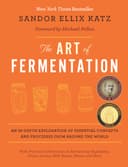
The Art of Fermentation by Sandor Ellix Katz is a definitive, 600+ page guide that covers practical and historical fermentation techniques for vegetables, fruits, grains, dairy, beans, and meats. A top-ranked bestseller in Food Science and Canning & Preserving categories, it offers in-depth knowledge for both beginners and experts, backed by over 3,000 glowing reviews. This book is your gateway to mastering fermentation’s health benefits and culinary creativity.


| Best Sellers Rank | #7,742 in Books ( See Top 100 in Books ) #6 in Food Science (Books) #7 in Canning & Preserving (Books) #10 in Natural Food Cooking |
| Customer Reviews | 4.7 4.7 out of 5 stars (3,133) |
| Dimensions | 7.39 x 1.58 x 9.53 inches |
| Edition | Illustrated |
| ISBN-10 | 160358286X |
| ISBN-13 | 978-1603582865 |
| Item Weight | 2.9 pounds |
| Language | English |
| Print length | 498 pages |
| Publication date | May 14, 2012 |
| Publisher | Chelsea Green |
B**S
Introduction To Post-Pasteurianism
First off: this book is beautiful. Hardcover, with a series of full-color plates 1/3rd and 2/3rds through. For only twice the price of a flimsy paperback, you're investing in five hundred solidly-constructed pages that will last. And a good thing, because this book is destined to be a classic. You don't need to have read Katz' other work, Wild Fermentation: The Flavor, Nutrition, and Craft of Live-Culture Foods , to understand, appreciate, and use this book - it stands alone. If you already own Wild Fermentation, don't be put off by the duplication of some recipes in the Table of Contents. Yes, sauerkraut, kimchi, and pickles are in here, but every section is greatly expanded with much more information and many more references. (Ever thought of using a layer of cooking oil as an airlock? Neither had I, but I'm going to try it!) Speaking of references... the Resources, Glossary, and Works Cited chapters could keep you busy for a few years. And yes: you will use this book. As Michael Pollan states in the well-written foreword, this is not one of those cookbooks you buy for the nice pictures and keep on your coffee table. This is a project manual. Fermentation is something you have to experience to understand, and Katz give you absolutely everything you need to get started. The first 67 pages are devoted entirely to the beginner, focusing not on specific recipes but on answering the inevitable questions: "WHY would I want to ferment food? is it safe? what equipment and general expertise do I need?" Again from Pollan: "Katz writes about the transformative power of fermentation with such infectious enthusiasm that he makes you want to try things just to see what happens." This is so true. Even if you don't initially intend to, many of these 'recipes' are so simple and unintimidating (hard apple cider, mead, sauerkraut and its derivatives, sourdough) that it's hard to resist the urge to pick up a box of Mason jars and some fresh produce the next time you're at the grocery store. Many of us are experimenters at heart, and fermentation is the perfect mix of art and science to tap into this nature and inspire all kinds of crazy projects. Already the neighborhood King of Kraut? I guarantee that this book will still have something for you. Chapter 12 - "Fermenting Meat, Fish, and Eggs" isn't enough? Turn to Chapter 13, for a short but serious discussion of what it takes to turn a fermentation hobby into a small business. Notes about scaleup, HACCP plans, and licensing are cool to read about, though I have no plans to open a tempeh factory anytime soon. Or how about Chapter 14 - "Non-Food Applications of Fermentation"? Again, I don't live on a farm, but it is neat to read about compost, silage, and bioremediation. (Surprise: Katz doesn't buy into corn ethanol biofuels) While this is by no means a biology textbook, the scientific content is much improved over Wild Fermentation. Chapter 1 - "Fermentation as a Coevolutionary Force" is, in general, accurate and well-referenced. Katz is not a formally-trained scientist, but he does not shy away from technical details when they are helpful for understanding, and he shows respect for the scientific method and its results. See, for instance, his discussion of 'homofermentative' and 'heterofermentative' organisms in vegetable fermentation (pg 96), or of commercial starter cultures (pg 132). If you subsist on white bread and margarine and bleach your cutting boards after every use, fermentation may not be the hobby for you. The first time I skimmed some strangely-textured yeast off of a crock of fermenting beets, I have to admit I was a little skeptical what those beets would look like when I pulled them out (they were absolutely delicious). While some of my more imaginative fermentation adventures have yielded delicious results, a few have been downright terrible (yep, ate them anyway!). If you don't see any issue with carving a bit of mold off some cheese or a piece of fruit instead of throwing it out, then you probably have what it takes. Many (most?) of the poor reviews on Wild Fermentation are from people taking issue with Katz' lifestyle or philosophies. Many of his philosophical discussions in this book are backed up with hard science and references, so even those who found Wild Fermentation to be overbearing may find this new book to be more palatable. If you have some problem with the fact that Katz has HIV (he states this outright in the new book, and includes a sidebar about how fermented foods may be helpful but they are not a disease cure), do the rest of us a favor and keep it to yourself. I've been experimenting with fermentation for about a year, relying mostly on Wild Fermentation and a substantial collection of online resources. I've only had this book for a week, and I've already had tons of fun and learned a lot. When I'm finished with my read-through, this book will definitely be making its rounds among my friends. A great reference and a worthwhile investment - highly recommended.
C**T
It's your body, give it a little probiotics, try the kraut
So helpful, already making my own kombucha, Smreka, and Tepache. Wonderful homemade sodas! You don't know what your missing, but I do!!! All those ingredients that aren't actual food ingredients. Do yourself a favor and get this book!!!
A**R
Best Book on Fermentation Currently Available
Fermentation was frankly something I had little to no experience or interest in until a few years ago....even then it was a slow progression. For health reasons (we're not getting any younger) we started taking an active interest in food - both the quality of the food and the preparation practices. The more we learned, the more we started cooking, baking and making our own food. Bread was perhaps one of the very first things we took the time to make from scratch and soon the bread baking became a weekly tradition. Fresh baked bread is so delicious, warm and comforting. Of course, that led to grinding our own flour and since bread is so much like beer - my spouse began experimenting with home brewed beer and wine and even soda. It wasn't long before something always seemed to be brewing in the kitchen and at least one of us, was quickly becoming a fermentation fan. Over those few years, our diet, shopping habits, food choices and preparation methods changed fairly radically from what we had thought was a decent diet to an all organic, homemade diet with local produce when possible. It was during that time I started hearing more and more about the benefits of fermentation of other foods - but frankly, not having grown up around anything remotely related to food preparation, I had no idea what was/wasn't fermented. In fact, I thought pickles were always made with vinegar and canned - I had no idea they were fermented. Ditto for sauerkrout or oodles of other items. Somewhere along the line, I came across Sandor's first book on fermentation and purchased it. It was NOT love at first sight...in fact, after the first read, I thought it sounded horrible (rotted food?!) and set it aside for at least another year. Then by chance, I happened to taste some REAL pickles..then fermented salsa and several other things that just knocked my socks off. I pulled that book out and decided to give it a try. Low and behold, it worked like a charm! Soon I was buying big fermentation pots and since then we have become regular consumers of fermented products made a home. I then bought the book and video set and several other books on fermentation...in fact, by this point, I probably own most of the major books about fermentation. So, when this came up as an advanced order option, I purchased it right away although I wasn't sure what to expect. It was delivered early and right from the start, it is obvious this book is MUCH larger than previous books. It provides a exemplary overview of fermentation from both a historical perspective as well as current uses around the globe. The information expands upon the understanding of fermentation in a dramatic way. It's both interesting and informative. Without a doubt, it's one of the best books I've read on the subject and I've read a LOT of them! Now, if you are just wanting an introduction to fermentation with a few quick and easy recipes' and examples, the older books by Katz are probably still your best choice. On the other hand, if you are a person that likes to understand a topic in depth when starting something new, this may be more to your liking. Existing fermentation fans will ABSOLUTELY want to purchase this new book for the expanded knowledge, information and insight. It will not disappoint! May your beer always bubble, your bread always rise - Your pickles always pucker and your crock never demise! Happy fermenting folks!
G**A
Pickle it!
Looking for recipes? This is not the book for that this book teaches the “why” behind recipes so you can safely pickle and ferment nearly anything.
K**R
Very good book, read it from cover to cover!
G**E
Pretty sure the information inside the book are very good but the quality of the book itself it's pretty poor. Just open it and it's already coming apart
T**M
More a book on personal experiences than a step by step guide/explanation of fermentation proces. Could be better.
H**O
Muy buen contenido
A**R
gives confidence to start fermenting food yourself
TrustPilot
1 个月前
1 周前