We remain fully operational. Our teams are working around the clock to ensure your deliveries continue safely.

下载应用程序


Buy anything from 5,000+ international stores. One checkout price. No surprise fees. Join 2M+ shoppers on Desertcart.
Desertcart purchases this item on your behalf and handles shipping, customs, and support to SINGAPORE.
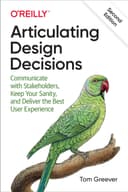
Articulating Design Decisions: Communicate with Stakeholders, Keep Your Sanity, and Deliver the Best User Experience [Greever, Tom] on desertcart.com. *FREE* shipping on qualifying offers. Articulating Design Decisions: Communicate with Stakeholders, Keep Your Sanity, and Deliver the Best User Experience Review: Want to communicate better? Read this - This book has some really good advice for articulating yourself and presenting to people. Knowing how to organize and communicate your thoughts and ideas is important in any setting, which is why I think this book would be great for anyone and not just designers. Review: Articulating Design Decisions - If you haven't read this yet, drop everything and start now—this book is a must-have for any designer. Tom Greever explains how to build trust with everyone from peers to C-level executives by mastering the art of articulating your design decisions. All questions about the book were promptly resolved with support.








| Best Sellers Rank | #93,424 in Books ( See Top 100 in Books ) #6 in User Experience & Website Usability #101 in Decision-Making & Problem Solving #118 in Business Decision Making |
| Customer Reviews | 4.7 4.7 out of 5 stars (593) |
| Dimensions | 6 x 0.75 x 9 inches |
| Edition | 2nd |
| ISBN-10 | 1492079227 |
| ISBN-13 | 978-1492079224 |
| Item Weight | 2.31 pounds |
| Language | English |
| Print length | 240 pages |
| Publication date | September 8, 2020 |
| Publisher | O'Reilly Media |
G**B
Want to communicate better? Read this
This book has some really good advice for articulating yourself and presenting to people. Knowing how to organize and communicate your thoughts and ideas is important in any setting, which is why I think this book would be great for anyone and not just designers.
S**S
Articulating Design Decisions
If you haven't read this yet, drop everything and start now—this book is a must-have for any designer. Tom Greever explains how to build trust with everyone from peers to C-level executives by mastering the art of articulating your design decisions. All questions about the book were promptly resolved with support.
D**.
Recommend Reading
This is a great book. Lots of great advice and guidance. Everything written is easy to apply to my everyday work. I highly recommend getting and reading this book by Tom Greever.
R**U
A Must-Read for Anyone Who Designs or Presents
So glad I finally got a chance to read this book! Many good nuggets, but what has stuck with me the most is always saying yes as a method of inviting collaboration and understanding perspectives.
C**S
Helpful
Very good information on talking with non-designers to be able to articulate the "whys" of the decisions we make. I always knew why, but having the help to articulate them in a more professional way and in terms that directly speak to stakeholders' goals is a very, VERY helpful angle. A must-have for designers, project managers, and creative directors FOR SURE.
M**W
As a UX instructor, I decided to make this book a required reading for my students.
"Articulating Design Decisions" is an absolute gem for anyone diving into the world of UX design, and it became a superhero in my college UX class! As a UX instructor, I decided to make this book a required reading for my students, and boy, did it work wonders! The book's clear and practical approach to explaining the art of articulating design decisions resonated with my students like never before. They went from feeling uncertain about presenting their design choices to confidently articulating their ideas with grace and clarity. I remember one particular student who had always struggled with conveying the reasoning behind their design decisions. After reading the book, they transformed into a persuasive storyteller, weaving their design rationale with confidence during class presentations. It was like witnessing a blossoming flower, blooming into a true UX professional. The book's insightful tips and real-world examples made it an invaluable resource for my class. I saw a noticeable improvement in my students' ability to communicate and defend their design choices, both in class and during internships. It's like a secret weapon that elevated their UX skills and boosted their confidence as designers. If you're a UX enthusiast or a design professional looking to master the art of articulating design decisions, this book is a must-have addition to your library. It's like a mentor that empowers you to confidently express your design rationale and become a persuasive advocate for your creations. Embrace the wisdom of "Articulating Design Decisions," and watch your design journey soar to new heights!
M**N
In-Depth Advice on How to Get Buy-In for Your UX
I thought this book was going to be more technical that it was. Oops. I'm a software engineer who works on the server-side. UX is rarely, if ever, my concern, so I was a bit peeved at myself for buying this book and not looking carefully enough at the description. Except for the last two or three chapters, there's definitely something of value for technical folks to take from Articulating Design Decisions. Articulating Design Decisions walks us step-by-step to getting buy-in from stakeholders. How do we do that? There's a number of ways, but it often comes down to tying choices to a goal/objective, considering the user of the product, appealing to data/studies, calling in support from stakeholders who agree with you (especially if they're high up in the chain of command), pointing at branding concerns, etc. The book also gives tips on how to navigate around stakeholders without offending them or making them feel unheard. While not all of this is useful for a software engineer, a lot of it is. Software engineers have code reviews/PRs. Oftentimes, these reviews can descend into utter chaos because we engineering types tend to have Magpie Syndrome. ;) Articulating Design Decisions lays out a focused, user-driven way to discuss these reviews in a way that's productive, leaves everyone feeling heard, and puts us in the best position to put out the best product possible. So even if you're not in UX or don't work on the frontend, you might find some value in this book. Perhaps someone with lots of experience talking to the business heads won't see anything new. The rest of us? Oh yeah, this is good stuff.
M**K
Structure and Organization to an Important Soft Skill
I was always told that my skill for communicating with stakeholders was a valuable soft skill that I should teach to others. Typically a soft skill is something that is developed over time and dependent on personality. Some say "a skill you can't teach". However, I was asked to teach those skills to those that I supervise. I struggled to put the thoughts together in the best way to teach something that came as second nature to myself. This book helps to organize the concepts behind all of the skills that make up the larger soft skill that is in such demand. It provides tools and structure for those trying to learn this skill to be able to measure their success throughout the development. Making it a valuable book for the new designer. I learned a lot of these concepts working with executives in my career, where most newer designers wouldn't have had that opportunity. So get the book! Mark it up, keep it as a reference, use the tools and you will soon find your habits second nature. You will have more success with your stakeholders as a result.
L**X
Having one’s design ideas critiqued during pitches - or worse, hated - can be pretty hard on the ego 🫣 This book has gives clarity into why some of our ideas don’t take hold, despite being technically rock solid. I’ve learned that the problem has generally not been stakeholders’ lack of ‘design sensibility’ - rather my own lack of empathy and skill to communicate in the space between design and non-design disciplines. On the flipside, it’s shown me how I can be clearer in communicating what I need from designers when my role is that of the decision maker. Anyone who ever felt their design reasoning was lost in translation will find this book a treasure trove of practical advice for selling design solutions - and for accepting our role as designers in removing friction from the decision-making process. A brilliant book.
N**.
Mi è stato consigliato in quanto sono un po' carente nella presentazione dei progetti e credo che mi abbia aiutato tantissimo la lettura di questo libro: consigli pratici, dritti al punto e applicabili. Poca filosofia tanti modi pratici per migliorarsi. Davvero consigliato!
M**V
As someone with over 15 years of experience in the design industry I expected this book to establish a vocabulary that can help designers, new and senior alike, articulate why they make decisions, and focus on outcomes so that they can be more intentional in their craft. Instead, I got a glorified self-help book on how to write emails and justify decisions by cowering down. This was completely misleading and quite frankly, a waste of time. No designer worth their salt will need this. I wish I could give negative stars.
K**A
The book is very educational/well thought through. A colleague recommended it amd I’m glad she did. Suitable for all design disciplines and Marketing people as well
D**S
As a product designer, I constantly have to present work, receive feedback and discuss several topics with different stakeholders. It can be a very tough and draining job sometimes. I was looking for new practices/frameworks to make my life easier. I am very grateful that I found this book, it is very easy to read and has tons of useful advice and best practices. I could not recommend it highly enough.
TrustPilot
1天前
3 周前