We remain fully operational. Our teams are working around the clock to ensure your deliveries continue safely.

下载应用程序




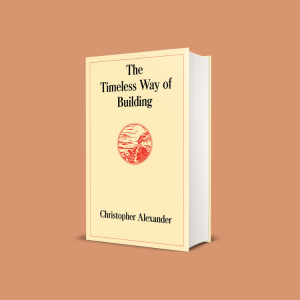
The Timeless Way of Building [Alexander, Christopher] on desertcart.com. *FREE* shipping on qualifying offers. The Timeless Way of Building Review: The Etymology of Software Architecture - I found this book so mesmerizing that I read it twice. During the first pass, I was surprised that the book was so philosophical and poetic in describing architecture. I expected something more technical. Later during the second pass, my goal was to find derivatives and analogies in software architecture. Based on what I found, I think every software architect would enjoy this book. The writing style that I noticed in my first read of the book made me feel like I was reading an architecture bible. I hesitate to describe the book as religious, but the book's description "the power to make buildings beautiful lies in each of us already" and the description of the word "alive" giving architecture "the quality without a name" triggered an epiphany when recalling that the Bible says "In the beginning God created the heaven and the earth." and, "So God created man in his own image." This is why I'd say this book has a primal, sacred aspect, and this is why we like to build. Additionally, the book especially moved me so my mind's eye was opened to see "alive" patterns and to think about the morphology of architecture filling voids and generating towns. On the second pass of reading, I was struck by this software architecture analogy in the table of contents: "16. Once we have understood how to discover individual patterns which are alive, we may then make a language for ourselves for any building task we face. The structure of the language is created by the network of connections among individual patterns: and the language lives, or not, as a totality, to the degree these patterns form a whole." Could this be the guidebook for designing enterprise software architecture? Obviously this book was the inspiration for the philosophy and vocabulary for software architecture, and I thought some of the following excerpts were noteworthy paradigm shifts. "The patterns are not just patterns of relationships, but patterns of relationships among other smaller patterns, which themselves have still other patterns hooking them together---and we see finally, that the world is entirely made of all these interhooking, interlocking nonmaterial patterns." This sounds like the difference between patterns of software architecture and object-oriented software design patterns. "Each pattern is a three-part rule, which expresses a relation between a certain context, a problem, and a solution." Deja vu for software patterns. "You may be afraid that the design won't work if you take just one pattern at a time...There is no reason to be timid...The order of the language will make sure that it is possible." Likewise in software architecture design, as one design pattern is considered at a time to see how it fits needs into the large picture of design. If this pattern is later deemed to be dead, it can be replaced by an "alive" design pattern. "Next, several acts of building, each one done to repair and magnify the product of the previous acts, will slowly generate a larger and more complex whole than any single act can generate." This correlates to software refactoring. "It is essential, therefore, that the builder build only from rough drawings: and that he carry out the detailed patterns from the drawings according to the processes given by the pattern language in his mind." When I read this, I thought about the metaphor to the software architect's vision and design. The software architect's design needs to be abstract enough to accommodate change easily, but yet simple enough so software programmers can understand it, finish the detailed component design and build the component to fit the architectural whole. Review: A timeless way of building ! - A good addition to your collection of books !

| Best Sellers Rank | #42,592 in Books ( See Top 100 in Books ) #4 in Architectural Criticism #5 in Urban & Land Use Planning (Books) #10 in Architectural Drafting & Presentation |
| Customer Reviews | 4.6 4.6 out of 5 stars (311) |
| Dimensions | 5.5 x 2 x 7.4 inches |
| ISBN-10 | 0195024028 |
| ISBN-13 | 978-0195024029 |
| Item Weight | 1.4 pounds |
| Language | English |
| Part of series | Center for Environmental Structure |
| Print length | 552 pages |
| Publication date | January 1, 1979 |
| Publisher | Oxford University Press |
K**T
The Etymology of Software Architecture
I found this book so mesmerizing that I read it twice. During the first pass, I was surprised that the book was so philosophical and poetic in describing architecture. I expected something more technical. Later during the second pass, my goal was to find derivatives and analogies in software architecture. Based on what I found, I think every software architect would enjoy this book. The writing style that I noticed in my first read of the book made me feel like I was reading an architecture bible. I hesitate to describe the book as religious, but the book's description "the power to make buildings beautiful lies in each of us already" and the description of the word "alive" giving architecture "the quality without a name" triggered an epiphany when recalling that the Bible says "In the beginning God created the heaven and the earth." and, "So God created man in his own image." This is why I'd say this book has a primal, sacred aspect, and this is why we like to build. Additionally, the book especially moved me so my mind's eye was opened to see "alive" patterns and to think about the morphology of architecture filling voids and generating towns. On the second pass of reading, I was struck by this software architecture analogy in the table of contents: "16. Once we have understood how to discover individual patterns which are alive, we may then make a language for ourselves for any building task we face. The structure of the language is created by the network of connections among individual patterns: and the language lives, or not, as a totality, to the degree these patterns form a whole." Could this be the guidebook for designing enterprise software architecture? Obviously this book was the inspiration for the philosophy and vocabulary for software architecture, and I thought some of the following excerpts were noteworthy paradigm shifts. "The patterns are not just patterns of relationships, but patterns of relationships among other smaller patterns, which themselves have still other patterns hooking them together---and we see finally, that the world is entirely made of all these interhooking, interlocking nonmaterial patterns." This sounds like the difference between patterns of software architecture and object-oriented software design patterns. "Each pattern is a three-part rule, which expresses a relation between a certain context, a problem, and a solution." Deja vu for software patterns. "You may be afraid that the design won't work if you take just one pattern at a time...There is no reason to be timid...The order of the language will make sure that it is possible." Likewise in software architecture design, as one design pattern is considered at a time to see how it fits needs into the large picture of design. If this pattern is later deemed to be dead, it can be replaced by an "alive" design pattern. "Next, several acts of building, each one done to repair and magnify the product of the previous acts, will slowly generate a larger and more complex whole than any single act can generate." This correlates to software refactoring. "It is essential, therefore, that the builder build only from rough drawings: and that he carry out the detailed patterns from the drawings according to the processes given by the pattern language in his mind." When I read this, I thought about the metaphor to the software architect's vision and design. The software architect's design needs to be abstract enough to accommodate change easily, but yet simple enough so software programmers can understand it, finish the detailed component design and build the component to fit the architectural whole.
R**G
A timeless way of building !
A good addition to your collection of books !
D**N
Excellent!
A bit pricey, but worth it. As a student of architecture, it's refreshing to read a perspective that integrates beauty and function in a way that harmonizes with our phenomenological experience. Tired of the lifeless modern styles. The author repeats himself a fair a bit i don’t hold that against him as I believe he's building his case from the ground up.
0**1
The art of architecture analyzed by a scientist
Not a wall, not a city, but an atom with its electrons, a molecule. Culture, intuition, know-how and crafts reduced to a periodic table of elements. Funny, amazing, worth reading. A real value added to other so-called research theses.An underlying consequence of this argument is that the profession of architect is seen as a dogma or ideology that distances people from truly high-quality housing. From the perspective of an architecture professor, one wonders if the person is entirely sane. But I partially agree, because I think there are more ideas in 100 people's minds than in a single architect's. However, these 100 people aren't available to design and build a neighbor's house together. And modern society has divided human activities into specialties, with butchers, bakers, doctors, and the architect being one of these specialities, which the others need—unless we all want to live in reed huts! While specialization has its advantages, particularly the leveraging of accumulated experience, a set of professional codes attempting to compensate for the loss of a unifying cultural foundation, it also has real disadvantages. These begin with a kind of limitation on imagination and common sense, a potential for excess, artificial solutions, and then self-protection through a system of barriers to entry for aspiring professionals. The architectural profession is not immune to this trend. But it is merely a small cog in this vast, ultra-capitalist evolution where developers and construction companies, in conjunction with local governments and politicians, call the shots. Not everyone is suited to participate in such projects. Therefore, and this is surely the aim of this book, as with any service, it is highly beneficial to be personally involved in creating one's living environment, alongside specialists, and to keep in mind a few basic principles.
N**V
Lo sto ancora leggendo, e già molte volte mi ha fatto scattare delle epifanie su tante cose, dalla musica alla organizzazione delle cose. Anche se il testo prende in esame il linguaggio architettonico, non si deve essere assolutamente degli architetti per comprenderne le idee. Io non lo sono.
D**D
All as described
D**Y
Beautiful book
S**P
It's a book about architecture. It describes a new way of looking at design. Breaking down the design problem and attempting to provide a procedure to solve it systematically. It is a companion book to A Pattern Language and The Oregon Experiment. The book is so beautifully written that I sometimes am moved to tears by the profoudness of the thoughts expressed. All architects mist read this book.
K**N
Am a software developer, so only reading it in weekends. About half way through and am thoroughly enjoying it. Its a book on 'philosophy of creating new things'. Treasureworthy book.