We remain fully operational. Our teams are working around the clock to ensure your deliveries continue safely.

下载应用程序


Buy anything from 5,000+ international stores. One checkout price. No surprise fees. Join 2M+ shoppers on Desertcart.
Desertcart purchases this item on your behalf and handles shipping, customs, and support to SINGAPORE.
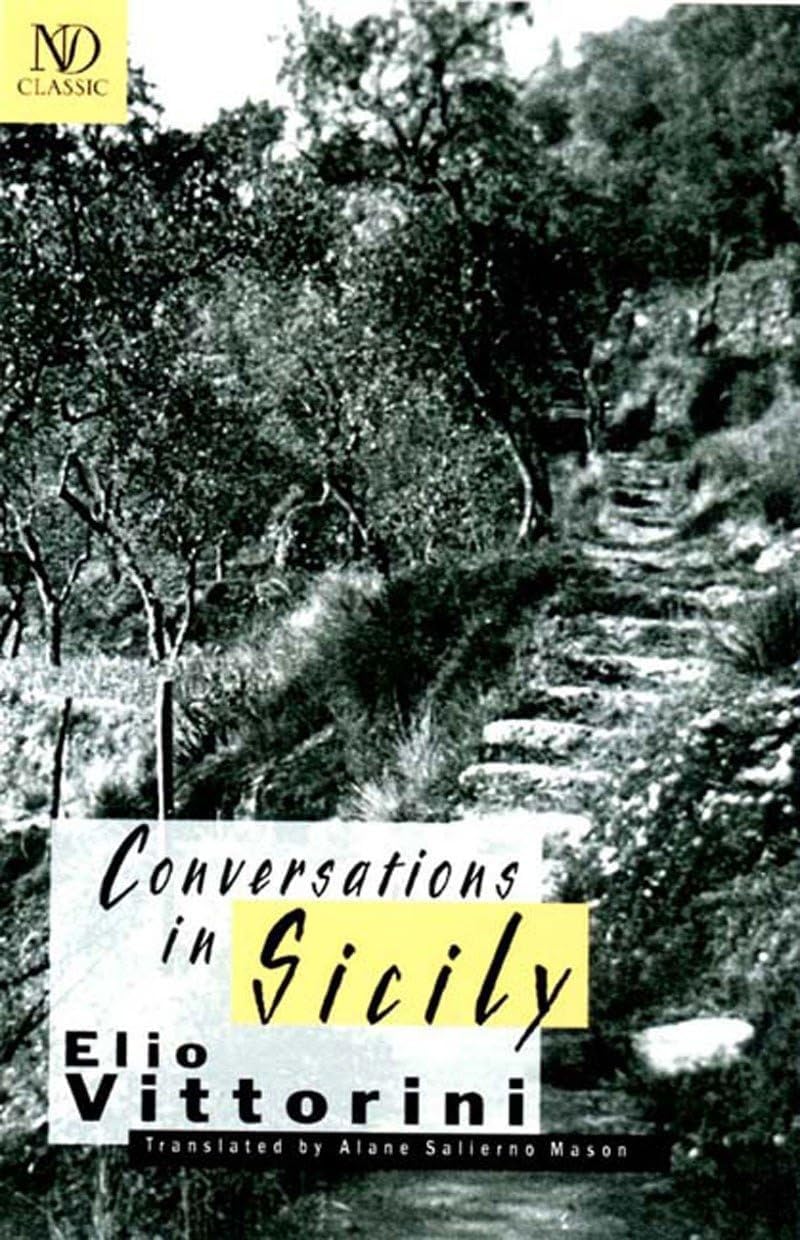
Conversations in Sicily [Vittorini, Elio, Mason, Alane Salierno, Hemingway, Ernest] on desertcart.com. *FREE* shipping on qualifying offers. Conversations in Sicily Review: Outstanding - If you have an appreciation and understanding for the history of Sicily, it's poverty, it's habits, it's tragedy.......then you will find humor, insight, and comfort in this simple but brilliant book. The author is honest, forward, and beautifully uncompromising. Admittedly, there is a little "magic lost" in the translated version, but nonetheless, this is a book about Sicily and it's people told by a Sicilian, and brought to life by the simple, everyday perspectives and habits of Sicilians. In some ways, this book defines the heartbeat and simplicity of Sicily and it's people without over saturating the reader with historical context, academic background, and mafia stories. This book is just about simple people, simple perspectives, simple emotion, and a simple island. If you can appreciate that, then this is a beautiful, honest, and capable story. Review: Five Stars - book is in excellent condition. thank you
| Best Sellers Rank | #721,294 in Books ( See Top 100 in Books ) #24,540 in Literary Fiction (Books) |
| Customer Reviews | 4.2 4.2 out of 5 stars (67) |
| Dimensions | 5.2 x 0.6 x 8.1 inches |
| ISBN-10 | 0811214559 |
| ISBN-13 | 978-0811214551 |
| Item Weight | 11.2 ounces |
| Language | English |
| Print length | 144 pages |
| Publication date | November 1, 2000 |
| Publisher | New Directions |
A**O
Outstanding
If you have an appreciation and understanding for the history of Sicily, it's poverty, it's habits, it's tragedy.......then you will find humor, insight, and comfort in this simple but brilliant book. The author is honest, forward, and beautifully uncompromising. Admittedly, there is a little "magic lost" in the translated version, but nonetheless, this is a book about Sicily and it's people told by a Sicilian, and brought to life by the simple, everyday perspectives and habits of Sicilians. In some ways, this book defines the heartbeat and simplicity of Sicily and it's people without over saturating the reader with historical context, academic background, and mafia stories. This book is just about simple people, simple perspectives, simple emotion, and a simple island. If you can appreciate that, then this is a beautiful, honest, and capable story.
M**N
Five Stars
book is in excellent condition. thank you
B**Y
Five Stars
Fantastic book.
L**O
EXCELLENT
THANKS. EXCELLENT CONDITIONS
S**Y
Five Stars
good service good read
F**Y
A Curious Read
Italio Calvino, the great Italian neo-realist author wrote that Vittorini's "Conversations in Sicily" was 'the book-Guernica'. As a testament to time and place, giving the reader an appreciation of the anti-fascist sentiments of the author, this is a solid book. I'm sure it has its place in university courses on 20th Century Italian history. As a work of literature, I feel it is somewhat secondary. Vittorini's prose is lively, it moves and swirls, it has a vibrant rhythm. It is like Opera with its use of verbal repetitions. The world is quite rustic and at times, a little absurd - especially when he describes the two men on the train. He calls them 'With Whiskers' and 'Without Whiskers'. Sometimes I found Vittorini's repetitions a little too distracting. What I mean is that the character will say "There's no cheese like ours" several times on his journey back to Sicily. I will admit, I found it a little annoying. There is also repetition in conversation. Characters will say the same thing over and over again in conversation. I found myself just skipping over some pages because of this. It is difficult being critical of a work translated from another language. In English, we reference the English language, the books we have read in English, whether written by English authors or translated into English. Maybe in Italian literature, this book has a revered place we can only understand if we studied Italian. As a work in English, I found it mildly entertaining. Some books are great because they are both artistic and timeless. They stand alone because they appeal to the universal in every epoch. If this book wasn't written by an anti-fascist writer in the 1930's, if it had been written last year or in the decade after fascism, I doubt it would make an impact. It is a good read. It is different, playful but it didn't strike me as being powerful within its own right.
R**Y
The world is big and it is beautiful but it has been badly wronged.
Elio Vittorini’s CONVERSATIONS IN SICILY is a quiet novel It was written a lifetime ago, at the end of the 1930s, in Northern Italy, although the story takes place in Sicily—takes place on a ferry crossing, a train ride, and then up to and around a hill town above Syracuse. It also takes place almost entirely in the mind of the narrator, Silvestro Ferrauto. This is not to say there are no actual conversations. Silvestro shares a few words with people he encounters on his journey, a pitiful old man from whom he buys an orange he doesn’t want. He brushes against others including a pair who may be secret police or a vaudeville act. Home, he speaks with and also interrogates his mother Concezione. The formidable Concezione, who, after a 15-year separation greets her son by asking, “But what the devil brought you here?” Later, he will converse with a knife sharpener, a saddle maker, a cloth merchant all of whom he follows into a bar. Together they form a comic if solemn confraternity who drink to the “wrongs of the world.” It is not a trivial concern. Who has not wronged the world and who has not been wronged? These scenes are among the saddest in the book. Leaving the bar, Silvano finds himself in the village graveyard where he is engaged in another conversation, one with ghost who is no stranger. The scene at the bar could be read as an absurdist aside within the story; Silvestro’s companions would not seem out of character if they were wearing grease paint, but I think that would be a mistake. Vittorini seems to argue, one can run but one can’t hide. Silvestro, like Vittorini, was first a runaway and then an exile. In the book’s telling, Silvestro who left home at 15 returns only after receiving a letter from his father who urges him to see his mother on her name day. A father who is no paterfamilias and so a man with no authority. A father who himself left home but whom we catch a glimpse of at the book’s end. Before the Silvestro begins his journey his anomie is conspicuous. He is detached from his work, girlfriend and from the events of the day. The visit home is not suggested as an antidote to anything, nor is it an obligation, but rather an inevitability. Home is both the beginning and the end. In CONVERSATIONS, Vittorini’s political views are, of necessity, disguised. If the reader is of a mind he or she can locate antifascist commentary. I suggest Vittorini’s politics are of no consequence. The story of the boy/man returning home is as old as Homer or the parable of the Prodigal Son. As for anomie, it is simply a condition of modernity. Silvestro is not Every Man, he is No Man. His ability to turn this way or that is less evidence of volition than being on edge and off balance. Silvestro’s sudden departure is merely a fact, like the price of a train ticket. The man is only another traveler "with no direction home."
S**N
This is a very odd but marvelous book, set deep in the poverty of the Sicilian peasantry, seemingly a conventional narrative but as it develops the world becomes stranger and more and more mythical.
E**A
Già letto in italiano, è un libro che volevo condividere con amici di lingua inglese che erano stati in Sicilia.
G**P
I read this while I was in Sicily and so recognised some of the places and landscapes Vittorini describes and that may have influenced me in its favour. It is hard to categorise because it's not really a travel book as it describes a fictional journey and it is barely a novel as there is not much of a plot. It is really a series of reflections on the Sicily of half a century ago revealed mainly through the protagonist's conversations with the people he meets. To start with these conversations give an insight into the lives of ordinary Sicilians of the period but gradually they become more personal and even metaphysical culminating in a strange nocturnal meeting with a soldier. Now it seems Vittorini is more interested in exploring his own (?) life and relationships with his family. Since reading the book a few weeks ago parts keep coming back to me, which must be a sign of a good book
P**L
Melancholic - I'm surprised Hemingway liked it so much as I loathe what I have had the misfortune to read of Hemingway and this is universes away from his work. It conveys eerily well the repressive atmosphere of fascist Sicily, the vacuity of relationships, the undercurrent of fear mixed with apathy. All in all a great work.
A**T
I reread this after many years and it is still full of metaphors and images that resonate. From Dante to Shakespeare it has so many references and making sense of it all is nearly impossible. Everyone takes on a multiple role be it Hamlet or Adam, Eve and the virgin Mary or Cornelia. Confusing and haunting