
下载应用程序



Desert Online General Trading LLC
Warehouse # 7, 4th Street, Umm Ramool, Dubai, 30183, Dubai
下载应用程序
Desert Online General Trading LLC
Warehouse # 7, 4th Street, Umm Ramool, Dubai, 30183, Dubai
Full description not available
R**O
Another winner in the Robert Langdon series.
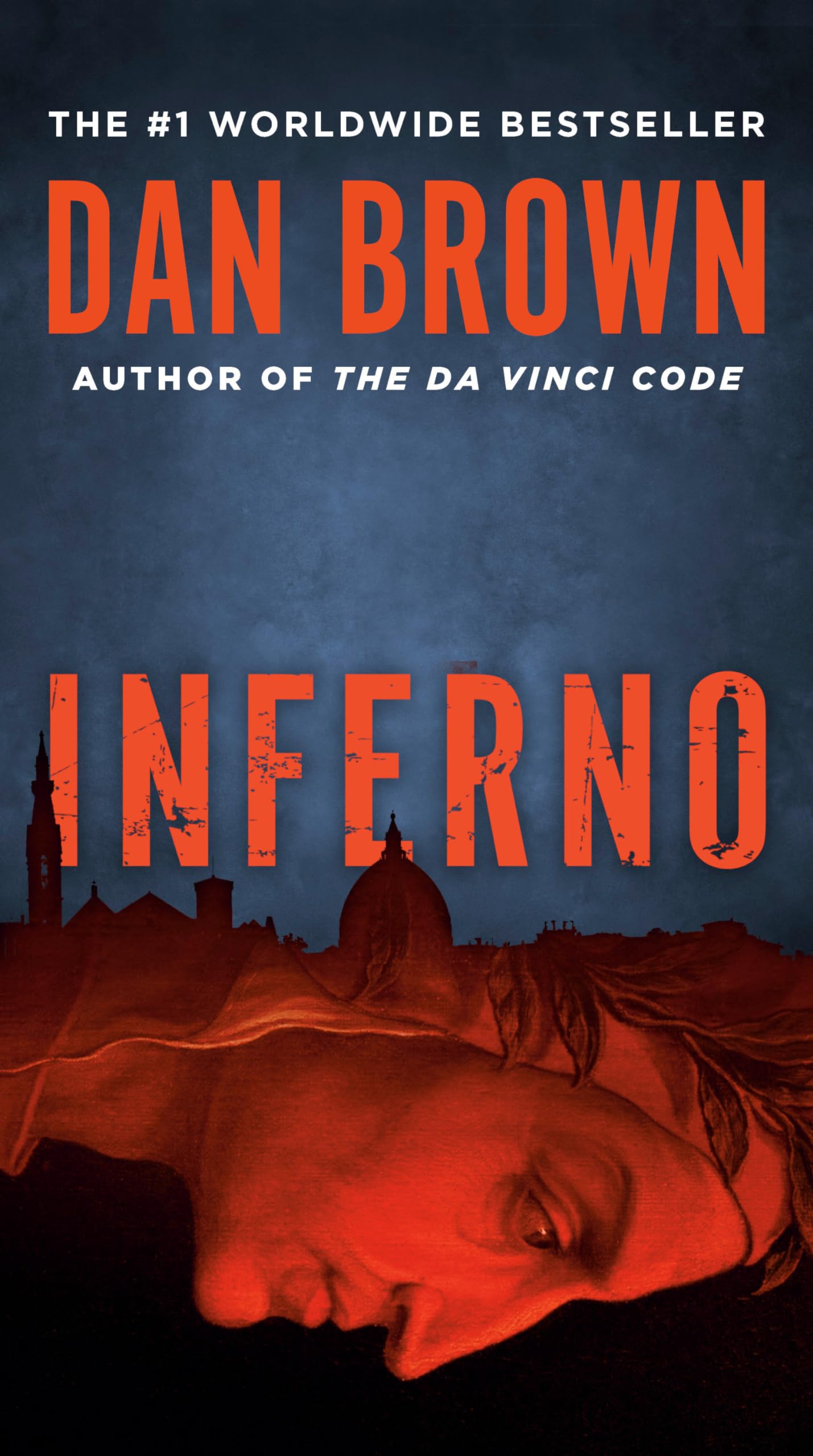
Dan Brown's newest novel, "Inferno," sends symbolist Robert Langdon on another mad dash adventure stretching from the Mediterranean to the Bosporus. I've given it a 5-star rating, because, as usual, Brown delivers on all fronts: interesting subject matter that is painstakingly researched, compelling characterizations, action squared, a plot that moves easily from one scene to the next and drags you along no matter how late it is, inclusion of interesting historical facts, lush settings, and a denouement that leaves you thinking not only about the novel, but about real life. And, of course, top notch proofing and editing.In other action thrillers, I sometimes feel as though I'm reading a movie script. The action is the focus, rather than the plot and/or characters. Not so with Brown. Here's an author who can handle the never-ending action, the constant danger, the exhausting, breakneck chase, the result of which will not only determine the life and death of the main characters, but perhaps the survival of human life on earth as we know it. The reader WANTS to go on this ride. Wants to feel the unrelenting adrenaline rush, the heart stopping suspense. You want it; you get it; you love it.For those Robert Langdon fans, this time the action races through the the famed houses of worship of Italy and Turkey, chasing clues from Dante's 14th Century epic poem, "The Divine Comedy," and specifically, the portion titled "Inferno." However, this time there is no religious conspiracy, no sacred quest. This time the subject matter involves the predicament we all find ourselves in: burgeoning world population vs. decreasing resources.In my youth, there was a movement known by the acronym "ZPG." Over the past couple years, whenever the overpopulation issue is mentioned, I've asked if anyone remembers what this stood for. Anyone under the age of about 45 or so does not. (Zero Population Growth) So this novel hit on an issue that has been of concern to me now for over 4 decades. But, that's another conversation.The book is nearly 500 pages long (462 to be exact). Long read. This has been a busy month for me, but I still managed to read every day -- in fact, I needed to read every day, as this book is full of the most fascinating twists and turns. Not only twists in the plots, but actually twists in who the individual characters are. Brown masterfully doles out bits and pieces of the solution to his puzzle all along the way, but still manages to surprise you when a character turns out to be the exact opposite of what you believed him or her to be. I'll admit to having one huge, and upon rereading, obvious clue go right over my head. When that part of the revelation came, I had to go back and do a -head/desk- over my oversight! :-) Tricky. And I loved it.So, I didn't read it all in one day or even in one week. Brown's novels are works to be savored. There is so much fascinating history, interesting concepts and wonderful mysteries that I have to stop every so often just to properly absorb what I've read. I need to taste the delightful flavor of each morsel of the literary puzzle. No. I take my time with Brown's novels. I drag out every Lucius paragraph, longing for the ultimate conclusion all while hoping it will never end.So, don't I have any complaints? Now, if you usually read my reviews, there usually something.For instance, starting on page 300, when Langdon and others are in the boat in Venice and come to the realization that the "plucker of bones of the blind" in Zobrist's poem referred to Saint Lucia, and their boatman began relating the legend of Saint Lucia, why didn't they ask him the identity of the doge who cut the heads off horses (another reference in the poem)?My other disappointment is in the extremely short timeline. If one starts with Langdon awaking in a hospital with memory loss, there are less than 2 days (actually less than 36) hours, I believe, in which this madcap race through the best known tourists sites of Italy to the Haga Sophia and beyond in Istanbul. It includes chases, conversations, motorbikes, boats, and just like Steve Martin and John Candy -- planes, trains and automobiles! Langdon has an injury and short term memory loss. There are two well organized forces chasing him. Yet, in all those hours, which are painstakingly chronicled, the only mention of eating or sleeping comes at the bottom of page 375. Langdon does get to splash some water on his face and change clothes back about chapter 7, but this is after what has already been a long (and for Langdon) forgotten night in a country he cannot remember either traveling to or why he might have done so.While I certainly don't expect a break in the action for the bathroom, I do expect to see scene that includes a hastily eaten meal, a quick shower -- something to indicate there was time to brush the teeth, revive the system with food, clean up. Pretty basic physical requirements for someone who will be in close, very close, contact with others throughout this adventure. I needed to see something to allow me to believe that an injured man suffering from retrograde amnesia would have the the physical and emotional stamina to do what he does, at the speed of light, for a prolonged time. I was also surprised that only one character in the novel -- and there are several who either know him or know of him -- notices that Langdon does not look his usual dapper self. I found the timeline exciting -- but maybe not so believable as one that allowed even one more day and at least one meal!However, Brown's descriptions of the places visited in the novel are rich and full. One of my favorite sections comes on page 300, the third paragraph in Chapter 84:"This was a world divided, a city of opposing forces -- religious, secular; ancient, modern; Eastern, Western. Straddling the geographic boundary between Europe and Asia, this timeless city was quite literally the bridge from the Old World . . . to a world that was even older.Istanbul."You run this race thinking you know what's at stake and what will happen if the 'good guys' don't win. You don't. Believe me, the revelations never stop coming. And, best of all, it will make you think.
R**L
A TRAVEL BETWEEN TIME AND SPACE
INFERNO (A Novel). Dan Brown 2013.Doubleday, Random House.The darkest place in hellFor Those Who Are reservedMaintain Their neutrality inTimes of moral crisis.Dante AlighieriIn his latest novel, Dan Brown, writer and American cryptographer author of Da Vinci Code, one of the most read books in this century, presents a journey through different worlds, different times, and spaces by which his character Robert Langdon goes in search of a place. Daw Brown character, is a professor of history and art of the prestigious Harvard University. Dante Alighieri narrates the novel taking as the basic framework of the poem "The Divine Comedy".The author's style has worked, to the extent that it creates the illusion of a "treasure hunt", with some clues, some real and some fake, that locate the reader immersed in big mazes, where the characters can disappear and die. Of course there is not one hundred percent true. Although there is a lot of fantasy itself framed by historical events. This is not an historical novel, however, encourages to continued historical and tourist routes, which all readers of thrillers and suspense are prone to compare. In my case, having been several times in the cities in which the narrative unfolds,Of course INFERNO novel, is a story of suspense, secret key, and a heroine character is reminiscent of the Millennium trilogy, Lisbeth Salander. Her name is Sienna Brooks. She will be the equivalent of a female Virgil the poet who accompanied Dante through hell, purgatory and paradise. She had and IQ of 204, thin, bald, medical doctor, specialist in martial arts, but especially a "drop out".The story is developed in three paradigmatic cities of Western culture: Florence, Venice and Istanbul. The suspense and epic storyline is supported by the account of the search for a place where going to change forever the history of mankind.Professor Robert Langdon wakes up groggy in a hospital in Florence not knowing what has happened in the previous night. How he is in Florence, when their habitual residence in the city of Boston. A pair of Italian doctors, one old, and a thin woman, blonde with a ponytail. They were reporting that he was the victim of a gunshot to the head, which caused a concussion and therefore retrograde amnesia. Robert know who he is, but is disoriented in time and space. Soundly Just, there is a woman with pointed haired, portly and tall, armed with a machine gun in black combat fatigues with green bracelet, breaks into the hospital, firing in the direction of the Professor.Robert watches as the older doctor dies, while the young doctor, speaking perfect English in addition to Italian, rescues him from that scene.She is Dr. Sienna Brooks, a dynamic lazarilla for an amnesiac Robert; she addressed a taxi just outside the hospital, while being pursued by a command through the streets of the city of Florence. In the department of Dr. Brooks, she indicated that in his clothing it was found a cylindrical object, with engravings that indicate bio-danger. The cylinder could be open by the Doctor's thumbs that object is a small projector that reproduces a painting a passage from Dante's Inferno. The painting is called: "The map of hell" and the author is Botticelli, the same painter of "Spring and the Birth of Venus", however Robert Langdon specialist in medieval and Renaissance art, immediately realizes that the painting has been altered. There is also a distributed key letters in some of the bodies of the sinners in the nine rings of Dante's Inferno.At the time they intend to decipher the meaning of the word CATROVACER, Dr. Brooks notices that have arrived already two black vans with a command, of black uniforms, surrounding the building where both of them are located.The couple must flee, and this will be the tone of the novel, the two are maintained by continuous getaway, the great escape, which is also seeking and found (The Quest).Meanwhile we learn that in the Adriatic Sea, an ultra-modern ship with a group known as The Consortium is in some way involved in what happens to Dr. Langdon. The boat is called "The Mendacious", that latter on we will find out, that has its Latin roots in something equivalent to cheating. The Consortium provided protection for one year to a scientist millionaire Bertrand Zobrist dedicated to genetics and to the Malthusian studies. This character was trying to convince the scientific community, foundations, benefactors and advisors of governments and even the World Health Organization, and especially to its director Dr. Elizabeth Sinskey, that should stop the exponential growth of the human population, because if not to do so in less than 100 years there will be a catastrophe because of the lack of resources for nutrition, health, work, education, water, energy, etc. Bertrand makes a remembrance, that after the Black Death epidemic, that killed one third of the humanity of that time, there was the phenomenon of the Renaissance. Although their mathematical predictions are correct, their proposals are never heard, because there is an ideological bias, cannot hear Dr. Bertrand Zobrist.The interesting thing about the novel is the deployment that Dan Brown makes historical knowledge, monuments, sculptures, and paintings in the three cities paradigmatic of Western culture. It also highlights the knowledge that he has on issues like genetics, advances in molecular engineering, psychopharmacology, psychology and updating of mass communication tools such as the Internet, virtual communication networks, gadget of different types and companies that are responsible for the massive deception.These companies like The Consortium, do business with things so personal and individual, for example, develop a false event, type a Scientific Congress, a business appointment, surgery, etc. for a wealthy men in order to have extra time for an affair. But these companies can build fictional events with an impact on the politics of nations and even the outbreak of armed interventions, handmade pretexts designed, as was the case of weapons of mass destruction of the Persian Gulf War.It is an entertaining read that through a streamlined narrative introduces us to the world of culture, in a stage of humanity where religions came together, geniuses and ambitious beings, usually politicians and bankers. Something similar to what happens at today time. We visit extraordinary places like cathedrals, palaces, gardens, and all framed in the poem of the divine eternal work of Dante Alighieri "The Divine Comedy".There is an old saying that has been attributed to Dante: "Remember tonight is the beginning of the eternity", this statement, is great understanding after the first kiss.
TrustPilot
2 周前
1天前