We remain fully operational. Our teams are working around the clock to ensure your deliveries continue safely.

下载应用程序


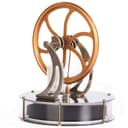
⚙️ Ignite curiosity and impress your circle with the coolest heat-powered desk marvel!
The Sunnytech Low Temperature Stirling Engine is a precision-crafted educational model that converts low-level heat from hot beverages into smooth mechanical motion. Featuring a mirror-polished stainless steel base, glass cylinder liner, and zinc alloy flywheel, it runs oil-free and rust-resistant. Designed for continuous operation over 24 hours with a steady heat source, it’s an elegant STEM toy and conversation piece perfect for professionals, educators, and science enthusiasts alike.


| ASIN | B008JOKO1O |
| Age Range Description | Youth |
| Best Sellers Rank | #21,455 in Toys & Games ( See Top 100 in Toys & Games ) #224 in Educational Science Kits |
| Brand Name | Sunnytech |
| Customer Reviews | 4.6 out of 5 stars 3,308 Reviews |
| Educational Objective | mechanical skills |
| Is Assembly Required | No |
| Item Dimensions | 8.5 x 5.7 x 4.3 inches |
| Item Weight | 0.71 Pounds |
| Manufacturer | Sunnytech |
| Manufacturer Minimum Age (MONTHS) | 180.00 |
| Manufacturer Part Number | LT001 |
| Material Type | Plastic |
| Size | Small |
| UPC | 999998610424 793631719792 885116903151 |
H**0
Great Kitchen Conversation Piece!
This is a great gadget and a lot of fun. It comes fast, works well, and is easy to assemble, though you may want to have a tiny screwdriver or dull knife point to click the two little drive shafts in place. It's super easy and the instructions are good. It took me fewer than five minutes to set up. The great thing about this, which is better than other similar products, is that you don't have to light a fire or use a candle or anything like that. You simply place it on the top of your coffee cup. You can put it on a hot beverage cup you want to keep hot, and watch the little motor do its cool thing, or you can microwave some water in a cup for two minutes and set this gadget on top of the cup for lots of fun. Kids are blown away by this and it is a real conversation piece for adults. Any kid would love to get this as a gift--birthday or Christmas or whatever, because everyone drinks hot tea, hot coffee or hot chocolate at some point, and if not, just hot water--no open flame. Also it is great for teaching kids about external combustion engines and the principles of physics. I haven't had it long, but already its my favorite gadget to play with in the kitchen while I am waiting for the rest of my meal, and I can't wait to show my friends when they come over for dinner. Just a lot of fun without an open flame or any dangerous substances to ignite.
E**N
exactly why the engine runs, detailed
This an elegant engine, both in appearance and in its functioning. You can see all the parts moving. Of my five Stirling engines, it is the best performer at low temperatures. The Stirling engine is a heat engine, just as are steam engines, gasoline engines, hurricanes and the "drinking bird" toy busily bobbing. The large cylinder at the bottom contains the displacement piston. I will call it the displacer. It is driven by a crank on the flywheel. In the small cylinder, the power piston cranks the flywheel twice each revolution, making everything move. The displacer moves the air in the displacement cylinder, alternately to the bottom plate to be heated and then to the top plate to be cooled. This air is confined to the interior of the engine, so that when heated (or cooled), it cannot expand (or contract) but instead must increase (or decrease) its pressure compared to the air outside in the room. The pressure differences cause two power strokes per revolution, one in which the pressure in the engine is below room pressure so the power piston is pushed down, and the other in which the greater pressure inside the engine pushes upward on the power piston. Crucial to a Stirling engine is that the cranks control the pistons so that the power piston is always a quarter of a turn behind in its motion compared to the displacement piston. Here is how this offset between piston motions causes the needed pressure changes. The downward power stroke begins when the power piston is at the top of its cylinder and the displacer is at the middle of its downward stroke. At this point in time, the air is divided evenly between the cool upper region and the warmer lower one. The turning flywheel pushes the power piston to start the power stroke. As the power stroke continues, the displacer pushes more air into the cool upper region, and the overall pressure in the interior drops below room pressure. When the power piston reaches half way down in its power stroke, the displacer is all the way down, so all the air is in the cooler part of the interior space. The pressure in the interior of the engine is at its lowest point so the room air is pushing hardest downward on the power piston. This is the most powerful part of the power stroke, the more so because here the power crank is oriented to furnish its highest torque. The power piston continues downward, reaching the end of this power stroke. The upward power stroke now begins, and the explanation as to how it functions mirrors that of the downward stroke. You can see the two power strokes, one down and the other up! Start the engine on a hot cup. After it is moving at about 1 rps (60 rpm) take it off and set it on the table. Watch as it slows to a stop. In the last 2 or 3 revolutions the flywheel moves with an easily seen jerk at every power stroke. I find it easiest to see this by watching the power crank. The up stroke is harder to see because the engine is not rotationally balanced. The flywheel probably is balanced, but the combined weight of the pistons pulling down unbalances the system. This explanation raises some questions. The main one is that we know that the heat flow between the air and its nearby plate is not instantaneous. But there is a hint that it does happen very quickly. As the engine runs, the rim of the top plate becomes much hotter than the center of the plate. (I measured the plate temperature with one of those thermometer "guns" whose laser pointer shows a red dot showing just which spot is being tested.) The rim is the place that the hot air from below the displacer enters the top space. So for that place to be much hotter than the rest of the plate indicates that much of the heat from below gets dumped here quickly, before the air moves further into the cold region. Another point: the engine leaks air from the space between the power piston and its cylinder wall. This leak is slow enough that it does not affect the efficiency of the engine. But the leak is crucial! If the engine did not leak, it would soon not run at all! The air inside the engine becomes much hotter than outside, and its pressure therefore would be enough to push the power piston all the way up and lock it there! But this is avoided because some interior air leaks out, restoring the interior pressure (averaged over a cycle) to match the outside pressure. You can observe this leak yourself. Hold your cold engine with its power cylinder horizontal. Turn the flywheel so that the power piston is at one end of its motion, and hold it there for about 20 seconds. Then turn the flywheel so the piston is at the other end of its allowed motion, and release it. You should see the piston move back close to where you had held it! Repeat, starting this time with the piston at the other end.
J**N
There’s something Zen about a Stirling Engine
Update: Oh, by the way, I didn’t mention in my last update but I cleaned the cylinder again and it’s been running fine ever since. I’m sorry for anyone that was emotionally committed to this experiment and was disappointed it was over. We’re at 2 years 9 months more-or-less constant use. I put a strobotach on it a long time ago and if i recall correctly at that time it was running about 300-400 rpm, but looking at it right now I bet it’s more in the 100-200 rpm range. I didn’t do the math how many revolutions this is total but I probably will someday. ———— Update: tonight I came home and the engine was oscillating back and forth, but not rotating. As others have mentioned, because of its magnetic coupling to the displacer, this engine can rotate in either direction. So if the engine loses enough energy (for whatever reason) the flywheel will stop rotating and begin to oscillate. If it can regain enough momentum it will restart in one direction or the other but if not it will eventually stop. Such drama as I was watching this! With each oscillation I’m wondering, “Will it get over the top??” Sadly it did not, and it eventually stopped. I have to admit, after 2-1/2 years it’s getting increasingly difficult to keep this running continuously. I think there are several factors, the first being that it’s been running continuously for about 2-1/2 years. Second, I cracked the power piston cylinder when I sprayed compressed air on it (inverted). Finally, in the past few months I put an UV LED over it so my painted-on glow-in-the-dark dots are glowy all the time. For some reason this has motivated gnats to think the power piston is a super place to call home even though the engine is under a glass globe. I don’t think the mass of the gnats on the piston is a problem but I could believe some gnat guts on the cylinder walls could be. Anyway, she’s all cleaned up and running again. ——— Update: it’s been a long time and I’m starting to lose track, but IIRC I’m at about 2yr 2mo of running this engine constantly on a 6w heater. I’m not going to do the math to see what that cost me on the electric bill. Ok, I probably will eventually. Anyway, it’s still going. There was a little while when it slowed down and even stopped but I cleaned up the power piston and now it’s going again full speed 24x7x365-1/4. —— Update: Coming up on a year of constant operation. At some point I painted glow-in-the-dark spots on it. That’s fun. —- Update: I’ve had this running 24/7 on the aforementioned warming plate I made for it for about 6 months now. There’s no indication that it’s going to quit. I would have thought that the arm would have sawed off the pin by now, but nope. As for the squeaking, contrary to the directions I put a small drop of light oil on the pin and that fixed it right up. Now for another PSA, if you get the urge to use an inverted can of compressed air to supercool the top plate, be careful not to get it on the glass cylinder because it *will* crack (I was able to fix mine). But, man, that engine will book when you spray it! ________________ Update: Just so you know, the DWCL-01 will not run if it’s set on a magnetic surface because of the magnet in the displacer, unless that metallic surface happens to be extremely warm. That means if you buy or build a warming plate it has to be non magnetic. I built a warming plate out of some spare power resistors I had laying around (we all have a collection of spare power resistors, right?) using a pickle jar lid as the surface. The engine would not spin! Unless I picked it up then it would run like crazy but if I set it down it would stop again! Turns out the magnet in the displacer was sticking to the jar lid. So I got rid of the lid and set it down with a thin piece of cardboard between the engine and the resistors and it ran ok. Turns out the resistors are also slightly magnetic. Anyway, not a knock on the product, just a PSA. Your physics may vary. ———— I got the DWCL-01 because some other people said it was a little better construction and had real bearings. When mine came today I opened it right off the UPS truck so the machine was pretty cold. I held it in my hand and it started right up. I heated up a couple mugs of water at work and it ran for just about an hour on each one. It’s neither noisy nor silent; sometimes it makes kind of a sqeaking sound, but overall I find the repetitive sound soothing! This one will be my home engine but I might get another for my office just for the sound! Tonight I put it in the fridge then took it out, held it in my hand, and it ran like gangbusters. I have many experiments planned for it. As for the construction, it’s smaller than expected but fit perfectly over the mug I had for it. The screws around the circumference actually held it in place nicely on the mug. The fit and finish is maybe not quite as nice as the photos but it’s fine. While I had it in my office every engineer that came in wanted to talk about it. (One non-engineer came in and was like, “What’s that?” and I said, “A Stirling Engine,” and she rolled her eyes and goes, “Ok, whatever.”) So, in summary, it’s cool and fun. Is it $40+ of fun? I don’t know. Between the price and fit and finish I’m torn between four and five stars. For the fun factor I’m going to give it the benefit of the doubt and go with five.
A**R
Good Stirling Engine for the money 👍🏼
Good little engine! Only reason I give it 4 stars instead of 5 is because the flywheel has a slight wobble but it doesn’t seem to affect the performance. I’ve used watch oil to lubricate the engine because it is so light in weight, I’ve oiled the ends of the flywheel axle and all of the pivot points of the crank shafts, also used graphite on the piston, it’s now nice and quiet. I wouldn’t recommend using any other type of oil because anything heavier might bog it down. It runs over half an hour on a cup of coffee ☕️ and I timed it at 2 hours and 58 minutes on a thermos style cup filled with hot water that was preheated in the microwave. I would definitely say the oil is working. I like the retro style of this engine and it is well built for the price!
J**.
Cool sterling engine!
I got this for my husband for Christmas. He loves it. It is fun to set over his coffee cup and watch it run. He said he will probably buy more of the Sterling engines that Sunnytech has for sale because this one works so good. It is a neat little gift. Thank you! Grandchildren thought it was fun also, power in the coffee cup.
J**D
Fun little toy!
This is a little great machine! I remember seeing one of these years ago in grade school that used an alcohol flame and always wanted one. Of course now I am able to relive those days as back then it would cost a small fortune to acquire it back then, and of course there was no amazon back then either. Absolutely love being able to watch it run for quite some time on a heated cup of water. You do need to let it break in a little bit, and I found that I needed to tweak the arms a little bit (probably due to shipping) but aside from that it works great!!! Thanks!
H**I
My candle was obviously of bad quality; the wick burnt down and left only ...
I bought the Sunnytech HA001 Mini hot Air together with the Sunnytech low temperature Lt001. Both where send almost immediately. Both came packed extremely well protected. The HA001 Mini Hot Air came with an additional spare glass tube, 2 spare rubber seals, a spare burner bottle (without magnet), and a spare wick. After attaching the upper piston arm to the crank I tried it right away with a candle as shown in another customer review. My candle was obviously of bad quality; the wick burnt down and left only a very very tiny flame. I was skeptical, but had no other, so I just put it on top of another such candle to get it closer to the glass cylinder. I didn't wait a minute until I gave the motor a first push - and it started running, speeding up rapidly! No lubrication, no adjustment. Amazing to watch it running. But as well it's just nice to look at this tiny little well built machine with it's many little details, standing at your desk or cabinet. Only thing I will probably change it the wick of the burner bottle which is just a very loose bundle of threads and doesn't look very convincing, but that certainly is not a big deal. 5 Stars+! The Lt001 low temperature needs you to install the flywheel and connect the two piston arms to the crank shaft. It definitely makes sense for a better protection at transport, and is not a big deal. Check for the bolts/screws which hold the base together. I found 1 loose screw, and 2 others also needed a bit tightening. I boiled some water, put it in a cup, and the stirling on top. Certainly here too I didn't wait a minute until giving it a push - and it started running! And runs and runs and runs. After a couple of minutes it started with a bit of a squeaking noise, but without slowing down. It surly will be gone with a bit of lubrication. This machine too is very nicely built, and joy to look at. 5 Stars + as well! Left to mention that both stirlings came with an instruction sheet, including email contact for customer service and promising immediate reply. I had no reason to try it, but based on the overall great experience I have no doubt about that. Very happy with that purchase!
M**M
Enthralling and Educational - A Sterling Choice!
I recently purchased this Sterling Engine and it’s absolutely fascinating! Placing it atop a hot cup of tea, it starts to work its magic, making it both a charming spectacle and a wonderful educational tool for children. The engine is beautifully crafted, robust, and easy to set up, which adds to its appeal. The seller provided excellent service with speedy delivery, ensuring the product arrived in perfect condition. This Sterling Engine not only entertains but also sparks curiosity about the principles of physics in young minds. I’m thoroughly impressed and delighted with this purchase - it’s a perfect blend of fun and learning. A resounding 5 stars for both the product and the seller! Highly recommended for anyone looking for quality and educational entertainment.