We remain fully operational. Our teams are working around the clock to ensure your deliveries continue safely.

下载应用程序


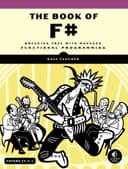
The Book of F#: Breaking Free with Managed Functional Programming [Fancher, Dave] on desertcart.com. *FREE* shipping on qualifying offers. The Book of F#: Breaking Free with Managed Functional Programming Review: Clear, concise, well organized - As I write this review (March 2021) this book is six years old and it covers F# 3.1 while F# 5.0 is the current version. Picking up this book would, by some, be considered historical research. Still, even though I have newer books on F#, this is this book that I reach for for my day to day programming chores. It seems that 99% of what I need to know was in 3.1 and this book is much better at clearly describing things than the more recent books. Even the typography is better (why do recent books choose such a large font and layout code with so much spacing and wrapping that it is hard to read?). And at a svelte 282 pages it is a delightful example of "K&R" concision in a world of computer books that are priced by the pound (as in weight). I strongly encourage the author to produce a Second Edition if for no other reason than to get this book in front of more eyes when everyone using desertcart is sorting by Publication Date. Review: Good book for starting with F# - Good introduction to F# and gets you quickly started (with Visual Studio). Covers lots of concepts. However, it does leave you with some unanswered questions here and there. All in all a nice read for beginners.
| Best Sellers Rank | #2,563,883 in Books ( See Top 100 in Books ) #145 in Functional Software Programming #746 in Object-Oriented Design #1,303 in Microsoft Programming (Books) |
| Customer Reviews | 4.2 4.2 out of 5 stars (34) |
| Dimensions | 7.06 x 0.65 x 9.31 inches |
| Edition | 1st |
| ISBN-10 | 1593275528 |
| ISBN-13 | 978-1593275525 |
| Item Weight | 1.35 pounds |
| Language | English |
| Print length | 312 pages |
| Publication date | March 1, 2014 |
| Publisher | No Starch Press |
G**.
Clear, concise, well organized
As I write this review (March 2021) this book is six years old and it covers F# 3.1 while F# 5.0 is the current version. Picking up this book would, by some, be considered historical research. Still, even though I have newer books on F#, this is this book that I reach for for my day to day programming chores. It seems that 99% of what I need to know was in 3.1 and this book is much better at clearly describing things than the more recent books. Even the typography is better (why do recent books choose such a large font and layout code with so much spacing and wrapping that it is hard to read?). And at a svelte 282 pages it is a delightful example of "K&R" concision in a world of computer books that are priced by the pound (as in weight). I strongly encourage the author to produce a Second Edition if for no other reason than to get this book in front of more eyes when everyone using Amazon is sorting by Publication Date.
A**R
Good book for starting with F#
Good introduction to F# and gets you quickly started (with Visual Studio). Covers lots of concepts. However, it does leave you with some unanswered questions here and there. All in all a nice read for beginners.
A**Z
Okay. Not quite a reference, not quite an instructional book. A "tweener".
Disappointed... I found that this book wasn't in depth enough to be a reference but too short on whys and hows to be an instructional book. I suppose that if you've already read an F# reference or two and wanted to reinforce your knowledge then this book would be a good fit. For me, I was hoping for something that would help me "think functionally" and it didn't do that for me since it was more about language features than how best to use those features. That said it didn't explain the language features as clearly and precisely as I would have liked. Maybe this is just a case of unrealistic expectations on my part based on prior reviews.
M**L
Use the book to learn F#.
It has what I wanted. I used it to help me with my Visual Studio for functional programming and type matching.
R**H
A great reference book for F# beginners coming from another language.
This book provides a clean and concise intro to F# for beginners covering almost every aspect of the language. I think it might actually be the first to have reasonably in-depth coverage of quotations. The only downside to this book is that it doesn't have any assignments for the user to do as they learn (the vast majority don't). Overall, a well worthwhile read for the experienced C# developer looking to learn F#.
D**O
Good Guide
This is a great introduction to F# and by extension functional programming. The primary downside of the book is that like many coding texts, it’s fairly dry.
R**4
Great book. The best introduction to the subject of ...
Great book. The best introduction to the subject of f# that I've read.
J**Y
Five Stars
Excellent book. Highly recommend for devs looking to learn functional programming.
T**L
Summary: this is not a bad book, just not "the one", at least for me. I will refer to it in the future, but as indicated at the bottom I found better resources to teach the language. F# is my favorite functional language, since at least for me reading/writing it - is as close I have at this point to thinking the algorithm. That said, I read somewhere that F# has 97 keywords (compared e.g. to Scala's 40'ish). Meaning that mastering this language requires to go through quite a lot. Unfortunately this book was not the one book I will turn to for that task. It did nice job with a lot of chapters but also horrible job with others - such as the Object Oriented one. With so much to cover in this language, I think that listing everything is just not the right approach for someone who wants to get her/his head around the language. I like a top to bottom approach. Understanding the high level and then drilling. I could not get that sense through the book. Moreover, I personally did not like much the notion of forward reference. The writer describes a lot of examples which you will get only later in the book/chapter. I find this confusing and discouraging when learning a new language. Luckily this was not my first book, but still it felt odd when I had to get a page or two, not grasping the examples. My recommendation to anyone is to follow two online sources ... which in combination seem like the best way to learn the language: Primarily the online wikibook for F# - which I highly recommend! ...[...] As a side reference the MSDN F# language reference ...[...]
N**T
The book delivers a very good starting-point for learning F#. But there is one major drawback for the kindle-edition: all code-examples are rendered without line-breaks (for whatever reason). This is very annoying, especially with F#'s line-based syntax. Unexperienced programmers may have a hard time figuring out the correct syntax of the examples. Let's just hope that this will be fixed some time...
N**S
Well written and to the point, that's the book I was looking for for a good description of F# 3.1.
M**L
If you write code you should learn F#... but this book if a bit light wieght.
TrustPilot
5天前
1天前